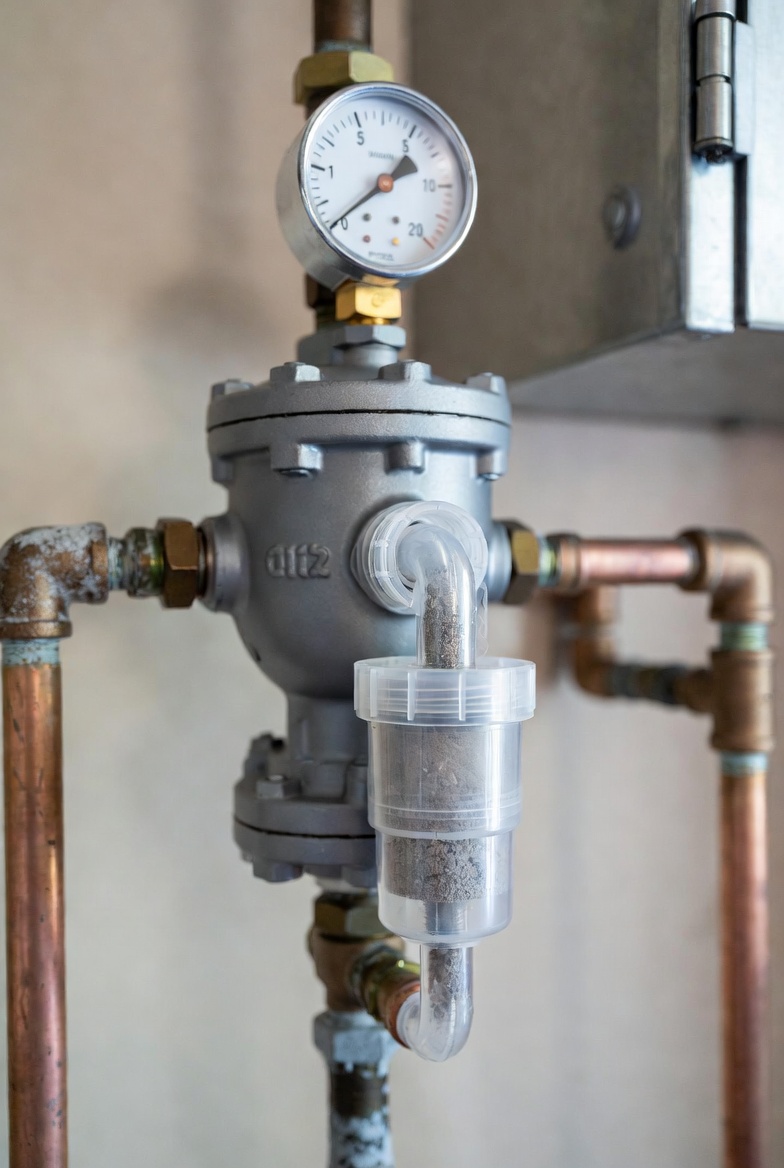
Start with actual work and supplier notices, the first visible material and the affected equipment. Sediment is a possible observation or assessed cause, not a diagnosis established by color, recurrence, a pressure drop or a smart-device alert.
Use and safety first
Keep away from wet electrical equipment. Do not touch wet appliances, plugs or switches, or enter water to reach a breaker. When no gas leak is suspected, power may be isolated only from a safely accessible dry location; otherwise call an electrician or emergency help. Wet equipment needs qualified assessment before it is used again.
For leakage or immediate danger, use only a separate known safely accessible permitted owner control without force or obtain prompt supplier/plumber help. Keep out of potentially energized water and do not touch wet appliances or enter water to reach a valve or breaker. Do not operate unknown shared, fire, meter or curb controls.
For a new unexplained water-quality change, use bottled water or another known-safe consumption source and contact the supplier; a private well needs the appropriate well/health response. Do not taste it or boil suspected chemical contamination as a general remedy. Actual notices and hazard-specific permitted uses govern. Clear appearance, clean screens or a specified number of minutes do not certify water safe.
Separate observation, permitted care and readiness
Color, size, location and work timing; appearance alone does not identify a substance.
Actual model, safe source/energy state and specifically captured discharge method.
Actual supplier restrictions, source correction and equipment commissioning; clarity alone is not clearance.
Appearance and source evidence
- Brown appearance after main use
- Cloudy restart water and a limited air observation
- Material at many fixtures: actual common paths
- Flakes: appearance versus material/source
Actual work and recovery
- Sand-like material after city repair
- Particles after new piping
- Curb work: actual crew/supplier restoration
- A flush plan for the actual system
- Prepare for a planned shutoff
Outlets, pressure and valves
- Sudden aerator debris
- Fixture clogging after outage
- Pressure loss: material and point evidence
- Suspected meter screen: actual device/layout
- Regulator symptoms after debris
- External leak versus internal valve passing
Appliances and legitimate model care
- Appliance codes/leaks and actual screen method
- Toilet fill: captured model-specific in-tank care
- Heater/tank material concern
- Tankless: sediment versus scale and actual service
- Smart trip: actual alert before restoration
Actual flow paths and valid service
Check actual supplier/repairer instructions before flushing or sampling. Identify the relevant flow path, actual control positions and accepting attended discharge; do not use a floor order or several open taps as a guarantee of where every particle goes. Preserve required treatment and protection. A nearby open faucet may not flush an isolated appliance hose or dead leg.
For retained supply connections, filter housings, regulator covers or valve parts, establish every-feed isolation, controlled pressure release and verification under the actual model. A main cannot isolate its own inlet and a mixer can have both hot and cold feeds. Unless the actual maker specifies a controlled captured service arrangement, keep the source isolated until compatible parts are fully secured; never substitute an exposed pipe, removed assembly or loose hose aimed at a bucket.
A maker-prescribed captured in-tank fill-valve flush or secured heater drain-open procedure is different from an improvised exposed-pipe test. The actual model, source control, cooling/energy, discharge and refitting/restart conditions must govern. A protective smart shutoff’s alert must be understood and its underlying condition resolved before restoration; clear water does not prove a nuisance trip.
Broader directory: Water Entry, Shutoffs & Flow Control Systems.
Safety sources
- CDC: electrical hazards near water
- CDC: drinking-water advisories
- CDC: selecting and maintaining a water filter
- American Standard example: actual covered in-tank fill-valve cleaning
- Example electric-heater manual: filling and maintenance requirements
- Rinnai CU example: qualified maintenance and model-specific isolation, flush and restart
- Moen Flo example: understand the alert before restoring water