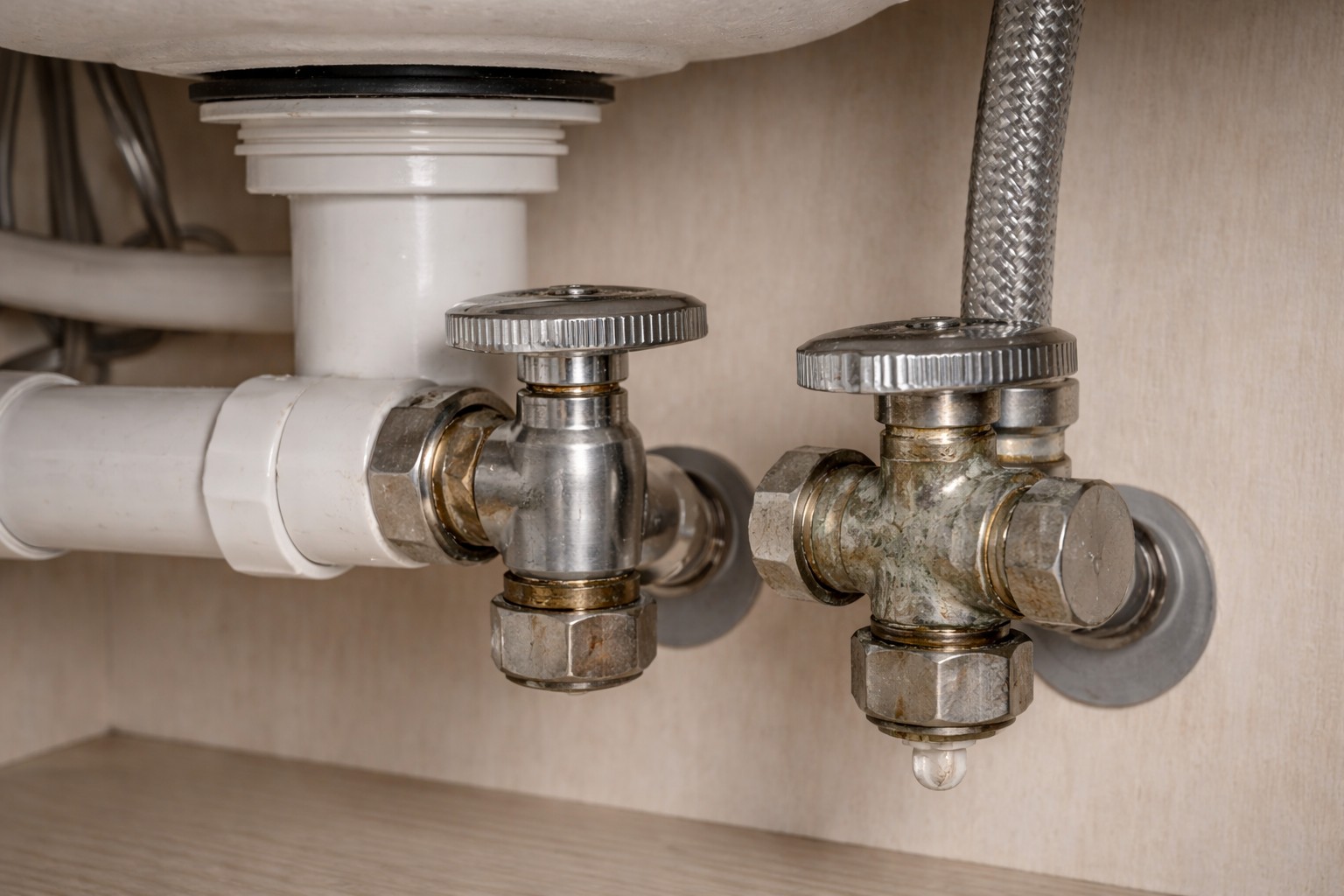
Choose the actual water-valve problem below. External leakage, water passing a closed stop, limited delivery and a stuck handle need different evidence. A directory label is not a diagnosis or permission to dismantle a pressure-retaining part.
If fuel gas is suspected, leave the building or affected area immediately. Do not operate valves, switches, plugs, appliances or phones there. Call the gas emergency service from a safe location well away, and wait for responders’ clearance.
Keep away from wet electrical equipment. Do not touch wet appliances, plugs or switches, or enter water to reach a breaker. When no gas leak is suspected, power may be isolated only from a safely accessible dry location; otherwise call an electrician or emergency help. Wet equipment needs qualified assessment before it is used again.
Contain an active leak first
Use a known effective safely accessible upstream household control without force, or obtain prompt plumbing/supplier help. The failed valve cannot isolate its own inlet. Do not operate unknown meter, curb, shared or fire-system valves. Do not disconnect a hose to test closure, free a valve with heat or restore flow into exposed parts aimed at a bucket.
Identify the function before a repair
Actual stem, body or connection leak; first visible wetness is evidence
Seat bypass, handle travel and low flow are different observations
Effective upstream control, controlled release and verified pressure state
Will not stop flow or a handle loses control
- Angle stop won’t shut off sink — An angle stop does not isolate the sink; keep the supply connection intact.
- Valve handle spins but won’t close — A loose external handle differs from a failed internal drive.
- Old gate valves that won’t seal — Actual gate design, seat function and qualified service; age is not a part diagnosis.
Stuck, unused or broken
- Under-sink valve frozen in place — Under-sink seized valve: actual parts and safe service, without generic oil/tape recipes.
- Valve stops working after years of no use — Failure found after nonuse: original behavior before source or lifetime claims.
- How to free stuck shutoff valve — Stuck-valve response: no universal heat, mallet, penetrant or wrench trial.
- Shutoff valve breaks during emergency — Emergency breakage: safe independent containment before handling.
External leaks and hidden conditions
- Toilet shutoff leaks after being turned — Toilet stop leakage: tank/bowl drainage is not inlet pressure verification.
- Shutoff valve dripping after reopening — After reopening: separate external escape from water passing an internal seat.
- Valve stem packing leaking — Stem seal: actual model, permitted adjustment and independent isolated service.
- Valve corrosion inside walls — Concealed corrosion/moisture: planned safe access before opening a wall.
Reopening, sound and actual measurements
- Valve won’t reopen fully — Handle travel versus restored delivery; do not force another cycle.
- Angle stop buzzing when partially closed — Buzzing while partly closed: actual operating duty, not automatic debris proof.
- Shutoff valve causes pressure loss — Weak delivery differs from measured valve pressure loss; measurement location matters.
- Multiple valves fail at same time — Several problems found together: actual individual evidence before a shared-cause verdict.
Recent installations and valve design
- Quarter-turn valve failure symptoms — Quarter-turn travel does not identify every internal design or repairable cartridge.
- Why new shutoff valves fail early — New work: actual installation and commissioning evidence before blame or repeated replacement.
- Valve failure after water heater install — After heater work: actual valve role and safe equipment commissioning.
Before retained parts are opened
Before any internal service or fitting removal, identify and isolate every supply that can pressurize the section, release trapped pressure through the appropriate controlled outlet and verify depressurization. Account for hot water and possible alternate feeds. Lowering a PRV setting, reducing flow or wearing gloves does not make a pressurized assembly safe to open. If isolation cannot be established, leave it assembled and obtain qualified help.
The valve being serviced cannot isolate its own inlet. Closing its handle or a downstream fixture does not establish upstream isolation. A main, shared or utility control may need the responsible supplier or qualified provider to arrange independent control; do not operate unknown curb, meter, fire-system or shared valves.
Keep independent isolation effective while any connection, bonnet or other pressure-retaining part is open. Do not reopen an upstream supply into a removed valve, exposed pipe or loosely held hose aimed at a bucket. Residual drainage is not a general sediment-removal cure. If actual construction/service flushing is needed, use its prescribed secured compatible arrangement and controlled accepting discharge path. Fully reassemble before restoring pressure under the actual instructions, then verify external leakage and the required shutoff function separately. A stronger stream alone does not verify the repaired valve.
Use the real instructions
A fixture stop, old gate, main control and gas/fire-system valve are not interchangeable. Some actual valve procedures permit specific lubricants or limited gland adjustment; that is not approval for generic penetrant, loosening retained parts or pressurized repacking. BrassCraft’s cited stop instructions distinguish connection and sealing methods. Apply the actual product directions and local requirements instead of one tape, tightening or replacement rule.
Browse Water Entry, Shutoffs & Flow Control Systems for the wider topic.