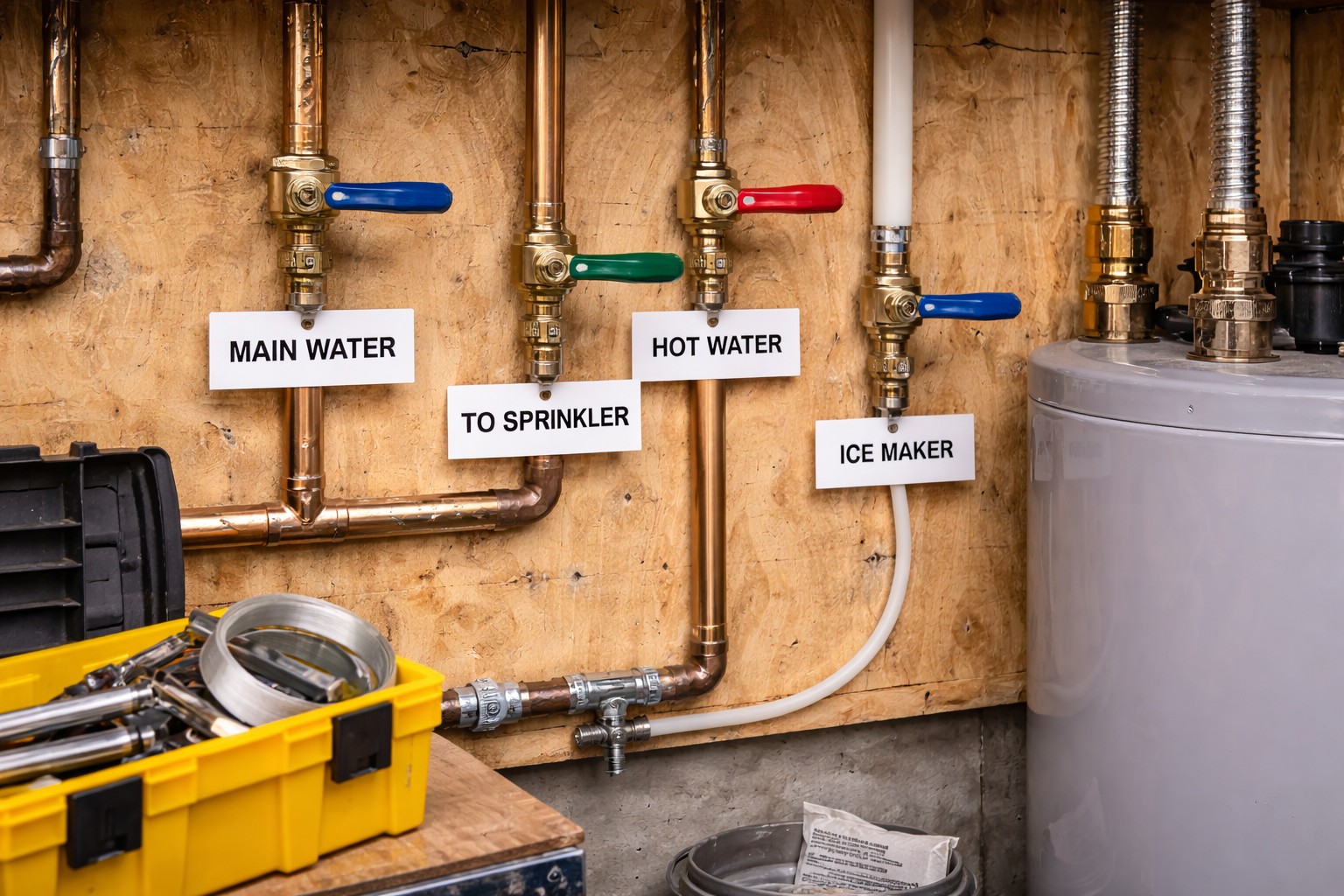
Start with the original event: a stuck handle, continuing water, an external drip, a replacement problem or a hidden control call for different evidence. These routes preserve those distinctions and the existing article addresses.
Uncontrolled water and immediate danger
Keep away from wet electrical equipment. Do not touch wet appliances, plugs or switches, or enter water to reach a breaker. When no gas leak is suspected, power may be isolated only from a safely accessible dry location; otherwise call an electrician or emergency help. Wet equipment needs qualified assessment before it is used again.
For active leakage, use only a separate identified, safely accessible owner-operated control under its known method, without force, or request prompt supplier/plumber assistance. A curb key, reachable meter box or property boundary does not establish permission to operate supplier equipment. Follow the actual supplier rules; Seattle’s different customer and crew controls are an example, not a universal ownership map.
Do not delay safe containment or urgent assistance to preserve a symptom. A known permitted owner valve can be used under its actual safe method; an unknown, damaged or supplier control requires the appropriate provider.
Understand the service boundary
Stops every relevant feed to the service section; actual authority and method matter.
Its own closed handle does not isolate its inlet or upstream connection.
Account for retained water, pressure, temperature and alternate feeds before opening retained parts.
A main shutoff cannot isolate its own upstream side. Closing its handle or opening a downstream faucet leaves its inlet connected to supply. Before opening a bonnet, replacing packing, cutting pipe or loosening a connection, arrange separate effective upstream isolation for every relevant feed, controlled pressure release and verification. If water continues or isolation cannot be established, stop and leave the assembly intact; obtain supplier or qualified plumbing help.
Keep independent isolation effective while any pressure-retaining part or connection is open. Fully secure compatible rated parts before controlled restoration under the actual product and installation procedure. Any required flushing needs a relevant secured discharge path and an accepting drain; never reopen supply into an exposed pipe or removed assembly aimed at a bucket. Verify leakage and the required shutoff function before relying on the repair.
Observation is not a complete diagnosis
Handle position does not prove internal travel. Finite stored water differs from sustained replenished flow. Meter movement needs the actual meter–valve–branch layout; it does not locate every leak. External stem leakage differs from water passing the closed internal barrier.
Handle movement and cold exposure
- Will not turn: stop forcing and identify control
- Stuck halfway: travel and isolation are unverified
- Broken handle: safe independent containment
- Free rotation without delivery control
- Will not reopen: movement versus supply
- Freeze suspicion and thaw containment
Flow and actual boundaries
- Water after closure: storage versus sustained feed
- Only hot delivery stops: identify the actual valve
- Failure clues versus proof of isolation
External leaks and installation
- Water around the handle or stem
- Drip first noticed after reopening
- New leak after replacement
- Reduced delivery after replacement
- Suspected internal corrosion and pipe condition
Noise and choosing maintenance
- Buzzing during flow
- Squeal during movement
- Bang after an operating event
- Gate versus ball: actual application and failed function
- Model-specific exercising and documentation
Finding and accessing the control
Use the actual model and completed work record
Some identified maker procedures allow a limited external gland adjustment for an actual stem leak. That differs from removing packing or loosening a bonnet. The cited NIBCO bronze-gate manual is for qualified personnel and warns against pressurized repacking, including when apparently back-seated. It does not supply a universal nut rotation, lubricant, unsticking or noise-repair recipe.
Keep a record of the actual valve/model, identified safe control, permitted operating method and emergency contacts. Repair choices need ratings, connection and pipe-condition evidence; neither an arbitrary maintenance interval nor a universal ball-valve lifetime promise establishes reliability.
Broader directory: Water Entry, Shutoffs & Flow Control Systems.