Use the actual recurrence, material and work record to choose a guide. A calendar interval, product label, hot-water response or newly installed sink cannot locate every restriction. Keep the meaningful scenarios below separate while using the same safe service boundaries.
For strong, widespread or unexplained gas-like fumes, exposure symptoms, or suspected high sewer-gas concentrations in an enclosed space, leave the building immediately and call the fire department or emergency services from outside. Avoid flames, switches and other ignition sources; do not remain to ventilate, sniff drains or investigate. Smell intensity does not measure the concentration. A faint localized drain odor without those warning signs calls for a different plumbing investigation; it does not automatically establish a fuel-gas leak.
If fuel gas is suspected, leave the building or affected area immediately. Do not operate valves, switches, plugs, appliances or phones there. Call the gas emergency service from a safe location well away, and wait for responders’ clearance.
Keep away from wet electrical equipment. Do not touch wet appliances, plugs or switches, or enter water to reach a breaker. When no gas leak is suspected, power may be isolated only from a safely accessible dry location; otherwise call an electrician or emergency help. Wet equipment needs qualified assessment before it is used again.
For wastewater rising from a drain or affecting several fixtures, stop adding water and keep affected appliances from discharging using only safely accessible dry controls when no gas emergency is suspected. Avoid sewage contact, keep children and pets away and arrange prompt drainage help. Notify building management or the sewer agency as appropriate. Do not run fixtures to locate a shared blockage.
If a cleaner may be present, identify the exact product and follow its label. Do not add another cleaner, acid, bleach, ammonia, vinegar or an improvised neutralizer. Do not plunge, snake or open the trap while hazardous residue may remain; tell the provider what was used. A rinse or elapsed time is not proof all residue is gone.
Capture, retain and refit
Remove captured debris to appropriate waste, outside the drain
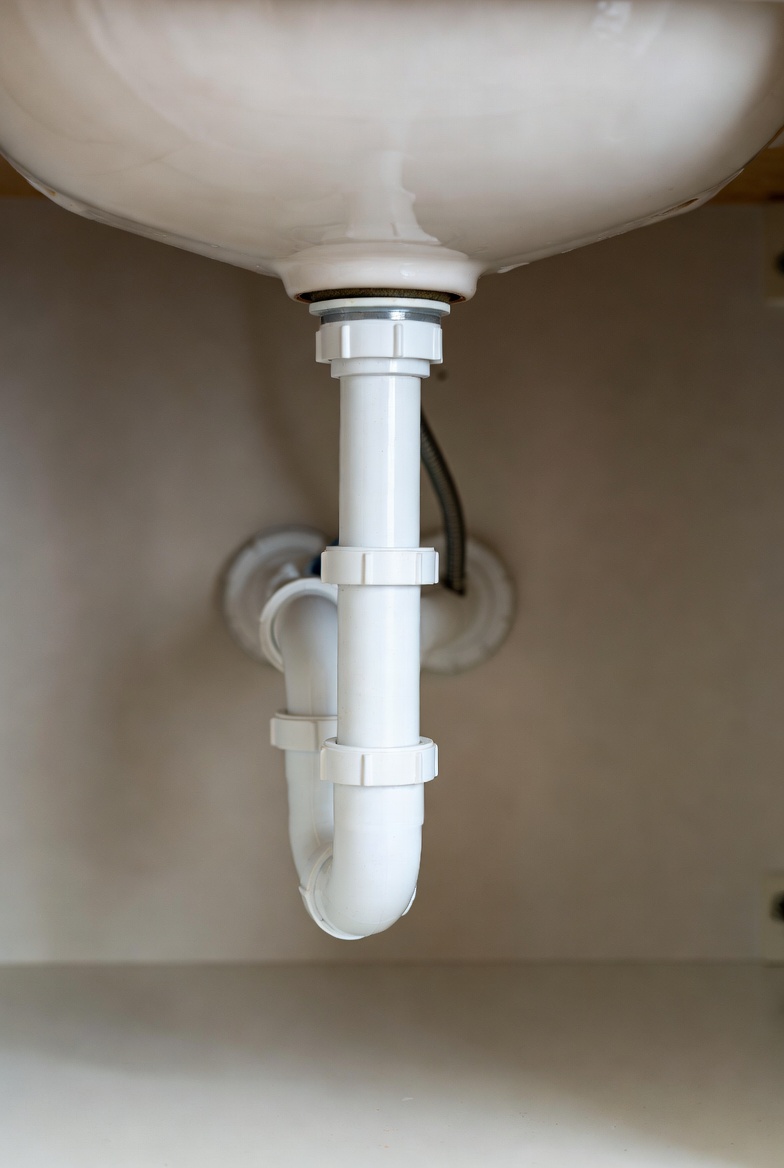
A trap normally holds water; depth alone does not establish faulty geometry
Inputs stay inactive during service; only then make a small attended check
Hair capture and ordinary local care
- Hair clog returns every few weeks — Record actual captured material and recurrence, without assuming a trap-inlet ring.
- Bathroom sink clogs after every haircut — Capture clippings before entry; one catcher trial is not a causal test.
- Hair buildup only in P-trap — Keep the intended water seal and fully refit before any water check.
- Hair clogs only in shared bathroom — Coordinate aggregate use and care without user blame or chemical neutralization.
Products, film and hardness
- Soap scum clogging sink repeatedly — Separate visible surface film from a located drain restriction.
- Soap clog after switching shampoo — A product change is history, not a one-week causal proof.
- Soap buildup from hard water — Related surface/hardness and treatment scope; not a complete drain diagnosis.
After cleaning or a chemical opener
- Recurring slow drain after cleaning — The cleaning record does not identify deeper or structural damage by itself.
- Recurring clog after snaking — Actual cable/access/recovery evidence rather than a pushed-plug assumption.
- Clog returns after a few days — Rapid recurrence needs assessment without a universal depth or clearance interval.
- Recurring clogs after using drain cleaner — Retained detailed chemical-opener precautions: no improvised rinse, wait or neutralizer.
After installation or repair
- Hair buildup after installing pop-up stopper — Identify the actual stopper control, seals and permitted removal.
- Hair clog after plumbing repair — Actual repaired parts and geometry, without installer blame from timing.
- Hair clog after remodel — Observed remodel material and secure removed-part cleaning.
- Recurring buildup in brand-new sink — Capture hair outside a new sink; new fixtures may retain old downstream pipe.
Location, season and hot-use conditions
- Sink clogs only in upstairs bathroom — Upstairs location does not certify a local fault or clear a shared path.
- Clogs worsen during winter — Seasonal conditions without full-load hot/cold stress tests.
- Recurring clog only on hot water — Equal time is not equal volume or proof of a thermal material cause.
A useful recurrence record
- What actually happened during ordinary use: amount/rate, stopper state, water level and associated appliance phase.
- What was actually cleaned, access/tool used, material recovered and how long improvement lasted.
- Exact product/chemical history and actual changed parts, without another reproduction or product challenge.
For suitable ordinary care, the bathroom-sink guide explains intended stopper, plunger and serviceable-trap limits. Preserve accepting capacity, actual product instructions, inactive inputs and complete refitting. No generic hot flush, deeper cable, household mixture or universal schedule substitutes for those conditions.
Browse Bathroom Sink Mechanics & Drainage for the wider topic. The hardness/surface guide above is related context and does not replace drainage assessment.
Safety sources
- Wisconsin DHS: sewer-gas exposure and emergencies
- Con Edison: suspected gas leaks
- CDC: electrical hazards near water
- Madison Metropolitan Sewerage District: stop discharge and report sewer backup
- Example drain-opener label: restrictions on plunging, disposal operation and mixing
- Delta example: identifying and removing a retained sink stopper
- Manufacturer kitchen-sink guide: strainer, plunger and reassembly sections