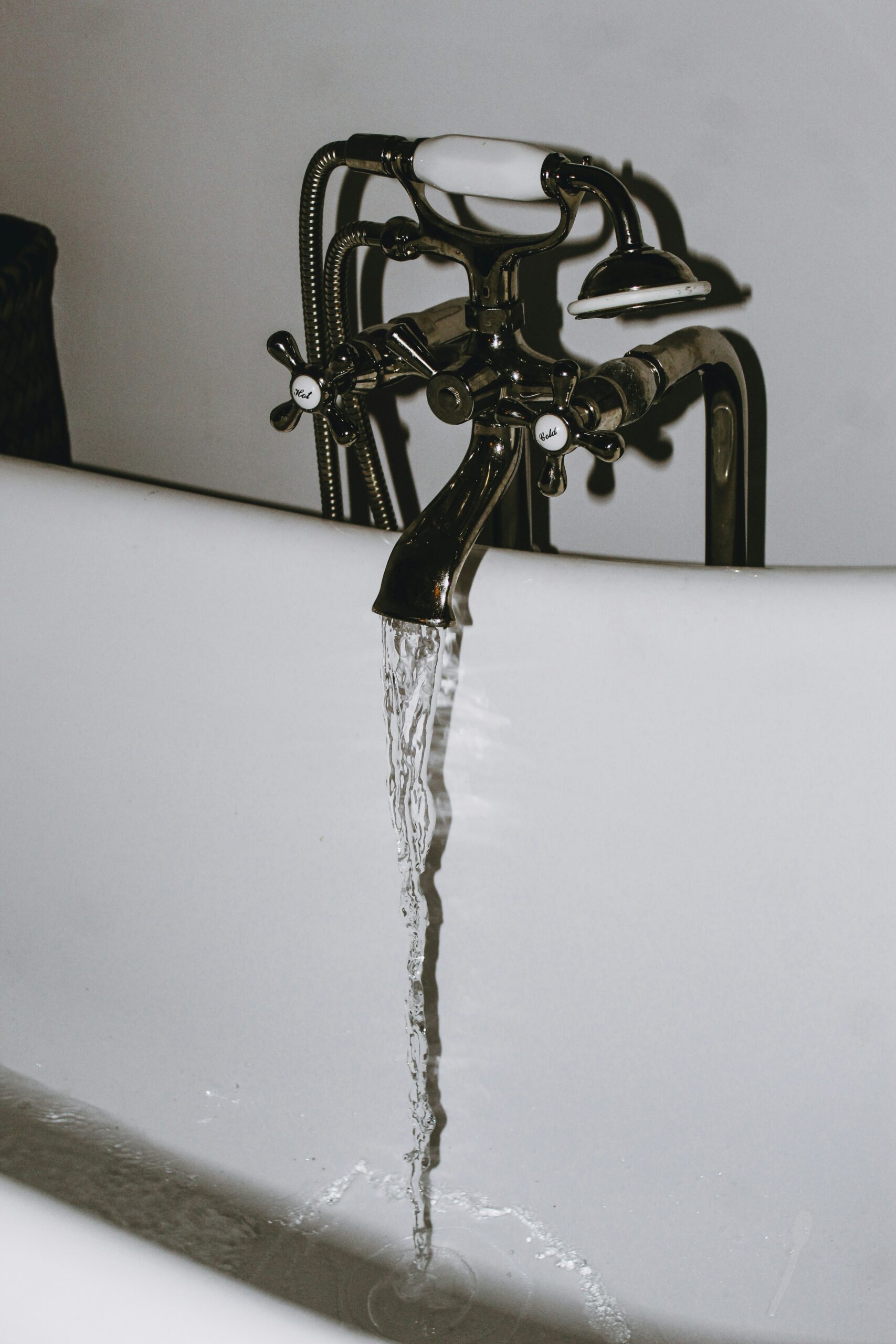
Find a guide for the fixture, setting and event you have noticed. A weak faucet stream, uneven spray and a slow toilet refill need different starting points. The links below help you choose a guide; their titles do not identify a failed part.
Keep away from wet electrical equipment. Do not touch wet appliances, plugs or switches, or enter water to reach a breaker. When no gas leak is suspected, power may be isolated only from a safely accessible dry location; otherwise call an electrician or emergency help. Wet equipment needs qualified assessment before it is used again.
If fuel gas is suspected, leave the building or affected area immediately. Do not operate valves, switches, plugs, appliances or phones there. Call the gas emergency service from a safe location well away, and wait for responders’ clearance.
Choose a starting guide for a faucet or shower
- General faucet troubleshooting — Start here when you need to sort out the flow pattern and suitable outlet care.
- One sink is weak while other fixtures work normally — Compare the affected sink’s hot, cold and spray modes.
- One faucet became weak after a shutoff — Keep the outage, repair and return-to-service instructions in view.
- One shower became weak after a shutoff — Keep the restoration notice, valve model and safe shower controls in view.
Start with the least intrusive useful evidence
- Record the actual model, original setting/phase, work and change from previous comparable use.
- Use only intended ordinary controls and owner-removable outlet parts where actual conditions are suitable. Do not force a stop or dismantle an unknown retainer.
- Stop for leakage, unsafe temperature, damage or a receiver that cannot accept water. No repeated hot/other-fixture challenge is required before help.
Three different levels of work
Actual selector, original use and safe visible model/condition
Exact removable parts, compatible cleaning and complete refit
Every-feed isolation, verified release and actual secured procedure
Start with intact checks
- Why Only One Faucet Has Low Water Pressure — After-shutoff faucet context: weak delivery does not rule out the served branch.
- Low water pressure at one faucet only — Single faucet: intended outlet care and service boundaries.
- Bathroom Sink Has Low Water Pressure Only At This Sink — Bathroom owner triage: start intact rather than disconnect supplies.
- Why Your Shower Has Low Water Pressure but Other Faucets Are Fine — Shower companion: actual controls, spray and care.
- Why Your Bathtub Has Low Water Pressure but the Sink Is Fine — Tub-versus-sink companion: real volume/time and different routes.
- Why Your Bathtub Takes Forever to Fill — Slow tub filling companion: previous comparable volume and setting.
Actual outlet and location
- Shower has low pressure but rest of house is fine — Shower service boundary: head-off response is not supply certification.
- Kitchen sink pressure suddenly dropped — Kitchen sudden drop: actual mode, hose and work.
- Low pressure at bathroom sink only — Bathroom service companion: hose/cartridge state and compatible parts.
- Toilet fills slowly but others are normal — Toilet refill: actual fill-valve design and retained installed service.
- Outdoor spigot has weak pressure — Outdoor spigot: attachment, protection and freeze-state limits.
- Tub spout low pressure but showerhead fine — Tub spout versus shower: actual paths and retention.
Mode, spray and temperature side
- Pressure drops only when aerator installed — Aerator fitted: changed resistance is not automatic clog proof.
- Fixture sprays unevenly — Uneven spray: actual pattern, parts and compatible care.
- Kitchen Sink Loses Pressure Only When Sprayer Is Used — Kitchen sprayer mode: supply and drain paths remain separate.
- Low pressure on cold side only at one fixture — Cold-only fixture: do not remove an unknown retainer.
- Low pressure on hot side only at one fixture — Hot-only fixture: no timed hot flush or particle-source verdict.
- One faucet whistles under low pressure — Whistle: sound and apparent location do not select a stop.
After fixture work or filtration
- Pressure loss after replacing faucet — New faucet: work record and actual commissioning, no exposed cartridge burst.
- Low pressure after installing water filter — New filter: treatment purpose and actual retained cartridge/bypass state.
- Single fixture pressure loss after repair — After repair: correct isolation and secured construction flushing.
- Low pressure after valve replacement at fixture — New fixture valve: real connection and rating, not price/handle proof.
Changes over time or with demand
- Pressure slowly worsening at one fixture — Gradual decline: actual cause evidence and mandatory source control.
- Pressure fluctuates at one tap only — Pulsing at one tap: actual parts and isolated service.
- Fixture pressure improves when others run — Improves with another outlet: changed demand is not sticking/contamination proof.
- Pressure fine in morning but poor at night — Morning versus night: actual original setting and schedule without repeated tests.
Before cleaning or opening parts
For a separately suitable routine outlet-cleaning case, use the exact model removal and finish-care instructions. Turn the outlet off, allow parts/water to cool, keep safe footing and contain retained water. Cover the drain to retain small parts without allowing a basin overflow. Use the actual aerator key or permitted tool; cloth on pliers does not make force harmless. Clean only intended removable parts using a compatible product and duration. Do not assume every screen pulls out, every finish accepts vinegar or every assembly contains an owner-serviceable check valve. Keep restrictors, checks and seals in their required places. Refit completely before a small attended safe-temperature check with an accepting drain. Stop for rise, leakage, binding or unsafe temperature.
Before any internal service or fitting removal, identify and isolate every supply that can pressurize the section, release trapped pressure through the appropriate controlled outlet and verify depressurization. Account for hot water and possible alternate feeds. Lowering a PRV setting, reducing flow or wearing gloves does not make a pressurized assembly safe to open. If isolation cannot be established, leave it assembled and obtain qualified help.
Keep all relevant feeds isolated while retained parts or supply connections are open. A failed stop is not trustworthy isolation, and closing that stop cannot unload its own inlet. A quiet remote tap or empty toilet tank alone does not verify every segment. Do not reopen a removed cartridge, exposed supply or loosely held hose into a bucket as a generic test. Some actual makers prescribe controlled outlet or installed-valve service flushing; follow the full model method, secured capture and source-off extraction/refitting sequence. Fully reassemble compatible parts before normal restoration and leak/function checks. Comfort, towels and a short burst do not replace source control.
Do not bypass a pressure regulator, backflow preventer or other protective control to see whether the symptom disappears. A different result after changing the supply arrangement does not prove the removed device was faulty. Approved protected arrangements and qualified device-specific tests are different from an improvised bypass.
If a new unexplained color, odor or other water-quality change accompanies the event, do not taste it or boil unknown water as a general remedy. Use a known-safe consumption source and contact the supplier for the actual restrictions and restoration directions. Clear flow does not lift an advisory.
Browse Water Pressure Behavior & Regulation for the wider topic.
Safety sources
- CDC: electrical hazards near water
- Con Edison: suspected gas leaks
- Moen: actual faucet supply shutoff before repair
- BrassCraft: water supply stop instructions
- CDC: drinking-water advisories
- Moen kitchen example: identify the aerator, screen and actual model
- EPA: cross-connections and maintaining appropriate protection
- Fluidmaster 400A example: actual installed-valve cap and controlled flushing procedure
- Woodford Model 17 example: model-specific operating rod, vacuum breaker and freeze-leak distinctions