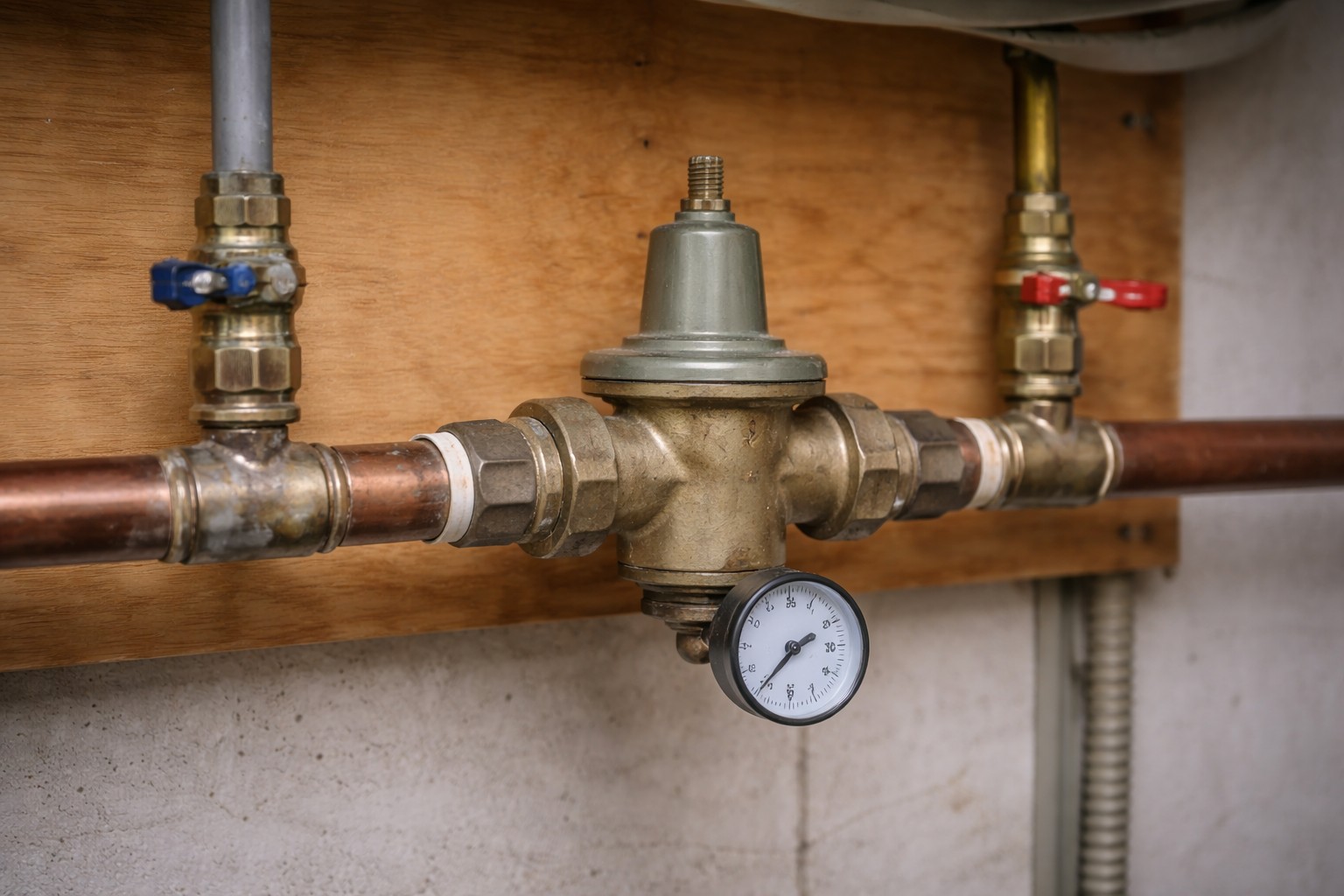
Use this directory when repeated leaks, damaged connectors, appliance symptoms or noise raise a pressure concern. The observation is a starting point; it does not prove excessive pressure caused the failure.
Keep actual part failure, sustained pressure, heated-water expansion, rapid closure shock and protective-device behavior distinct. Compare model requirements with relevant evidence before selecting parts or controls.
Match the observed problem below. Contain active leakage before testing, and preserve actual component and pressure evidence without reproducing a hazardous event.
Contain the problem before testing
Keep away from wet electrical equipment. Do not touch wet appliances, plugs or switches, or enter water to reach a breaker. When no gas leak is suspected, power may be isolated only from a safely accessible dry location; otherwise call an electrician or emergency help. Wet equipment needs qualified assessment before it is used again.
Stop using the affected leaking appliance or fixture. From a safe dry position, close an identified owner-operated supply only if it is accessible without force, hot spray or wet equipment. If that cannot control the leak safely, request prompt plumbing or utility assistance. Keep a damaged line isolated; do not patch it and reopen, pull an appliance through water, or repeat a cycle to prove the failure.
Observation, evidence, then action
Observation: A leak, bulge, bang or alert identifies what happened. It does not identify the pressure or failed mechanism.
Evidence: Match the actual part and pressure zone, timing and instrument response with the product requirements. Preserve uncertainty and existing records.
Action: Contain damage, preserve protection and repair the established fault with compatible parts and safe commissioning.
Sustained overpressure, pressure rise as trapped water heats, and rapid valve-closure hammer are different findings. Select a regulator, approved expansion control or arrester from the actual mechanism, system design and component limits, not from a leak alone. Do not use an ordinary partly closed stop as a pressure regulator, bypass required protection or change a protective alarm merely to suppress the symptom.
A pressure check is optional evidence, not a prerequisite for containing a leak or getting help. Use an intact, accessible existing owner test connection, compatible rated gauge and its actual connection/release instructions. Identify the measured side of regulators, checks and shutoffs; the outlet must admit the intended pressure. A maximum-only pointer does not record when, how long or why its peak occurred, and a normal dial can miss fast transients. No live fitting, backflow test cock or improvised appliance adapter is a generic test point.
Related subcategory: Water Pressure Behavior & Regulation
Fixture and valve failures
Separate the failed part and leak path from any independently verified pressure problem.
-
High pressure breaking faucet cartridges
Identify the actual cartridge, leak path and repair history before assigning a pressure cause or lifespan.
-
Toilet fill valves failing repeatedly
Distinguish inlet shutoff, overflow, tank-to-bowl loss and external leakage before another fill-valve replacement.
-
Shower valves leaking due to pressure
Locate the actual shower leak and use model-specific parts, isolation and temperature-protection commissioning.
Hoses, lines, and connections
Keep a released connection, damaged washer hose and distorted flexible connector distinct.
-
Washing machine hoses bursting
Contain the failed washer hose and follow actual hose/application, condition and replacement requirements.
-
Ice maker line blowing off
A released refrigerator tube needs actual fitting/tubing compatibility, isolation and electrical safety assessment.
-
High pressure warping supply lines
This article addresses flexible fixture connectors, their bend/installation damage and actual replacement requirements; it does not diagnose rigid PEX or copper.
Leaks and appliance impacts
Identify actual supply, appliance and waste paths without operating damaged equipment.
-
Dishwasher leaks caused by high pressure
Separate pressurized inlet leakage from tub/door, circulation and drain faults; avoid several-cycle fault reproduction.
-
High pressure ruins solenoid valves
Chatter, restricted filling and idle leakage need actual hydraulic and control diagnosis rather than an automatic new solenoid.
-
High pressure voiding appliance warranties
Use actual written warranty terms and failure evidence; present-day readings do not decide historical cause or coverage.
Noise and hammer symptoms
Distinguish a rapid closure bang from steady-flow noise and gradual thermal movement.
-
High pressure causing pipe hammer
Assess rapid closure shock, measurement response and actual support/arrester needs without forcing another hazardous event.
-
High pressure causes noisy pipes
Noise timing helps direct assessment but does not measure pressure or establish whole-home overpressure.
Pressure control and protection devices
Identify the actual regulator, filter pressure boundary and protective alert before adjustment or service.
-
High pressure damaging PRV
Separate model lockup/flow behavior, heating and genuine regulation faults; a few-psi rise alone is not proof of damage.
-
High pressure damages filters
Separate exterior seal leaks, cartridge treatment paths, bypass position and damaged housings under actual model requirements.
-
High pressure triggers smart shutoff
Read the actual alert and valve state, resolve its cause and preserve protection instead of pausing rules or blindly resetting.
Supply increases and pipe material risk
Keep work timing and actual material/application evidence separate from a pressure-cause assumption.
-
High pressure after city upgrade
Report actual work timing and mapped readings promptly; a house outlet is not automatically a street-pressure test.
-
High pressure cracking CPVC
Isolate damaged CPVC and assess actual material, handling, chemistry, pressure and approved cure/test requirements.
All Articles in This Cluster
- High pressure breaking faucet cartridges
- Toilet fill valves failing repeatedly
- Shower valves leaking due to pressure
- Washing machine hoses bursting
- Ice maker line blowing off
- High pressure warping supply lines
- Dishwasher leaks caused by high pressure
- High pressure ruins solenoid valves
- High pressure voiding appliance warranties
- High pressure causing pipe hammer
- High pressure causes noisy pipes
- High pressure damaging PRV
- High pressure damages filters
- High pressure triggers smart shutoff
- High pressure after city upgrade
- High pressure cracking CPVC