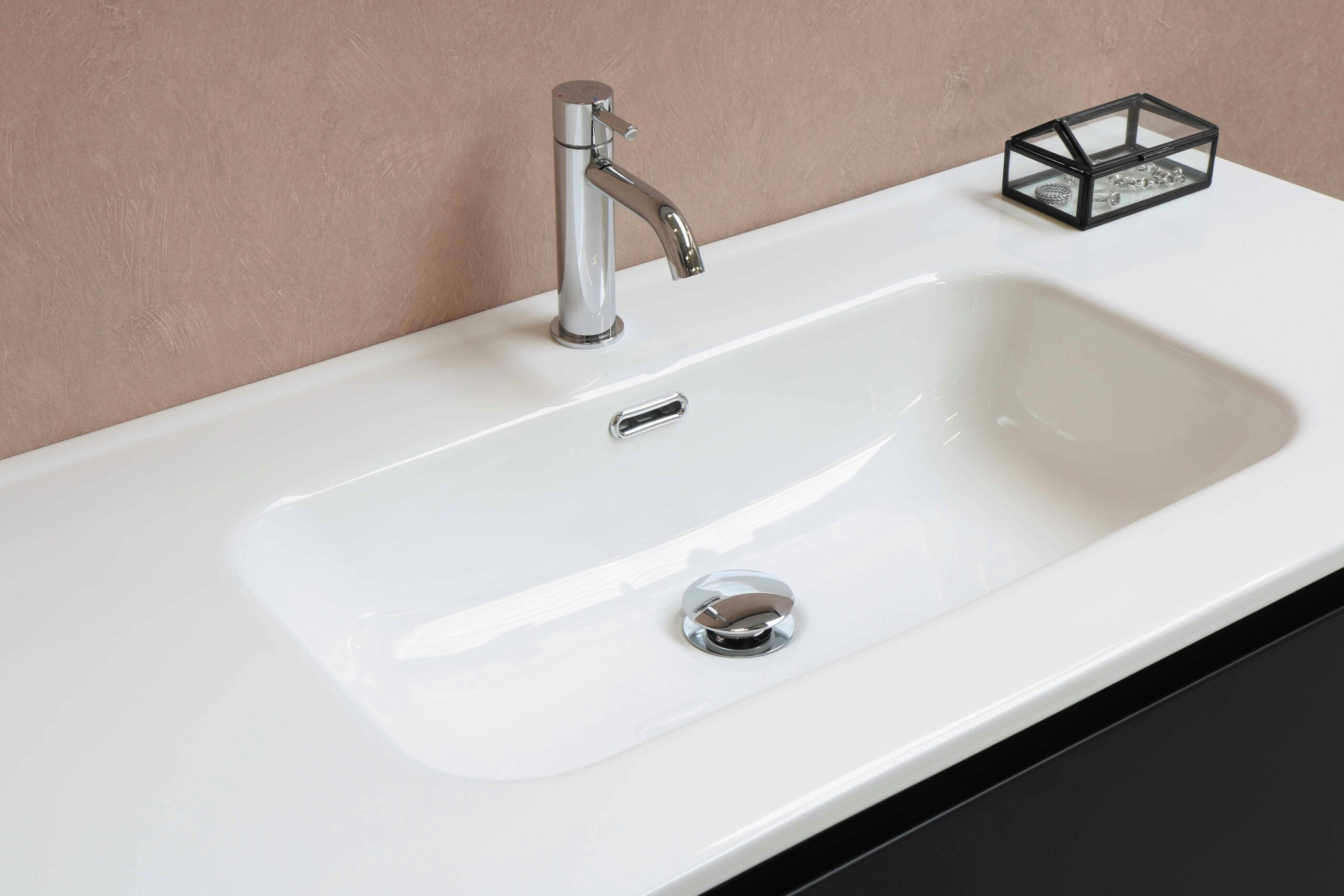
For a bathroom sink that remains weak, this guide covers the service boundary before hoses, inlet parts or a cartridge are opened. It complements the intact owner-triage guide; a sudden spray caught in a bucket is not an appropriate generic diagnostic.
First check the situation
Stop affected use for leakage, unsafe temperature, damaged parts or a drain that cannot accept water. Seek prompt appropriate help without another comparison test. Do not enter wet cabinets, wall spaces or water to reach a valve or electrical control.
Keep away from wet electrical equipment. Do not touch wet appliances, plugs or switches, or enter water to reach a breaker. When no gas leak is suspected, power may be isolated only from a safely accessible dry location; otherwise call an electrician or emergency help. Wet equipment needs qualified assessment before it is used again.
If fuel gas is suspected, leave the building or affected area immediately. Do not operate valves, switches, plugs, appliances or phones there. Call the gas emergency service from a safe location well away, and wait for responders’ clearance.
Record the original observation
- Actual faucet/cartridge, both supply connections and any completed work record.
- Original hot/cold or mixer setting, visible damage and safe owner-care result already obtained.
- Effective independent controls, retained heat and accepting drainage.
What it can tell you
A hose bypass changes the arrangement and does not uniquely prove a collapsed line. Looking through a disconnected hose or bending it is not a full condition assessment. Service permission, compatibility and warranty terms are product-specific.
Useful next steps
- Do not disconnect and bend a hose to look for internal collapse, bypass it or restore supply with a cartridge removed for a short dirty spray.
- Do not proceed past a failed stop by merely being ready to close the main. Every relevant feed must be effectively isolated and depressurization verified first.
- Identify actual retaining, sealing and compatible hose/cartridge parts before extraction. Do not loosen an unidentified nut or rely on photographs made after taking it apart.
- Any model-prescribed service flush needs the complete controlled arrangement and source-off refitting step. Do not promise that all flushing cannot void anything.
Ordinary outlet care has limits
For a separately suitable routine outlet-cleaning case, use the exact model removal and finish-care instructions. Turn the outlet off, allow parts/water to cool, keep safe footing and contain retained water. Cover the drain to retain small parts without allowing a basin overflow. Use the actual aerator key or permitted tool; cloth on pliers does not make force harmless. Clean only intended removable parts using a compatible product and duration. Do not assume every screen pulls out, every finish accepts vinegar or every assembly contains an owner-serviceable check valve. Keep restrictors, checks and seals in their required places. Refit completely before a small attended safe-temperature check with an accepting drain. Stop for rise, leakage, binding or unsafe temperature.
Before internal or connection service
Before any internal service or fitting removal, identify and isolate every supply that can pressurize the section, release trapped pressure through the appropriate controlled outlet and verify depressurization. Account for hot water and possible alternate feeds. Lowering a PRV setting, reducing flow or wearing gloves does not make a pressurized assembly safe to open. If isolation cannot be established, leave it assembled and obtain qualified help.
Keep all relevant feeds isolated while retained parts or supply connections are open. A failed stop is not trustworthy isolation, and closing that stop cannot unload its own inlet. A quiet remote tap or empty toilet tank alone does not verify every segment. Do not reopen a removed cartridge, exposed supply or loosely held hose into a bucket as a generic test. Some actual makers prescribe controlled outlet or installed-valve service flushing; follow the full model method, secured capture and source-off extraction/refitting sequence. Fully reassemble compatible parts before normal restoration and leak/function checks. Comfort, towels and a short burst do not replace source control.
Check only an identified owner-operated shutoff whose normal position and operating method are known, without force or repeated cycling. Do not manipulate curb stops, meter valves, utility fittings, backflow test cocks or an unknown valve. Contact the supplier for its equipment and the installer or plumber for household equipment.
Is flushing always permitted without affecting warranty?
No universal assurance is supportable. Follow the actual product/service/warranty instructions and ask the maker or provider when uncertain.
Give the provider the model, actual work record, original setting/phase and any material already recovered. Persistent or recurring low delivery needs actual fixture/supply evidence; a temporary change does not certify the whole system. A weak stream or spray feel is not a measured pressure, and a nearby working tap does not clear every shared condition. If a new unexplained color, odor or other water-quality change accompanies the event, do not taste it or boil unknown water as a general remedy. Use a known-safe consumption source and contact the supplier for the actual restrictions and restoration directions. Clear flow does not lift an advisory.
Related guides
- Outdoor spigot has weak pressure
- Low pressure after installing water filter
- Low Pressure at Single Fixture
- Bathroom sink owner triage before internal service