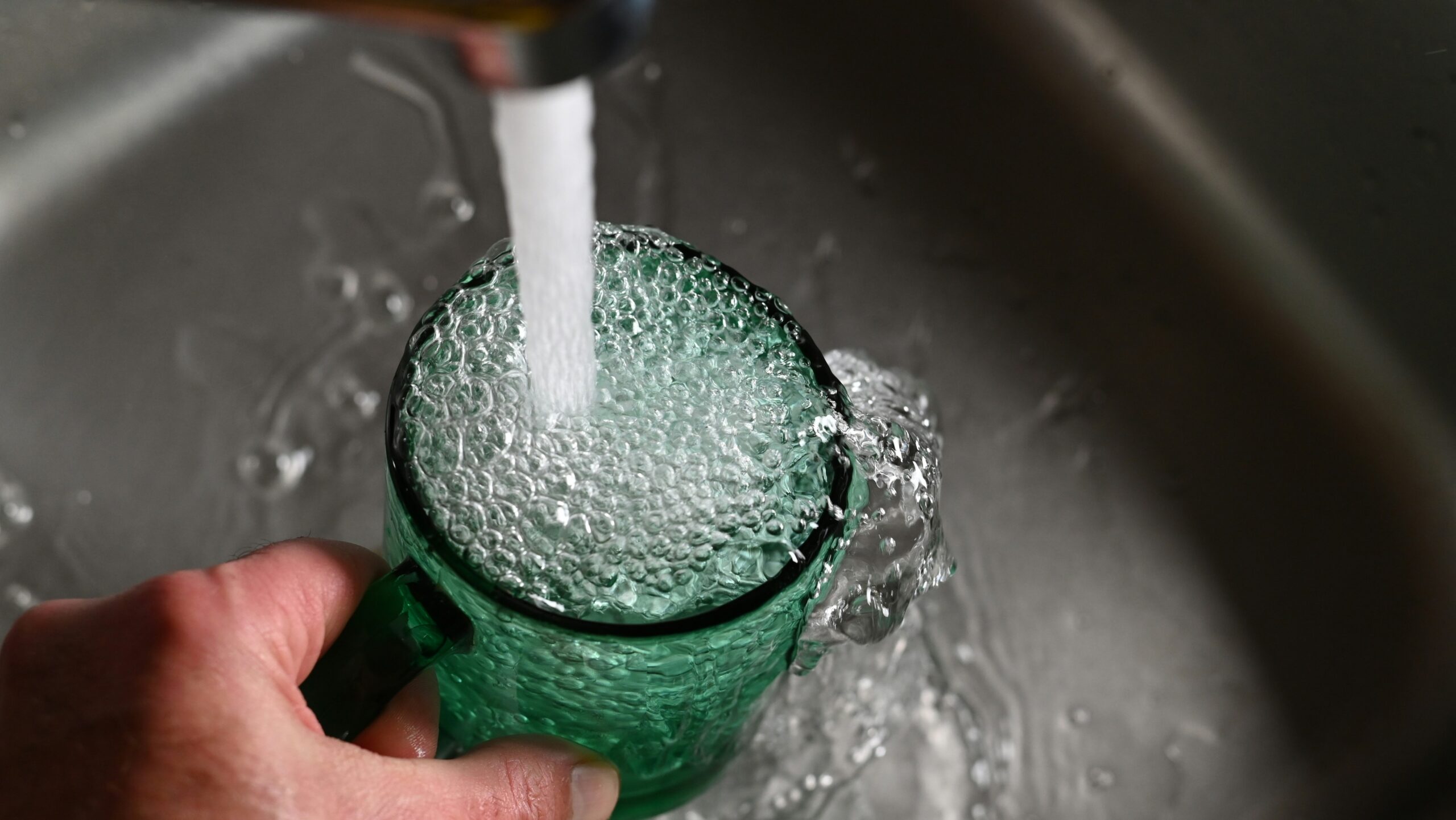
If one faucet became weak when the water was turned back on, keep the shutoff or repair event in the diagnosis. Debris at a removable outlet is one possibility, but a valve position, faucet component or supply-branch problem may also need checking. Follow any water-supplier instructions before trying to restore normal flow.
Check water-use restrictions and immediate hazards first
For a new, unexplained water-quality change: do not deliberately taste the water. Use bottled water or another known-safe supply for drinking, food preparation, teeth brushing and ice while you contact the supplier. Follow the actual local notice for other uses. Boiling does not make chemically contaminated water safe, and clear appearance or a fading odor does not certify safety.
Stop for leakage, unsafe temperature, a sink that cannot drain, sudden worsening or a control that will not work. Do not run every tap or repeat a hot-water test before asking for help.
Keep away from wet electrical equipment. Do not touch wet appliances, plugs or switches, or enter water to reach a breaker. When no gas leak is suspected, power may be isolated only from a safely accessible dry location; otherwise call an electrician or emergency help. Wet equipment needs qualified assessment before it is used again.
Keep the before-and-after information
- What was shut off, why, and whether the plumbing was drained or winterized.
- When the faucet first became weak and whether it was normal before the work.
- Whether hot, cold, mixed water or one spray mode is affected.
- What you already know about other fixtures, visible leaks and changes in color or odor.
These notes can help the supplier, installer or plumber. They are not a checklist you must finish before reporting an urgent problem.
Choose the next step from what changed
| What you noticed | Useful next step |
|---|---|
| There is a new color, odor or water-use advisory | Follow the supplier’s restrictions and return-to-service directions. Do not taste the water or treat clear-looking flow as proof that it is safe. |
| Only this faucet is weak; water use is otherwise permitted | Look up the exact outlet’s owner-care instructions. Check visible connections and valve identification without loosening or disconnecting anything. |
| Only hot or only cold changed | Report the affected side along with the work history. That helps target assessment; it does not prove which valve or cartridge failed. |
| Several fixtures are affected or flow remains severely reduced | Report the wider pattern to the supplier or plumber. Do not compensate by raising house pressure or bypassing protective devices. |
| The system was drained or winterized | Use the installed equipment’s refill and startup instructions. Water heaters and other equipment can have requirements beyond opening a faucet. |
Outlet cleaning and flushing are model-specific
Identify the faucet before taking off an aerator or spray head. Use only owner-removable parts, the correct tool and compatible cleaning products; leave non-serviceable outlets intact. Turn the faucet and connected functions off and let hot parts cool. Keep required seals, checks and flow controls in their proper places, and do not force removal with pliers or assume vinegar is suitable for the finish.
Some makers prescribe a controlled check or flush with an aerator removed. Follow the full instructions for the model, including water control, safe temperature, splash containment and source-off refitting. The basin must be able to drain the water. There is no universal 30–60-second full-flow flush, floor-by-floor sequence or waiting period that clears every installation. A known leak, unsafe temperature or poor drain is a reason to stop.
More flow with the outlet removed does not prove that the branch supply is fault-free. Do not open a cartridge housing or disconnect a hose to blast out debris as a general household test; internal service and any manufacturer-prescribed service flushing need their own controlled procedure.
Do not force a shutoff or open a pressurized part
A small valve under the sink may be quarter-turn or multi-turn. Identify it, its intended position and its condition before operating it. Do not apply a universal turn-until-it-stops rule, force a seized valve or change an unknown control.
Do not disconnect a supply hose or remove a cartridge, bonnet or valve part just to see whether water comes out. Before opening a part that holds back water pressure, every supply feeding it must be shut off, trapped pressure safely released, and the section checked to confirm it is no longer pressurized. A towel or a quiet tap elsewhere cannot confirm this. Leave the faucet assembled if you cannot establish safe isolation.
Keep the supplies off while those parts are open. Stop if water continues to flow, a shutoff fails, or a part is seized or corroded. Use approved compatible parts and fully secure the assembly and its protective components before the model’s attended restoration and leak checks. Shut off and release pressure again before further internal work. A permitted external trim adjustment is a different task from removing parts that contain water pressure.
When flow has not returned to normal
Contact the supplier about an unresolved supply or water-quality issue, or the installer/plumber about the faucet and branch that were worked on. Persistent weakness after suitable owner care needs assessment. Do not increase the regulator setting or replace a cartridge merely because other taps seem normal. A weak stream measures neither the actual pressure nor the condition of hidden pipework.
Before an attended return-to-use check, complete the required refill/startup procedure, fully refit compatible parts and restore protective components. Make sure water use is permitted, temperature is safe and drainage can keep up. Do not continue if water escapes or control fails.
Related situations
- Single-fixture delivery scenarios
- After-shutoff source and startup decisions
- General faucet outlet assessment
Browse broader Plumbing topics. Choose from the actual symptom and equipment.