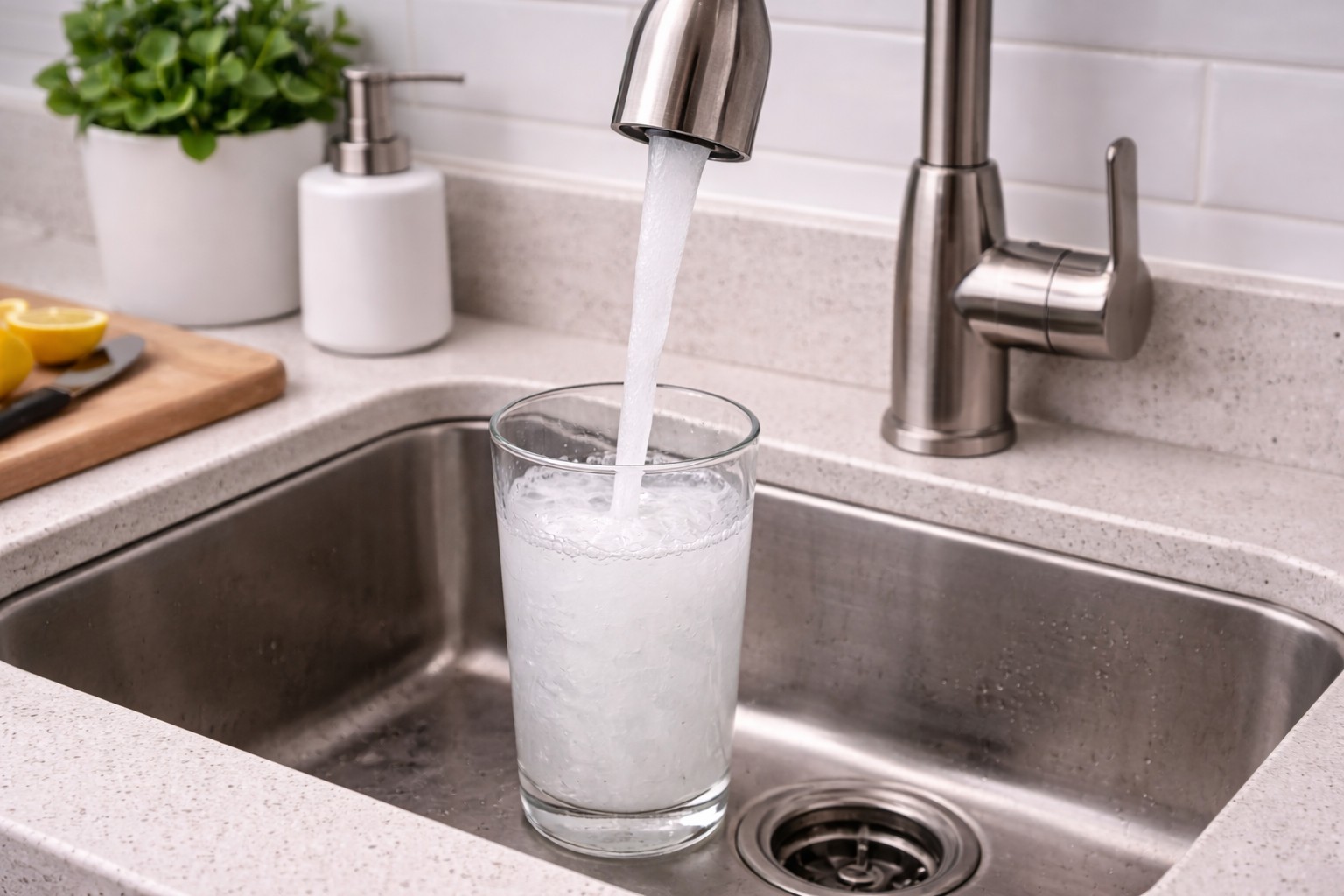
Use the original event and location to choose a guide for cloudy, milky or white-particle water. Ordinary explained air bubbles, persistent material, bowl or cookware residue and incomplete equipment startup need different evidence; a clear glass does not answer every question.
Appropriate water use
For a new, unexplained water-quality change: do not deliberately taste the water. Use bottled water or another known-safe supply for drinking, food preparation, teeth brushing and ice while you contact the supplier. Follow the actual local notice for other uses. Boiling does not make chemically contaminated water safe, and clear appearance or a fading odor does not certify safety.
Ordinary, provider-identified air-only milkiness can be a harmless visual effect and does not automatically require laboratory testing. A new unexplained change, persistent material, unusual color/odor or a current notice needs advice suited to that concern. Rising bubbles do not exclude a coexisting dissolved or microbial problem.
Keep these questions separate
Rising bubbles or retained material describe an observation.
Actual supplier advice and suitable tests answer the specific quality question.
Correct installation, filling and protection require their own verification.
Before changing conditions
For a new unexplained quality change, ask the supplier or a state-certified drinking-water laboratory which substances, sample points, containers and handling conditions fit the history. Obtain instructions before collecting, flushing, removing an aerator or changing treatment; a first-draw sample may matter. A stored household glass or residue from a screen, bowl or heater drain is not automatically a representative drinking-water sample.
Keep the exact work notice, winterizer product, cartridge or regulator model and heater service record. Do not identify material with taste, touch, vinegar or a hand magnet, boil unknown water dry, bypass required treatment or turn a PRV to chase clarity.
A glass or ordinary-use pattern
- Cloudiness that clears in about a minute
- Milky Water in Glass but Clears Quickly: First Steps
Start with the original clearing pattern and appropriate water-use advice, without treating a glass as a contamination test.
- Milky Water in Glass but Clears Quickly: Observation and Lab Questions
Separate an existing visual observation from the specific questions and collection instructions needed for laboratory evidence.
- Milky appearance during cold-tap use
- Bubbles versus retained material: interpreting an existing glass
- Cloudy Water Only in the Morning: First Steps
Start with appropriate water use and the original morning event before changing conditions.
- Cloudy Water Only in the Morning: Observation Log and Sample Plan
Use four observation fields and a fictional log to distinguish an ordinary-use record from an actual collection plan.
After a supply or seasonal event
- Cloudiness after an outage
- Milkiness after a pressure change
- Cloudy Water After Winterization: First Steps
Start with appropriate water use, the actual winterizing history and prompt exposure advice when needed.
- Cloudy Water After Winterization: Check the Product Record
Use four paperwork checks and an explicitly fictional note to separate product identity, application and completed restoration.
- Bubbles versus material after restoration or plumbing work
After filter, regulator or pipe work
- Cloudy Water After Replacing a Filter: First Steps
Start with appropriate water use, the actual replacement part and completed product startup.
- Cloudy Water After Replacing a Filter: Check the Claims
Use the four document checks and hypothetical label example to distinguish fit, intended purpose, claimed reduction and conditions of use.
- Cloudy Water After PRV Work: First Steps
Start with appropriate water use, the actual installation and supplier or installer advice.
- Cloudy Water After PRV Work: Read the Pressure Record
Read the existing gauge location, no-flow or water-use condition, units and recorded time window. The fictional example is not a pressure recommendation.
- White buildup after pipe replacement
Where persistent material was noticed
- White Specks Clogging Aerators: First Steps
Start with the actual aerator, original flow/particle event and any preservation or collection instructions.
- White Specks Clogging Aerators: Flow and Particle Record
Use the three-part record to keep flow recovery, accumulated material and independent source findings separate.
- White Flakes in Toilet Bowl: First Steps
Start with the original bowl location, cleaner history and any separate tap-water concern.
- White Flakes in Toilet Bowl: Bowl, Tank and Tap Record
Keep bowl, tank, cleaner and ordinary-tap observations in separate fields; use the fictional note to preserve unknowns.
- White Residue After Boiling Water: First Steps
Start with a deposit already left on a cooled vessel, actual care history and the source question.
- White Residue After Boiling Water: Vessel and Source Record
Use the vessel/source/care record and fictional example without creating another boiling or cleaner trial.
- White particles during hot-water use
- White Particles After Water Heater Refill: First Steps
Start with the original particle event and the separate questions of water use and safe heater startup.
- White Particles After Water Heater Refill: Startup and Particle Record
Use the actual service record to separate completed fill/startup evidence from particle identity and use advice.
Shower and private-well context
- Milky Water in Shower Only: First Steps
Start with the original shower appearance and appropriate use advice before changing the fixture or creating another spray.
- Milky Water in Shower Only: Appearance and Fixture Evidence
Keep spray/vessel appearance, assembled equipment and independent use or fixture questions separate.
- Cloudiness from a private well
What these routes can establish
The glass guides explain a visual observation. Event guides add the actual reopening, product or equipment record. A toilet bowl, kettle and accumulated aerator material each have a different use and cleaning history; none is automatically an incoming drinking-water sample. Timing and fixture count help describe the concern without uniquely locating its cause.
Where restoration is appropriate, follow the actual supplier, installer or product directions after the concern is assessed. Use sound, fully assembled plumbing, the specified outlet and sequence, a drain that can receive the discharge, safe temperature and continuous attendance. Stop for leakage, backup or another hazard. Do not invent a hotter, longer or whole-house purge; clear appearance is not water-quality clearance.
Broader category: Water Contamination, Taste & Odor.
Safety sources
- CDC: drinking-water advisories
- EPA: certified drinking-water laboratories
- EPA: home testing and laboratory sampling instructions
- USGS: why air bubbles can make water cloudy
- United Utilities: ordinary air cloudiness and bottom-up clearing
- USGS: hardness and deposits after heating
- CDC: selecting and maintaining a water filter
- NSF: specific treatment standards and reduction claims