White material in an aerator records what the screen caught under its use history. A vinegar reaction or one-versus-many-fixture comparison cannot uniquely identify the material, locate its source or establish harmlessness.
For the immediate response and care boundaries, start with White Specks Clogging Aerators: First Steps.
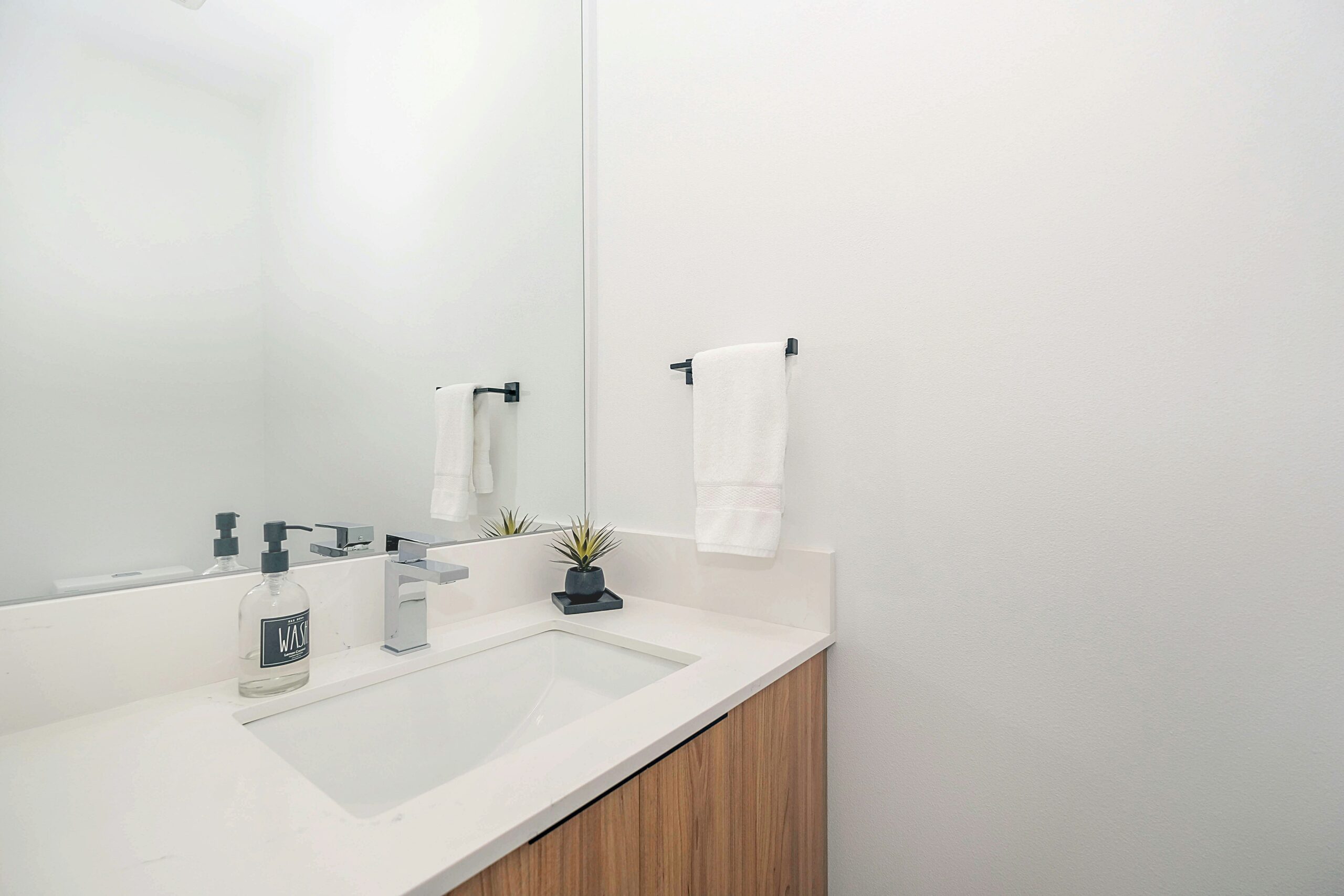
The sink photograph provides fixture context. It is not a close-up of captured particles or evidence about their source.
Appropriate water use
For a new, unexplained water-quality change: do not deliberately taste the water. Use bottled water or another known-safe supply for drinking, food preparation, teeth brushing and ice while you contact the supplier. Follow the actual local notice for other uses. Boiling does not make chemically contaminated water safe, and clear appearance or a fading odor does not certify safety.
A record you can use
- Flow record
- Keep the original reduced-flow event and any result already observed after suitable, completed owner care. Improved delivery describes a flow change; do not reproduce the event with a bare outlet.
- Accumulated-material record
- Keep the actual screen, service interval and cleaning history in the description. A screen retains material over time; an unknown fragment is not identified by its color or by a vinegar reaction.
- Source and collection record
- Keep the supplier’s notice, relevant work history and laboratory instructions separately. Ask about preservation before cleaning or removal when the unexplained change needs assessment.
A record of existing evidence, not three experiments. Suitable owner maintenance and a laboratory collection plan are different tasks; follow the instructions for the actual task and product.
Fictional example: “During earlier compatible owner maintenance, flow improved after the complete aerator was refitted. The retained material was not identified, and no laboratory result exists.” This supports a recorded flow improvement, not a conclusion about particle composition, the upstream source or drinking-water safety.
Keep the useful evidence
- Actual faucet/aerator model, original reduced-flow observation and recent compatible part or pipe work.
- Existing appearance without touching unknown grit, and whether cleaning/chemicals already changed it.
- Any lab collection instructions, supplier notice and known recurrence after prior owner maintenance.
What the observation means
Known hard-water deposits can occur, but white grit is not automatically scale. A clean screen restoring flow shows a flow effect; it does not determine all upstream water quality or justify a generic treatment purchase.
What to do next
- For a new unexplained supply-quality change, settle sample and use advice before removing or cleaning the screen.
- If suitable, use only the actual owner-removable aerator’s tool and finish-safe method, with the tap off, cool parts and retained pieces. Some recessed or retained parts need a specific key; do not force them with pliers.
- Use only a cleaning method approved for the actual materials, seals and existing chemical history. Do not use vinegar on unknown residue as identification or impose a universal soak time.
- Refit the complete compatible assembly before appropriate normal use. Do not run hot/cold at full flow or compare multiple exposed outlets to certify the source.
- If material returns, report the original maintenance/work history and follow suitable source/material assessment rather than repeating chemical cleaning.
Sampling before changing conditions
For a new unexplained quality change, ask the supplier or a state-certified drinking-water laboratory which substances, sample points, containers and handling conditions fit the history. Obtain instructions before collecting, flushing, removing an aerator or changing treatment; a first-draw sample may matter. A stored household glass or residue from a screen, bowl or heater drain is not automatically a representative drinking-water sample.
Restoration under actual instructions
Where restoration is appropriate, follow the actual supplier, installer or product directions after the concern is assessed. Use sound, fully assembled plumbing, the specified outlet and sequence, a drain that can receive the discharge, safe temperature and continuous attendance. Stop for leakage, backup or another hazard. Do not invent a hotter, longer or whole-house purge; clear appearance is not water-quality clearance.
Is an aerator particle sample the same as a drinking-water sample?
No. It represents accumulated material and a particular screen history. Ask the lab which sample and handling method fit the actual question.
Related guides
- Cloudy Water After PRV Work: First Steps
- Milky-looking water from cold tap
- White Particles, Cloudy Water, or "Milky" Water
- Cloudy Water After PRV Work: Read the Pressure Record
- White Residue After Boiling Water: Vessel and Source Record
Safety sources
- CDC: drinking-water advisories
- EPA: certified drinking-water laboratories
- EPA: home testing and laboratory sampling instructions
- USGS: hardness and deposits after heating
- CDC: selecting and maintaining a water filter
Manufacturer example: aerator tools, retained parts and reassembly. This example is not identification of your faucet or a universal cleaning, soak or flushing instruction.