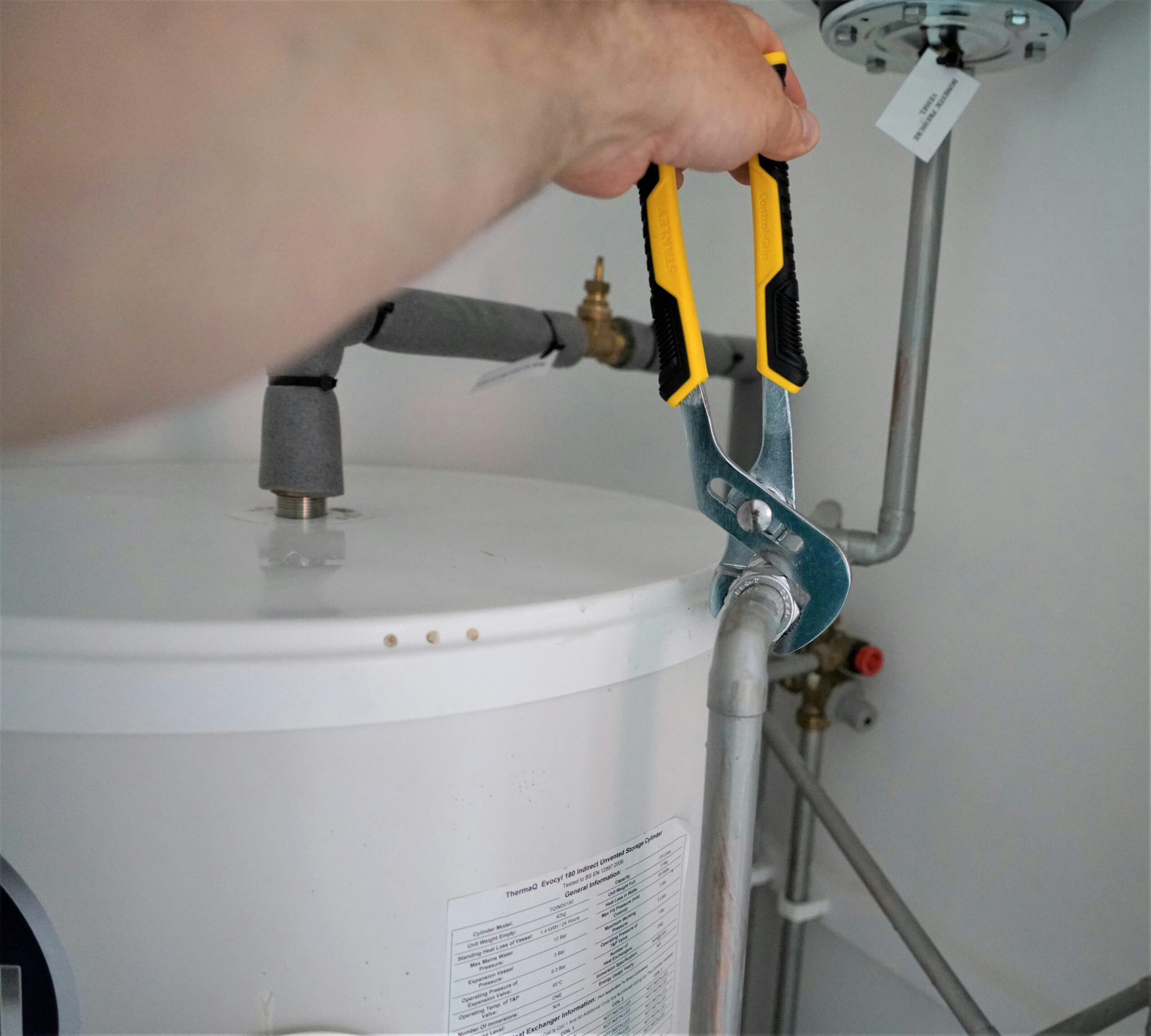
Ticking or clicking noticed after a water heater runs can involve metal expanding or cooling, a pipe contact point, a heat-trap component or another sound transmitted through the building. Timing alone does not prove harmless thermal movement or excessive water pressure. Use the original event to choose the next assessment; do not heat the tank again to recreate it.
Check the hazard before a noise investigation
If fuel gas is suspected, leave the building or affected area immediately. Do not operate valves, switches, plugs, appliances or phones there. Call the gas emergency service from a safe location well away, and wait for responders’ clearance.
If a carbon monoxide alarm sounds or you suspect carbon monoxide exposure, get everyone outside immediately and call emergency services from safety. Carbon monoxide has no smell; an odor comparison cannot rule it out. Do not restart or repeatedly cycle a fuel-burning heater to investigate a possible combustion problem.
Keep away from wet electrical equipment. Do not touch wet appliances, plugs or switches, or enter water to reach a breaker. When no gas leak is suspected, power may be isolated only from a safely accessible dry location; otherwise call an electrician or emergency help. Wet equipment needs qualified assessment before it is used again.
Stop affected use and obtain prompt qualified help for active leakage, hot spray, steam, relief discharge, severe temperature change, violent movement or a protective shutdown. Use an identified emergency control only from safe access when no gas leak is suspected. Do not cap or isolate a relief outlet, reset a limit repeatedly or approach a damaged hot vessel to listen.
Keep the original event and equipment details
- Heater model and fuel/type from existing paperwork or a safely visible label; recent replacement, pipe work or expansion-control service.
- Whether the click followed heating, occurred as water started/stopped, or continued as pipes cooled, based on normal use already observed.
- The general location, visible leakage or damage and existing pressure/temperature records. A phone recording is optional from safe access; do not stay near a burner or move a cover to obtain it.
Similar sounds need different evidence
Heating and cooling can change dimensions. A contact-point noise is not a pressure reading.
A closed heated zone needs suitable expansion control. Actual pressure and equipment state matter.
A heat trap or control can have another mechanism. Identify the actual model and event.
Conceptual comparison only; no installed diagnosis or service connection is depicted.
Separate two meanings of thermal expansion
Metal pipes and components can change dimensions during heating and cooling and may move at a contact or support point. Separately, heating stored water in a closed pressure zone can increase water pressure. These are different questions: a fine tick does not measure pressure, and pressure trouble is not cleared because a sound resembles ordinary metal movement.
A click can have another mechanism
Some heater heat-trap designs can click under changing flow or pressure; electrical or powered controls can also make their own sounds. The actual model and event determine relevance. Do not remove heat traps, check valves, insulation, relief components or required protection because a general bulletin mentions a possible noise source. A room location can also receive sound conducted along piping or framing rather than identify the source there.
Choose a proportionate next step
For a mild new recurring tick without hazard signs, record the existing pattern and ask the installer or qualified technician whether model-normal operation, a pipe contact or an actual equipment fault fits. Noise that worsens or comes with damage needs prompt assessment. Do not touch hot or moving pipe, tighten fittings or structural supports, wedge combustible padding near a heater/flue, or open walls as a first test.
If pressure assessment is warranted, the technician needs the actual heated zone, control/bypass arrangement and instrument side and operating state. A generic normal range, opening a faucet to see whether ticking stops, or a remote gauge maximum cannot uniquely diagnose the cause. Do not deliberately force a closed-tank recovery, use the drain as a generic hot gauge port, or adjust precharge/PRV from the sound. Preserve required protection and verify service isolation, pressure release, safe temperature and full commissioning before any return to heat.
Does ticking mean the heater must be replaced?
No single sound establishes that decision. Some model-specific expansion/contraction or heat-trap sounds can be ordinary; that does not certify an unidentified noise harmless. Actual condition and suitable inspection determine whether support adjustment, component service, expansion-control work or replacement is needed.
Related situations
Safety sources
- Con Edison: suspected gas leaks
- CDC: carbon monoxide alarms and wet electrical devices
- CDC: electrical hazards near water
- A. O. Smith: heat-trap clicking is one model-dependent explanation
- A. O. Smith: closed-system thermal-expansion context
- A. O. Smith commercial example: ticking/metallic sounds in troubleshooting table, page41