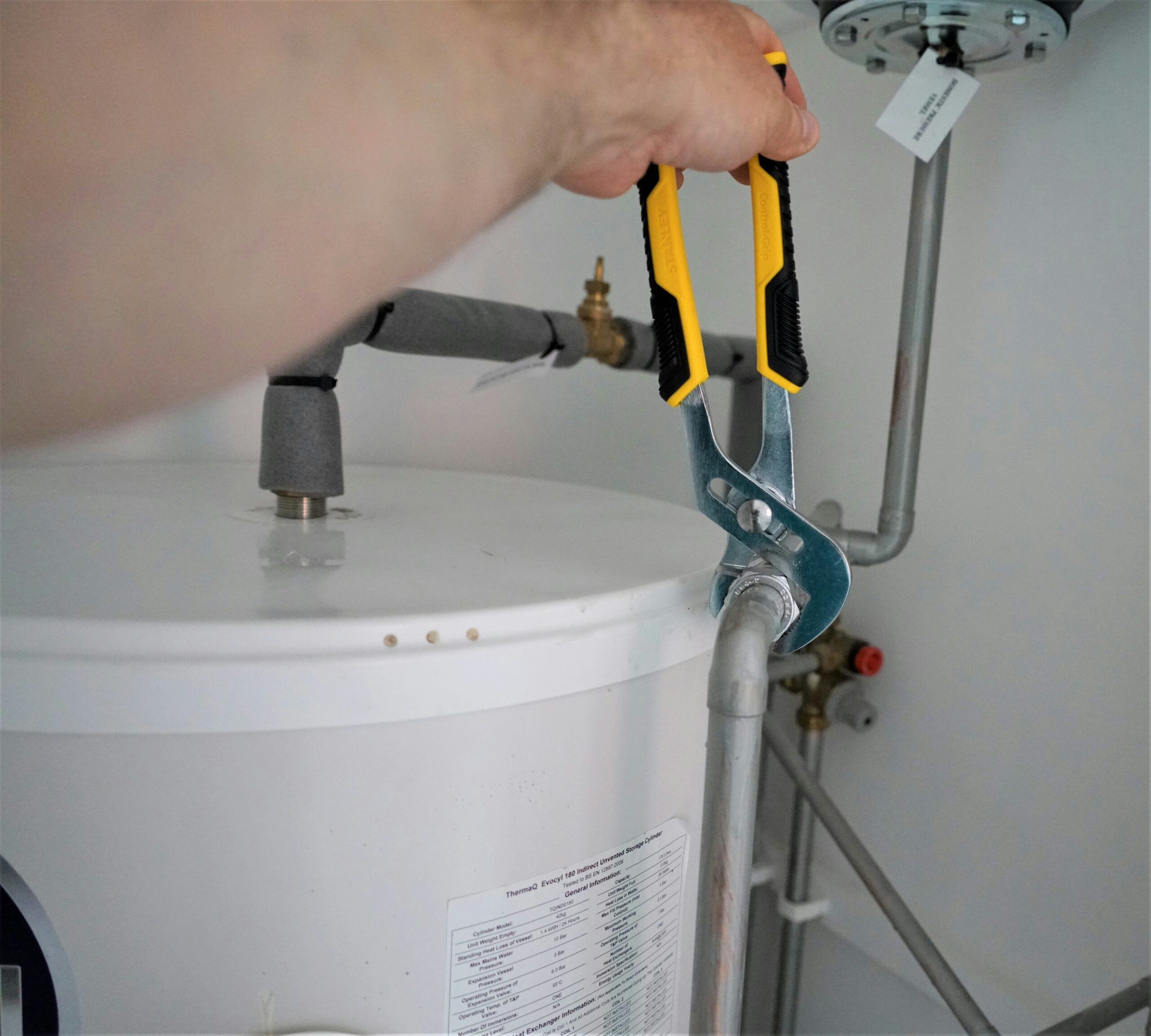
Interpret the pattern carefully: Thermal expansion can raise pressure in a closed water system as it heats; it is not the same event as the rapid pressure transient commonly called water hammer. A hot-side observation alone does not confirm thermal expansion. Never plug a temperature/pressure relief outlet or use repeated heater cycling as a pressure test; obtain a model-appropriate assessment.
Use the actual application and observation below. Keep potable domestic water distinct from closed hydronic heating, a temperature/pressure safety event from a suspected tank fault, and a slow rise from water hammer.
Hazards before another heating test
If fuel gas is suspected, leave the building or affected area immediately. Do not operate valves, switches, plugs, appliances or phones there. Call the gas emergency service from a safe location well away, and wait for responders’ clearance.
If a carbon monoxide alarm sounds or you suspect carbon monoxide exposure, get everyone outside immediately and call emergency services from safety. Carbon monoxide has no smell; an odor comparison cannot rule it out. Do not restart or repeatedly cycle a fuel-burning heater to investigate a possible combustion problem.
Keep away from wet electrical equipment. Do not touch wet appliances, plugs or switches, or enter water to reach a breaker. When no gas leak is suspected, power may be isolated only from a safely accessible dry location; otherwise call an electrician or emergency help. Wet equipment needs qualified assessment before it is used again.
Keep away from steam, hot spray, relief discharge, a leaking/corroded pressure vessel or unstable supports. Stop affected use and obtain prompt qualified service for these conditions, unsafe temperature or abnormal pressure. Follow the actual heater emergency shutdown only from safe access; suspected fuel gas takes the departure response above before controls. Never cap, plug, isolate or disable a relief function. Do not force another heating cycle, long shower or valve closure to reproduce a known hazardous event.
Two different pressure questions
Target: The actual model/design uses the appropriate normal cold pressure at the tank’s connection, established under the required supplied conditions.
Measurement state: That positive operating pressure is not depressurization. The named potable-tank examples require an independently isolated, unloaded water side; Amtrol specifies empty of water and ambient adjustment.
Condition first: Do not recharge a corroded, damaged or weakened pressure vessel. Use the actual maker’s qualified service requirements.
Identify potable domestic water versus a closed hydronic heating circuit, the actual heater/tank/relief models and their approved application, materials, pressure and temperature limits. A boiler expansion vessel, potable expansion tank and water hammer arrester are not generic substitutes. Connection size, color, shell sound or a familiar pressure number does not establish compatibility. Keep any valid heating-circuit example explicitly separate from drinking-water service.
A temperature-and-pressure relief valve can operate for excessive temperature as well as pressure. A normal-looking remote pressure peak does not prove the safety valve is weak or safe to replace blindly. Assess actual temperature, pressure, valve/connection condition and ratings together. Do not defer a faulty safety-device assessment until a presumed expansion repair is complete. Keep discharge unobstructed and do not use its lever as an improvised pressure test or control. Prescribed maintenance has its actual manual, safe discharge and qualified-service conditions.
The intended precharge target and the state required to measure it are different. The target comes from the actual model/design and the appropriate normal cold pressure measured at the relevant point before isolation; it is not a universal household or boiler number. A positive cold-static water reading is not depressurization. The named Amtrol potable-tank example requires an isolated tank empty of water and ambient-temperature adjustment; the Watts example requires zero water-side pressure. A closed valve or one remote open tap does not prove the tank unloaded. Do not adjust/repressurize a corroded, damaged or weakened vessel. Use the actual maker’s qualified installation/inspection/service requirements.
Trace the actual heated pressure zone and a usable connection from it to approved expansion control. A backflow device on an irrigation branch does not automatically close the whole home, and an open smart valve is not automatically a one-way barrier. In Amtrol’s named potable example, the tank connects on the heater cold supply between the heater and the relevant one-way device. Do not move it to the other side of that barrier, open unidentified nearby valves or bypass required checks to make pressure fall. Other applications use their own approved arrangement.
Use only a suitable existing instrument or actual approved owner test connection, rated for the pressure/temperature and following its connection/release procedure. Identify its source, regulator, valve and heated-zone position, and whether the connection actually admits the intended water pressure. A gauge on a closed hose bib is not yet reading the live supply. Record time and active flow/heating conditions. A maximum-only pointer stores its registered peak, not when, how slowly or why it occurred; an ordinary dial may miss fast transients. No backflow test cock, drain cleanout, improvised hot connection or live fitting is a generic test point.
Before retained parts or a tank connection are opened, establish the actual heater/pump safe energy state, cooling, every independent supply isolation, controlled release and verified absence of pressure at that segment. A tank may be heavy; support and safe handling need the actual product method. Do not drain or service a heater by a generic gas/pilot/electrical recipe. Fully secure compatible parts, restore required protection and complete the model’s refill/air-release and commissioning conditions before energy returns. A quiet tap or one reduced peak does not certify the whole repair.
This hub covers pressure changes caused by thermal expansion—when water heats up and expands in a closed plumbing system. It often shows up as pressure building while the water heater runs, relief valves dripping, or hot-only pressure spikes. Use the groups below to match what you’re seeing and open the article that fits.
Pressure rises during heating cycles
Articles in this group focus on pressure that climbs while the water heater runs or after extended hot use.
-
Pressure rises when water heater runs
Explains why system pressure climbs during normal water heater operation and what readings to watch for.
-
Water heater causes system over-pressure
Describes how thermal expansion can push a closed system past safe pressure limits and common warning signs.
-
Pressure relief opens after heating cycles
Looks at relief valve operation tied to heating cycles and how to tell if the valve is responding to expansion.
-
Pressure builds overnight when heater runs
Addresses slow overnight pressure increases linked to extended water heater use and how to narrow the cause.
-
Pressure increases after long hot shower
Focuses on short-term spikes following long hot-water draws and whether the expansion tank is behaving correctly.
Hot-only spike patterns
A hot-only symptom needs its own investigation. Record where and when pressure was actually measured; unequal readings or a weak hot stream alone do not establish a closed-system expansion fault.
-
Pressure spikes only on hot water
Outlines diagnostic steps to confirm hot-only pressure spikes and likely causes inside the hot-water loop.
-
Pressure normal cold but high when hot
Compare a hot-side symptom with properly measured system behavior. Do not infer a missing expansion tank or choose equipment solely from the word “hot.”
Relief valve drips and hammering
Relief discharge, noise and toilet water loss need their actual temperature/pressure, source and component evidence; they do not prove one tank fault.
-
Thermal expansion causing relief valve drip
Shows why relief valves may weep or drip when expansion raises system pressure and what to inspect first.
-
Thermal expansion causes hammering pipes
Differentiate a sharp shutoff bang from pressure rising over a heating cycle. A professional can assess whether water hammer, support movement, expansion, or more than one issue is present.
-
Thermal expansion causing toilet fill leaks
Explains how pressure pulses from expansion can force fill valves to leak and what to check in the tank assembly.
Expansion tank condition and sizing
These articles cover waterlogged, failed, leaking, or undersized expansion tanks and their symptoms.
-
Thermal expansion tank waterlogged symptoms
Separates actual tank condition and safe unloaded service from shell-sound or zero-air-reading assumptions.
-
Expansion tank failed causing high pressure
Discusses how a failed tank can allow unchecked pressure rises and when replacement is appropriate.
-
Expansion tank leaking from air valve
Identifies air-valve wetness and potable versus hydronic applications without pressing a suspect vessel or copying universal settings.
-
Expansion tank undersized problems
Uses the actual approved application, sizing inputs and usable acceptance rather than choosing a larger tank from a drip.
Installation and retrofit issues
Problems that arise from incorrect installation or changes to the plumbing system are described here.
-
Expansion tank installed wrong
Highlights common installation mistakes that reduce an expansion tank’s effectiveness and how to spot them.
-
Thermal expansion after system retrofit
Reviews how retrofits or new backflow devices can create closed systems with unexpected expansion issues.
Further reading on broader pressure behavior and regulation is available at the sub-category hub: Water Pressure Behavior & Regulation
All Articles in This Cluster
- Pressure rises when water heater runs
- Water heater causes system over-pressure
- Pressure relief opens after heating cycles
- Pressure builds overnight when heater runs
- Pressure increases after long hot shower
- Pressure spikes only on hot water
- Pressure normal cold but high when hot
- Thermal expansion causing relief valve drip
- Thermal expansion causes hammering pipes
- Thermal expansion causing toilet fill leaks
- Thermal expansion tank waterlogged symptoms
- Expansion tank failed causing high pressure
- Expansion tank leaking from air valve
- Expansion tank undersized problems
- Expansion tank installed wrong
- Thermal expansion after system retrofit
Sources and equipment instructions
These sources support the safety precautions and plumbing principles above. They do not diagnose this particular home. Use the actual equipment model’s instructions; ask a qualified professional about concealed piping, vents, primers, and gas appliances.
Safety sources
- Con Edison: suspected gas leaks
- CDC: carbon monoxide alarms and wet electrical devices
- CDC: electrical hazards near water
- Amtrol ST/T potable-tank instructions: application, condition, unloaded precharge and placement
- A. O. Smith Bulletin 52: temperature and pressure relief are distinct functions
- Watts PLT-35 example: qualified service and zero-water-pressure precharge state
- Watts IWTG example: retained maximum is not a time trace
- EPA: cross-connections and maintaining appropriate protection
- Example electric-heater manual: filling and maintenance requirements