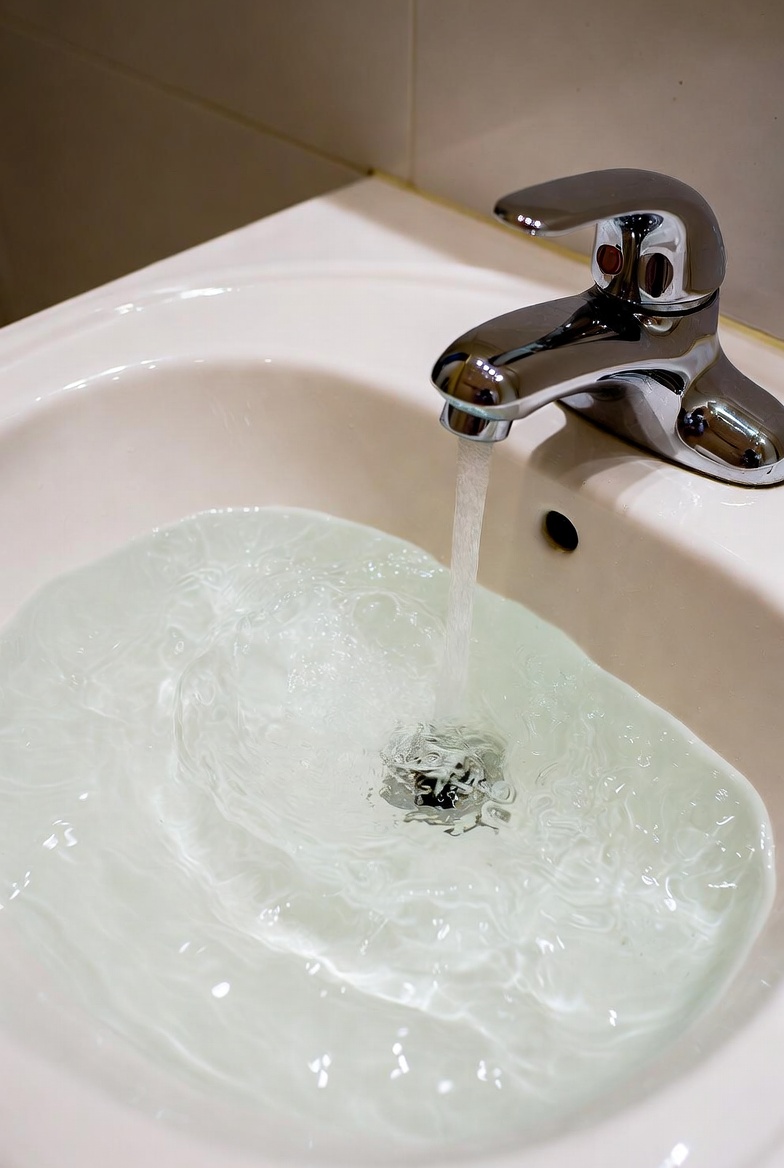
A brand-new sink can connect to older downstream plumbing. Early hair or film needs the actual stopper, captured material and installed parts checked; new age does not prove a manufacturing defect or a flat tailpiece.
For strong, widespread or unexplained gas-like fumes, exposure symptoms, or suspected high sewer-gas concentrations in an enclosed space, leave the building immediately and call the fire department or emergency services from outside. Avoid flames, switches and other ignition sources; do not remain to ventilate, sniff drains or investigate. Smell intensity does not measure the concentration. A faint localized drain odor without those warning signs calls for a different plumbing investigation; it does not automatically establish a fuel-gas leak.
If fuel gas is suspected, leave the building or affected area immediately. Do not operate valves, switches, plugs, appliances or phones there. Call the gas emergency service from a safe location well away, and wait for responders’ clearance.
For wastewater rising from a drain or affecting several fixtures, stop adding water and keep affected appliances from discharging using only safely accessible dry controls when no gas emergency is suspected. Avoid sewage contact, keep children and pets away and arrange prompt drainage help. Notify building management or the sewer agency as appropriate. Do not run fixtures to locate a shared blockage.
Record the original recurrence
- What was actually replaced and what existing piping remained.
- Stopper/strainer model, visible hair or observed burr/debris and any leak.
- Original water amount/use, prior products and installer commissioning record.
What the evidence can tell you
A vertical tailpiece, horizontal trap arm and intentional trap seal have different geometry. Do not assign a universal slope to the tailpiece or replace a deep-looking trap from appearance. A compatible catcher should intercept hair for removal, not deliver it to the trap.
Before tools or another product
If a cleaner may be present, identify the exact product and follow its label. Do not add another cleaner, acid, bleach, ammonia, vinegar or an improvised neutralizer. Do not plunge, snake or open the trap while hazardous residue may remain; tell the provider what was used. A rinse or elapsed time is not proof all residue is gone.
What to do next
- Capture loose hair outside the drain and empty a compatible removable catcher into appropriate waste. Do not condemn every large stopper or fine screen; actual fit and maintained water flow matter.
- Do not hot/soap-flush for minutes to move residue or simulate hair washing/shaving runoff as a repair challenge. Start with a modest hair-free attended check after correct reassembly.
- Use only actual owner-removable stopper/strainer and serviceable-trap methods in a safe ordinary case. Keep all inputs inactive, contain retained water and clean removed parts separately.
- Leave permanent joints, unknown burrs, concealed pipework and warranty/fit concerns to appropriate installer service. Do not file or replace parts solely from the date of installation.
Limits for ordinary local care
For a sound isolated plain-water sink only, with no chemical, sewage, gas, electrical or damage concern, keep the faucet and all connected inputs inactive. Use only the actual maker’s owner-removable stopper/strainer method; a retained horizontal rod, push-button and lift-and-turn design are not interchangeable. Wipe accessible hair into appropriate waste and clean removed parts separately. Do not force an unidentified drain body or probe a hidden route.
A suitable cup plunger or accessible serviceable slip-joint trap can be ordinary owner care under the linked local guide and actual tool/fixture instructions. Account for retained cool plain water, sound parts, overflow/other-bowl arrangements and inactive inputs. Do not open glued, corroded or unidentified connections or a cleanout. Never run the faucet into a disconnected drain or during reassembly. Refit the correct washers, alignment and tightening method completely before a small attended cool-water leak check. Stop for rising water, leakage, movement, unknown material or no improvement; a generic quarter turn, cable size or greater force is not a repair method.
Will a finer strainer keep debris moving to a place I can clean later?
The prevention goal is to capture loose hair for removal outside the drain. A maintained compatible catcher can reduce entry; it does not guarantee a permanent fix or prove all hidden geometry correct.
Persistent or rapid recurrence, unusual debris, damaged fittings or several affected fixtures needs appropriate assessment. Give the provider actual material, work and use records; do not choose pipe replacement, a camera, vent modification or deeper clearing from the timing alone.
Related guides
- Soap clog after switching shampoo
- Hair clog returns every few weeks
- Recurring Hair & Soap Buildup Cycles
- Bounded ordinary bathroom-sink care
- Chemical-opener history and service precautions
Safety sources
- Wisconsin DHS: sewer-gas exposure and emergencies
- Con Edison: suspected gas leaks
- Madison Metropolitan Sewerage District: stop discharge and report sewer backup
- Example drain-opener label: restrictions on plunging, disposal operation and mixing
- Delta example: identifying and removing a retained sink stopper
- Manufacturer kitchen-sink guide: strainer, plunger and reassembly sections