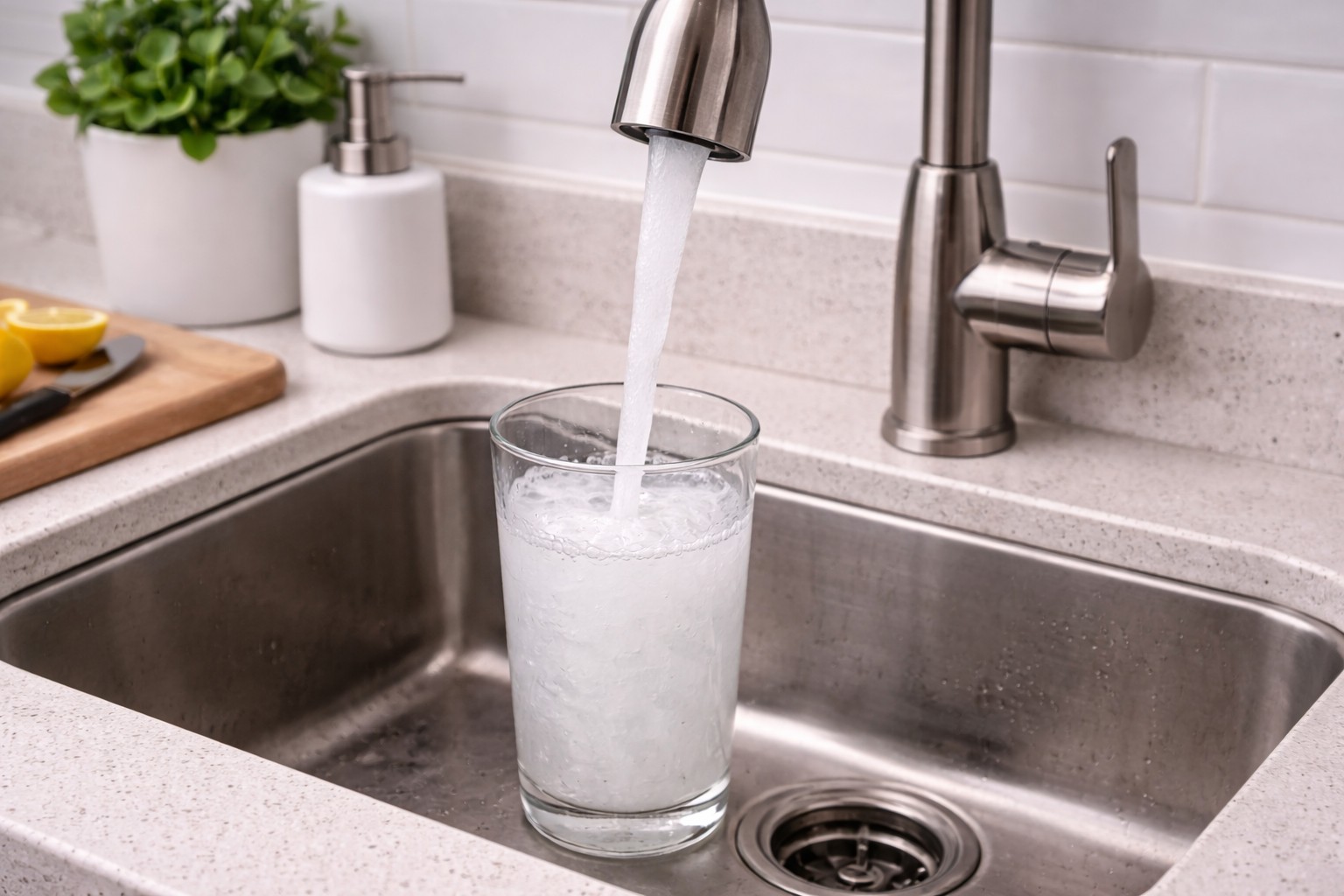
Tiny bubbles can make water look milky and then disappear as the gas leaves the water. USGS describes that common effect. It is different from forceful alternating bursts at a faucet, and a glass becoming clear is not a test for every possible water-quality problem.
Before collecting or flushing a sample
Check the supplier’s notice after an outage or work. For a new unexplained change, do not taste the water; use a known-safe consumption source while obtaining source/health advice. Ask about collection requirements before a long flush or aerator cleaning, because a requested laboratory sample may need specific first-draw conditions.
What can a glass observation tell you?
If collecting a cold sample is consistent with the actual supplier advice and safe access, use a clean suitable container without touching or tasting the water. Bubbles that dissipate support a gas-bubble explanation for that visible cloudiness. They do not identify the gas, exclude simultaneous dissolved contaminants or certify potability. Do not use a fixed minute count as clearance.
Record the actual appearance and event
- Fine bubbles versus distinct particles or color, and whether the original change followed repair, meter work or an outage.
- Cold, hot or both sides and the outlets affected during ordinary use. Do not obtain hottest-water samples to strengthen the comparison.
- Whether cloudiness disappears while the sample stands or persists, and whether the outlet also spits forceful bursts. Give the observation without inventing a contaminant.
- The supplier’s actual restrictions and any recent treatment or filter change.
Flushing and equipment are separate decisions
Where flushing is directed, use the actual selected outlet and sequence, an accepting drain and safe temperature/splash controls. Do not work from lowest to highest by default, run an ice maker or dishwasher to clear unknown water, refill an unidentified heater or replace every filter because a glass looks cloudy. Each device has its own condition and startup requirements.
When to seek help
Contact the water supplier for unexplained or recurring cloudiness, particles, color or odor, particularly after supply work. A private well needs its appropriate health or well-water assessment. For a leak, severe banging or abnormal supply behavior, obtain plumbing or source help promptly. A bubble explanation for appearance does not prove that all mechanical effects are harmless.
Related guides
- Air pockets after replacing shutoff valves
- Air trapped after city water outage
- Air trapped after meter replacement
- Air blasts from faucet after water restored
- Air sputters after main shutoff used
- What to Do If Water Smells or Looks Dirty After a Shutoff
- Air in Pipes After Shutoff