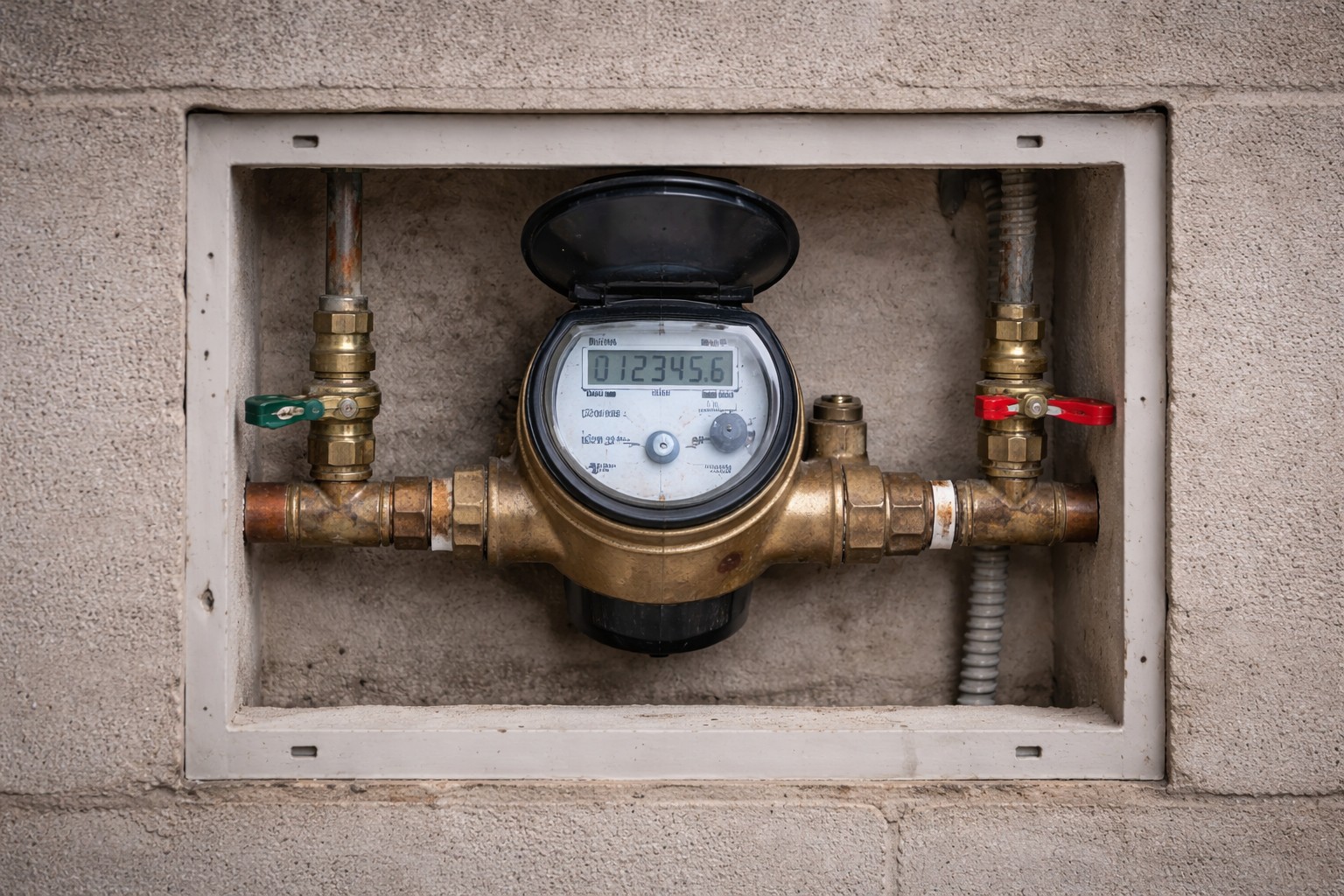
If delivery seems adequate with one fixture but weakens when a second opens, record the actual demand and measurement conditions. Some pressure reduction under added flow is expected; its size and effect must be assessed against the installation. The pattern alone does not prove a PRV, meter or supply pipe has reached its limit.
Check hazards before a demand test
If you smell fuel gas or suspect a gas leak, leave the building or affected area immediately and take others with you. Do not operate switches, plugs, phones, appliances, thermostats or valves in the affected area, light flames, or stay to ventilate or investigate. From a safe location well away, call the local gas emergency service or emergency services. Do not re-enter until responders say it is safe. Plumbing checks and normal maintenance must wait.
Keep away from wet electrical equipment. Do not touch wet appliances, plugs or switches, or enter water to reach a breaker. When no gas leak is suspected, power may be isolated only from a safely accessible dry location; otherwise call an electrician or emergency help. Wet equipment needs qualified assessment before it is used again.
Record the original pattern
- The exact two fixtures and hot/cold settings involved during the original event, their approximate delivery and any temperature change.
- An existing gauge’s location, no-flow versus flowing reading and the actual demands active at the time, including automatic or shared use.
- Recent valve, meter, filter, piping or equipment work, source notices and any leakage or severe noise.
Use a measurement arrangement that fits the question
A gauge that caps an outlet prevents flow through that outlet. It may read pressure at that location while a separate known demand runs, but it is not automatically a measurement of the capped fixture’s own flowing pressure. Measuring pressure while the same outlet flows needs a suitable identified arrangement, such as the actual approved tee/inline setup. Do not improvise one on unknown plumbing.
An existing safe gauge or an owner test connection must have a known place in the system and an instrument suitable for pressure and temperature. Follow its connection and pressure-release instructions, or have a plumber establish the test. Do not create a port, use a backflow test cock or loosen a live fitting.
For an appropriate controlled comparison
- Keep the gauge location and relevant source/valve conditions fixed, and record permitted ordinary demand. Do not disable protective or required shared services to create an assumed all-off condition.
- If the system is stable and the receivers and temperatures are safe, a documented single-demand reading and an explicitly simultaneous two-demand reading describe different operating points. Do not substitute two separate single-fixture tests for the simultaneous condition.
- Stop for leakage, unsafe temperature, severe movement or poor drainage. Stream appearance or a meter-speed increase is not a pressure reading or a component capacity test.
- Give the actual readings, locations, loads and work history to the provider. Branch resistance, source delivery, equipment and control behavior can overlap; measurements guide further assessment rather than uniquely identifying a failed part.
Do not adjust or open equipment from the pattern alone
Retain the actual model’s permitted owner-adjustment boundary, with a verified measured target. Do not turn a PRV by arbitrary increments, open meter equipment or swap fixtures to make the result follow a branch. A storage heater normally receives replacement water during a draw; do not treat an imagined separate refill cycle as proof of the cause.
Before opening a cartridge, bonnet, filter housing, supply joint or other pressure boundary, identify and isolate every feed that can pressurize that segment, control temperature, relieve it through the appropriate controlled outlet and verify depressurization. A remote faucet may relieve a shared circuit after main closure, but may not relieve the tub segment beyond closed local stops. Keep the assembly isolated while open, and fully reassemble before normal restoration. A specifically prescribed controlled service flush needs its own secured capture arrangement and source-off step before extraction or refitting.
Related guides
- Water temperature changes with pressure drop
- Pressure weakens when water heater refills
- Pressure Drops When Multiple Fixtures Run
- Why Your Water Pressure Is Low After Turning the Water Back On
Safety sources
- Con Edison: suspected gas leaks
- CDC: electrical hazards near water
- Watts 25AUB example: regulator service, pressure measurement and limitations
- EPA: cross-connections and maintaining appropriate protection
- BrassCraft: water supply stop instructions
- Example electric-heater manual: filling and maintenance requirements