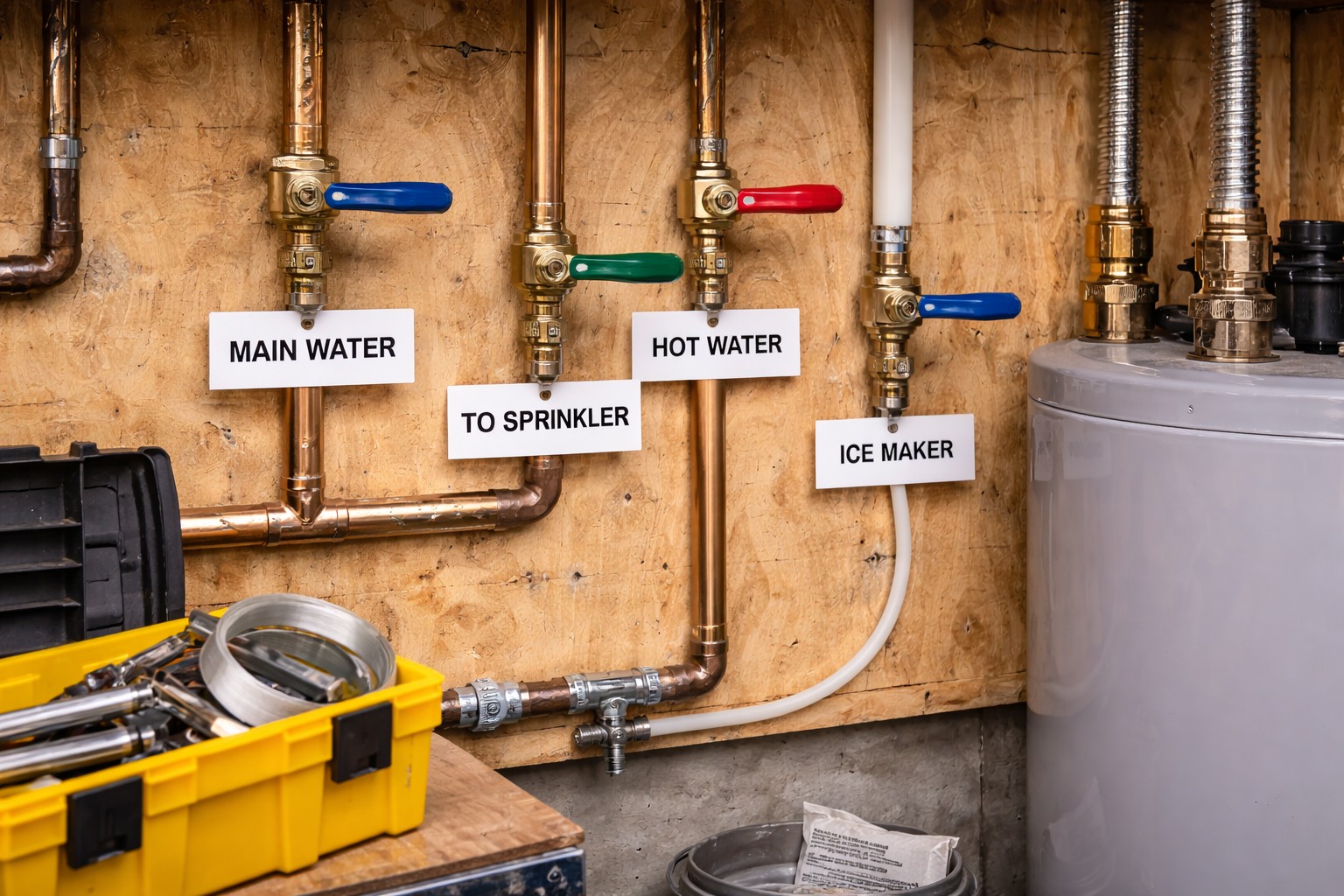
A post-outage flush plan must come from the actual event, supply layout and equipment requirements. There is no universal cold-then-hot, toilets-last sequence that clears every path safely.
Use and safety first
If fuel gas is suspected, leave the building or affected area immediately. Do not operate valves, switches, plugs, appliances or phones there. Call the gas emergency service from a safe location well away, and wait for responders’ clearance.
If a carbon monoxide alarm sounds or you suspect carbon monoxide exposure, get everyone outside immediately and call emergency services from safety. Carbon monoxide has no smell; an odor comparison cannot rule it out. Do not restart or repeatedly cycle a fuel-burning heater to investigate a possible combustion problem.
Keep away from wet electrical equipment. Do not touch wet appliances, plugs or switches, or enter water to reach a breaker. When no gas leak is suspected, power may be isolated only from a safely accessible dry location; otherwise call an electrician or emergency help. Wet equipment needs qualified assessment before it is used again.
For leakage or immediate danger, use only a separate known safely accessible permitted owner control without force or obtain prompt supplier/plumber help. Keep out of potentially energized water and do not touch wet appliances or enter water to reach a valve or breaker. Do not operate unknown shared, fire, meter or curb controls.
For a new unexplained water-quality change, use bottled water or another known-safe consumption source and contact the supplier; a private well needs the appropriate well/health response. Do not taste it or boil suspected chemical contamination as a general remedy. Actual notices and hazard-specific permitted uses govern. Clear appearance, clean screens or a specified number of minutes do not certify water safe.
Keep the original observation
- Actual supplier notice/collection and flush directions for this event.
- Inline versus branch treatment, controls and the actual discharge route.
- Heater/appliance models, whether drained and completed commissioning status.
What it can and cannot identify
Closing the inlet of an inline main treatment unit may stop all intended flushing flow. A steady clear tap or short appliance cycle does not prove an isolated branch clean, a treatment unit ready or a heater correctly filled.
What to do next
- Check sampling-before-flushing and actual permitted uses. Do not replace a do-not-use restriction with a household purge.
- Map which controls are intended to remain isolated and which complete secured path the provider’s procedure uses; do not simply close every appliance/filter inlet.
- Do not open all hot taps, flush toilets repeatedly or run an appliance to clear its inlet as the default.
- Keep required treatment and backflow protection effective; any intended service bypass needs actual application and permitted-use instructions.
- Restore equipment by actual refill/purge, pressure, temperature and protection requirements. Return to normal use only under the applicable actual conditions.
Relevant controlled path
Check actual supplier/repairer instructions before flushing or sampling. Identify the relevant flow path, actual control positions and accepting attended discharge; do not use a floor order or several open taps as a guarantee of where every particle goes. Preserve required treatment and protection. A nearby open faucet may not flush an isolated appliance hose or dead leg.
Actual service and discharge conditions
For retained supply connections, filter housings, regulator covers or valve parts, establish every-feed isolation, controlled pressure release and verification under the actual model. A main cannot isolate its own inlet and a mixer can have both hot and cold feeds. Unless the actual maker specifies a controlled captured service arrangement, keep the source isolated until compatible parts are fully secured; never substitute an exposed pipe, removed assembly or loose hose aimed at a bucket.
Use the actual heater model for safe energy isolation, cooling, water/alternate-feed isolation and secured hose/discharge conditions. Do not prescribe a universal gas-pilot position, drain a hot tank into a hand-held bucket or infer cooling from a few gallons. A prescribed controlled drain-open flush is different from opening a pressure-retaining part. Close/refit as directed, verify full refill and required air purge before electric storage-tank energy, and complete actual leak/function checks.
Can every appliance be restarted after a short test cycle and clear water?
No. Its actual inlet/path, service and commissioning plus the event’s permitted uses must be established separately.
Related guides
- Sediment buildup after curb stop work
- Preventing sediment damage after shutoff
- Air in all lines after outage
- Sediment clogging fixtures post repair
- Sediment & Debris at Water Entry
Safety sources
- CDC: electrical hazards near water
- CDC: drinking-water advisories
- CDC: selecting and maintaining a water filter
- Con Edison: suspected gas leaks
- CDC: carbon monoxide alarms and wet electrical devices
- Example electric-heater manual: filling and maintenance requirements
- A. O. Smith: water-heater maintenance and refill before restart
- EPA: cross-connections and maintaining appropriate protection