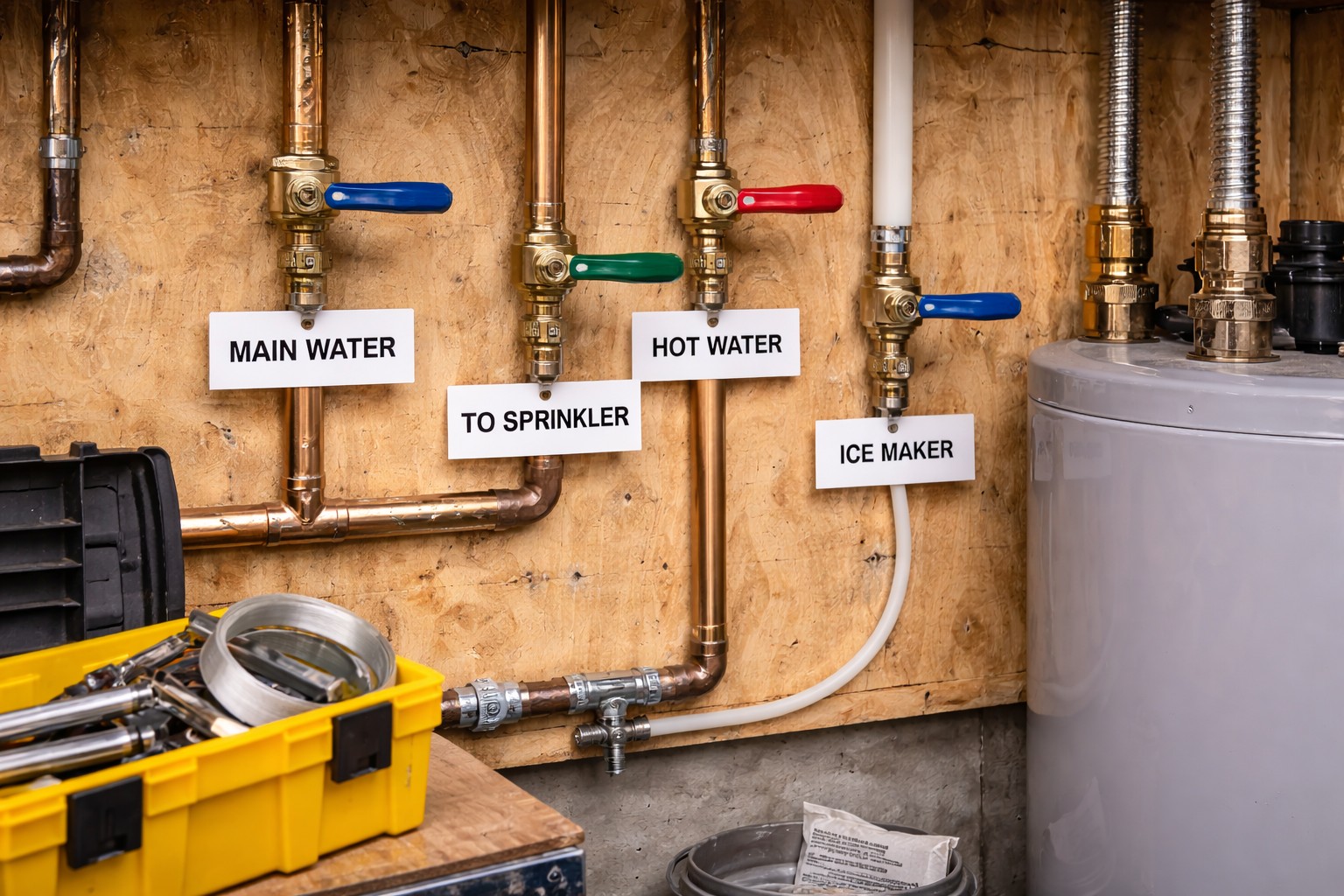
A suspected expansion-tank installation fault needs the actual tank-to-heater pressure zone, approved application and support checked. A tank can be correctly downstream of a service one-way device while still connected to the heater.
Hazards before another heating test
If fuel gas is suspected, leave the building or affected area immediately. Do not operate valves, switches, plugs, appliances or phones there. Call the gas emergency service from a safe location well away, and wait for responders’ clearance.
If a carbon monoxide alarm sounds or you suspect carbon monoxide exposure, get everyone outside immediately and call emergency services from safety. Carbon monoxide has no smell; an odor comparison cannot rule it out. Do not restart or repeatedly cycle a fuel-burning heater to investigate a possible combustion problem.
Keep away from wet electrical equipment. Do not touch wet appliances, plugs or switches, or enter water to reach a breaker. When no gas leak is suspected, power may be isolated only from a safely accessible dry location; otherwise call an electrician or emergency help. Wet equipment needs qualified assessment before it is used again.
Keep away from steam, hot spray, relief discharge, a leaking/corroded pressure vessel or unstable supports. Stop affected use and obtain prompt qualified service for these conditions, unsafe temperature or abnormal pressure. Follow the actual heater emergency shutdown only from safe access; suspected fuel gas takes the departure response above before controls. Never cap, plug, isolate or disable a relief function. Do not force another heating cycle, long shower or valve closure to reproduce a known hazardous event.
Keep the actual observation
- Actual product/installation drawing and safe visible connection relative to the heater and relevant barrier.
- Support, orientation, corrosion/leakage and recent work without lifting or turning a loaded vessel.
- Existing pressure/temperature record and intended normal valve state from the installer.
The tank must see the heated zone
Trace the actual heated pressure zone and a usable connection from it to approved expansion control. A backflow device on an irrigation branch does not automatically close the whole home, and an open smart valve is not automatically a one-way barrier. In Amtrol’s named potable example, the tank connects on the heater cold supply between the heater and the relevant one-way device. Do not move it to the other side of that barrier, open unidentified nearby valves or bypass required checks to make pressure fall. Other applications use their own approved arrangement.
Do not move a tank to a vague “supply side” across the very check that isolates the heater. Do not open nearby unknown valves as an experiment. Correct support and independently unloaded precharge principles remain necessary; alternative mounting and floor-standing models have their own weight/support requirements. A different house-side reading alone does not establish the actual tank connection.
A cold static check does not remeasure precharge
After restoration, a water-side gauge gives system pressure, not the isolated empty tank’s air-precharge value. Actual verified installation and safe commissioning need more than disappearance of a peak. Do not adopt a universal default mounting orientation when the actual manual specifies another arrangement.
Identify the actual application
Identify potable domestic water versus a closed hydronic heating circuit, the actual heater/tank/relief models and their approved application, materials, pressure and temperature limits. A boiler expansion vessel, potable expansion tank and water hammer arrester are not generic substitutes. Connection size, color, shell sound or a familiar pressure number does not establish compatibility. Keep any valid heating-circuit example explicitly separate from drinking-water service.
Relief needs temperature and pressure assessment
A temperature-and-pressure relief valve can operate for excessive temperature as well as pressure. A normal-looking remote pressure peak does not prove the safety valve is weak or safe to replace blindly. Assess actual temperature, pressure, valve/connection condition and ratings together. Do not defer a faulty safety-device assessment until a presumed expansion repair is complete. Keep discharge unobstructed and do not use its lever as an improvised pressure test or control. Prescribed maintenance has its actual manual, safe discharge and qualified-service conditions.
Precharge target is not the measurement state
The intended precharge target and the state required to measure it are different. The target comes from the actual model/design and the appropriate normal cold pressure measured at the relevant point before isolation; it is not a universal household or boiler number. A positive cold-static water reading is not depressurization. The named Amtrol potable-tank example requires an isolated tank empty of water and ambient-temperature adjustment; the Watts example requires zero water-side pressure. A closed valve or one remote open tap does not prove the tank unloaded. Do not adjust/repressurize a corroded, damaged or weakened vessel. Use the actual maker’s qualified installation/inspection/service requirements.
Measurement and service boundaries
Use only a suitable existing instrument or actual approved owner test connection, rated for the pressure/temperature and following its connection/release procedure. Identify its source, regulator, valve and heated-zone position, and whether the connection actually admits the intended water pressure. A gauge on a closed hose bib is not yet reading the live supply. Record time and active flow/heating conditions. A maximum-only pointer stores its registered peak, not when, how slowly or why it occurred; an ordinary dial may miss fast transients. No backflow test cock, drain cleanout, improvised hot connection or live fitting is a generic test point.
Before retained parts or a tank connection are opened, establish the actual heater/pump safe energy state, cooling, every independent supply isolation, controlled release and verified absence of pressure at that segment. A tank may be heavy; support and safe handling need the actual product method. Do not drain or service a heater by a generic gas/pilot/electrical recipe. Fully secure compatible parts, restore required protection and complete the model’s refill/air-release and commissioning conditions before energy returns. A quiet tap or one reduced peak does not certify the whole repair.
Related situations
- Pressure rises when water heater runs
- Thermal expansion causing relief valve drip
- Thermal Expansion Pressure Behavior
- Expansion tank undersized problems
- Pressure rises when water heater runs
- Thermal Expansion Pressure Behavior
Safety sources
- Con Edison: suspected gas leaks
- CDC: carbon monoxide alarms and wet electrical devices
- CDC: electrical hazards near water
- Amtrol ST/T potable-tank instructions: application, condition, unloaded precharge and placement
- Watts PLT-35 example: qualified service and zero-water-pressure precharge state
- Watts IWTG example: retained maximum is not a time trace
- Example electric-heater manual: filling and maintenance requirements
- A. O. Smith Bulletin 52: temperature and pressure relief are distinct functions
- EPA: cross-connections and maintaining appropriate protection