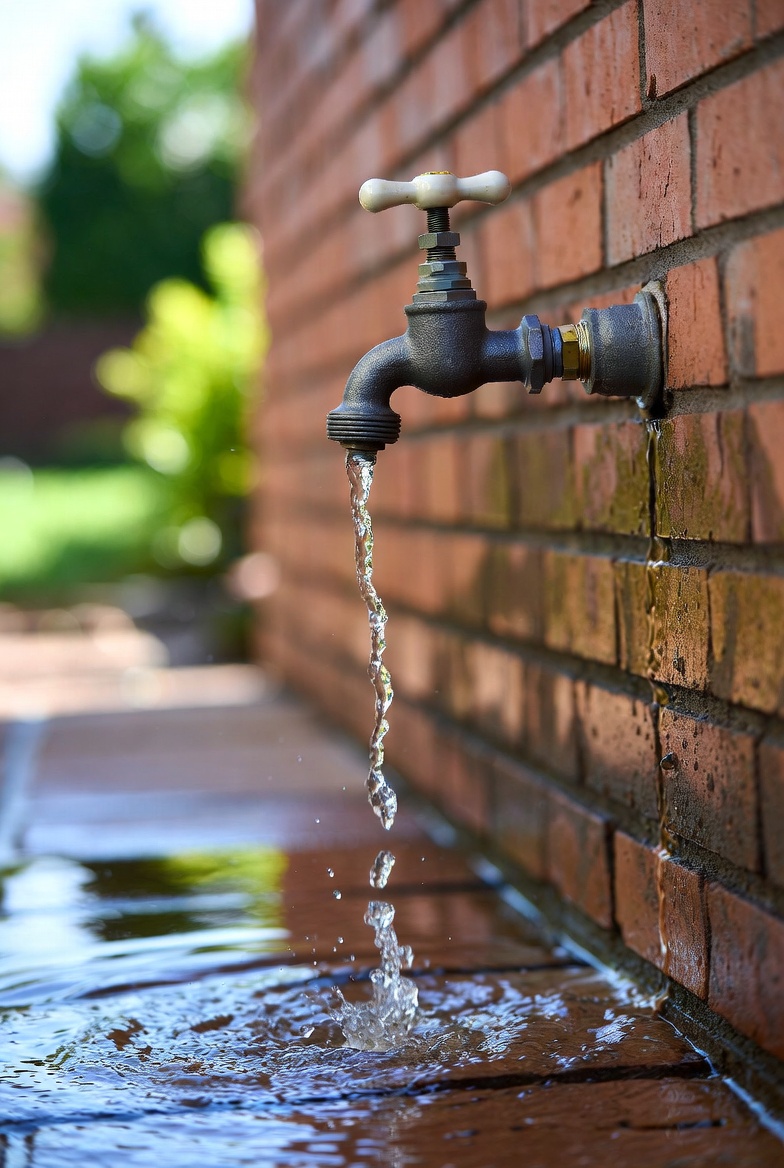
An outdoor leak noticed during upstairs faucet use identifies an event to report. It does not confirm an upstairs tee, prove a shared connector is defective or justify adding a generic balancing device.
Keep away from wet electrical equipment. Do not touch wet appliances, plugs or switches, or enter water to reach a breaker. When no gas leak is suspected, power may be isolated only from a safely accessible dry location; otherwise call an electrician or emergency help. Wet equipment needs qualified assessment before it is used again.
Contain the existing leak
For an active leak, stop use and use a known effective safely accessible homeowner supply control. Keep suspected damage isolated; do not reopen it to collect proof. Obtain urgent help for uncontrolled flow, water entering the building or unsafe access. Do not force a valve or operate utility equipment from its location alone.
Keep timing distinct from the source
- Which upstairs fixture and hot/cold setting were originally in use, and where the outdoor water escaped.
- Known other demand, pump/heating activity, work history and suitable existing measurements.
- The actual piping route where safely visible; the floors’ relationship alone does not establish a dedicated upstairs branch.
Understand what isolation changes
Closing the whole-house main removes supply and many possible triggers. A leak stopping then cannot localize it to an upstairs connection. Even a local valve response changes demand and pressure as well as one path. Do not repeatedly run the upstairs faucet to reproduce leakage or operate unknown controls to map the plumbing.
Trace the actual wet source
A qualified assessment can identify a connected route, leak point and pressure state independently. Do not tighten a guessed tee, saddle or compression fitting or install a PRV from the trigger alone. Safe existing access is different from entering an unsafe attic/crawlspace or opening finished walls.
Locate the actual joint and its sealing method before service. A hose washer-face joint, O-ring union, compression fitting and tapered pipe thread use different instructions. Use the correct approved seal, support and maker torque; no universal quarter-turn or blanket tape application applies. Stop for corrosion, binding, cracked material or an uncertain concealed connection. External maker-permitted packing adjustment is different from loosening a pressure retainer.
Before removing a bonnet, packing, operating rod, cartridge or pressure-retaining breaker part, identify the exact model and its approved service procedure. Close a known effective homeowner supply control for every feed, control other connected inputs, and relieve and verify pressure at the actual serviced segment. A different indoor tap may not relieve an isolated outdoor branch. Stop if flow continues, the control is uncertain or parts bind. Use compatible approved parts and fully secure all pressure-retaining and protective components before an attended restoration. Re-isolate and verify relief before further disassembly. Cosmetic handle trim and maker-permitted external packing adjustment are different operations; neither authorizes loosening an unknown retainer under pressure.
A later functional check
A justified check after correction needs every pressure-containing and protective part fully secured, sound known containment, safe water-use conditions and an accepting discharge path. Follow the actual controlled restoration procedure and attend accessible connections. Stop and re-isolate for renewed leakage, binding or other unsafe change; verify relief before further internal work. A short successful run does not certify a concealed cavity or future duty.
Give the plumber the original upstairs-use condition and what is unknown. Optional notes are helpful; completing isolation trials is not a prerequisite to obtaining help.
Related situations
Browse the existing Outdoor Spigot Leaks Under Load group. These are distinct triggers and water paths, not proof of the same failed part.