Weak upstairs delivery needs the actual floor, fixture, elevation and distribution scope recorded. A normal ground-floor static gauge reading cannot by itself prove a restricted upstairs branch or clear the shared supply under demand.
If fuel gas is suspected, leave the building or affected area immediately. Do not operate valves, switches, plugs, appliances or phones there. Call the gas emergency service from a safe location well away, and wait for responders’ clearance.
Keep away from wet electrical equipment. Do not touch wet appliances, plugs or switches, or enter water to reach a breaker. When no gas leak is suspected, power may be isolated only from a safely accessible dry location; otherwise call an electrician or emergency help. Wet equipment needs qualified assessment before it is used again.
Record the original situation
- Which upstairs fixtures and hot/cold sides were originally affected, versus ordinary downstairs use.
- Known branch/pump/control layout and actual work, without operating an unknown zone valve.
- Existing gauge locations and demand conditions, leakage and unusual temperature.
What the observation establishes
Elevation and distribution can matter without identifying a failed part. A gauge at one elevation and branch is not a measurement everywhere else. Improvement after a change does not uniquely prove a local restriction, and a low hose reading does not alone assign a service-entry defect.
What to do next
- Use the original floor comparison rather than open multiple fixtures, flush upper branches or stage a hot shower test.
- Do not operate unidentified zone valves or adjust a pump/regulator to compensate. Have the real arrangement identified first.
- For a separately safe isolated fixture, only intended owner-removable outlet parts belong in actual maker care with water off and parts cool. Do not remove every showerhead or cartridge as a pressure test.
- Report several affected upstairs outlets, unstable temperature, recurrence or leaks for suitable distribution and supply assessment. Do not automatically drain the heater because upstairs hot use is weak.
Measurements have a location and state
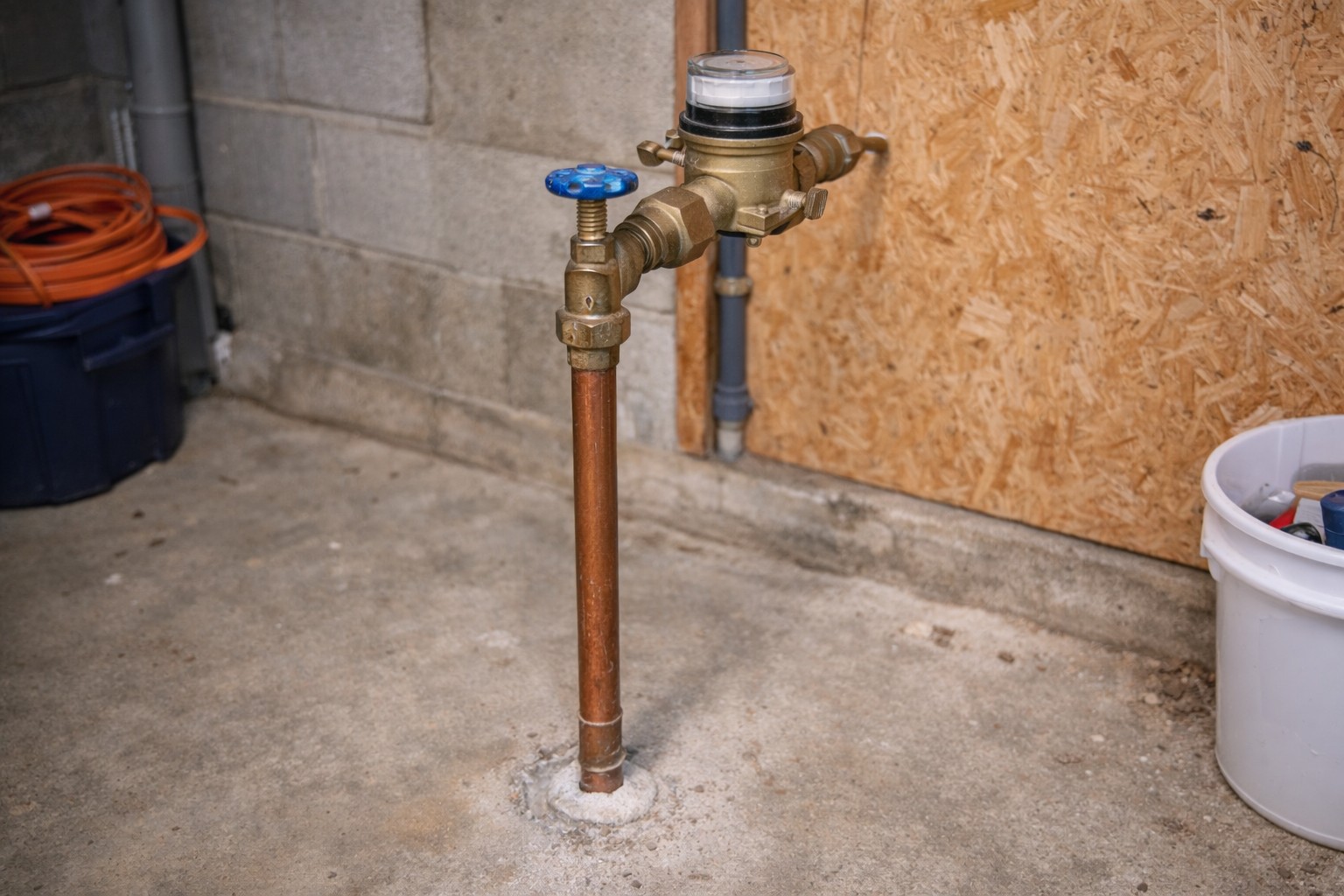
For an optional cold-water measurement, use only an intact, safely accessible owner test connection whose location in the system is known, with a compatible gauge rated for the actual pressure and temperature. Follow its connection and pressure-release instructions; never loosen a pressurized fitting or use a backflow test cock as a household gauge port. Do not create a new connection to perform this check. A plumber can install or verify the measurement instead.
Record the gauge location, time, units and whether water was already flowing elsewhere. Static pressure describes a no-flow condition; a running reading describes that specific demand. A hose outlet closest to the street is not necessarily upstream of the regulator or representative of the meter. Compare with the actual equipment limits and local supply requirements rather than a universal household target.
Before changing a component
Check only an identified owner-operated shutoff whose normal position and operating method are known, without force or repeated cycling. Do not manipulate curb stops, meter valves, utility fittings, backflow test cocks or an unknown valve. Contact the supplier for its equipment and the installer or plumber for household equipment.
Do not bypass a pressure regulator, backflow preventer or other protective control to see whether the symptom disappears. A different result after changing the supply arrangement does not prove the removed device was faulty. Approved protected arrangements and qualified device-specific tests are different from an improvised bypass.
Before any internal service or fitting removal, identify and isolate every supply that can pressurize the section, release trapped pressure through the appropriate controlled outlet and verify depressurization. Account for hot water and possible alternate feeds. Lowering a PRV setting, reducing flow or wearing gloves does not make a pressurized assembly safe to open. If isolation cannot be established, leave it assembled and obtain qualified help.
Keep every relevant supply isolated while a connection, filter cover, strainer plug or regulator bonnet is open. Do not restore water into an exposed part aimed at a bucket. Actual required construction or service flushing needs a securely connected compatible path, accepting receiver and prescribed procedure. Fully reassemble before restoring pressure, then verify leakage and actual required function. The serviced valve cannot isolate its own inlet; a downstream quiet faucet alone does not verify every retained cavity.
Do not make whole-house flushing, hot-water purging or filter bypass the default repair. Follow the actual supplier restoration directions and the actual product service instructions if debris is suspected. Keep drains able to accept the discharge; stop for leakage, backup or severe noise. Do not open several outlets to force a problem clear.
If a new unexplained color, odor or other water-quality change accompanies the event, do not taste it or boil unknown water as a general remedy. Use a known-safe consumption source and contact the supplier for the actual restrictions and restoration directions. Clear flow does not lift an advisory.
Does a good downstairs reading prove the problem is upstairs piping?
No. Location, elevation and actual demand differ. Give the provider the original scope and known reading conditions without assigning a branch repair from one number.
Contact the supplier for actual service concerns and an appropriate household plumber, installer or well provider for connected equipment. Report leaks, severe loss, unstable temperature or protective alerts promptly. A complete log, another failed flush or a neighbor agreeing is not required before asking for help.
Related guides
- Low pressure only downstairs
- Pressure drops when washing machine fills
- Whole-House Low Water Pressure
Safety sources
- Con Edison: suspected gas leaks
- CDC: electrical hazards near water
- Watts 25AUB example: regulator service, pressure measurement and limitations
- EPA: cross-connections and maintaining appropriate protection
- BrassCraft: water supply stop instructions
- CDC: drinking-water advisories
- Denver Water example: service restoration and cold-outlet guidance