Check for an emergency first
Keep away from wet electrical equipment. Do not touch wet appliances, plugs or switches, or enter water to reach a breaker. When no gas leak is suspected, power may be isolated only from a safely accessible dry location; otherwise call an electrician or emergency help. Wet equipment needs qualified assessment before it is used again.
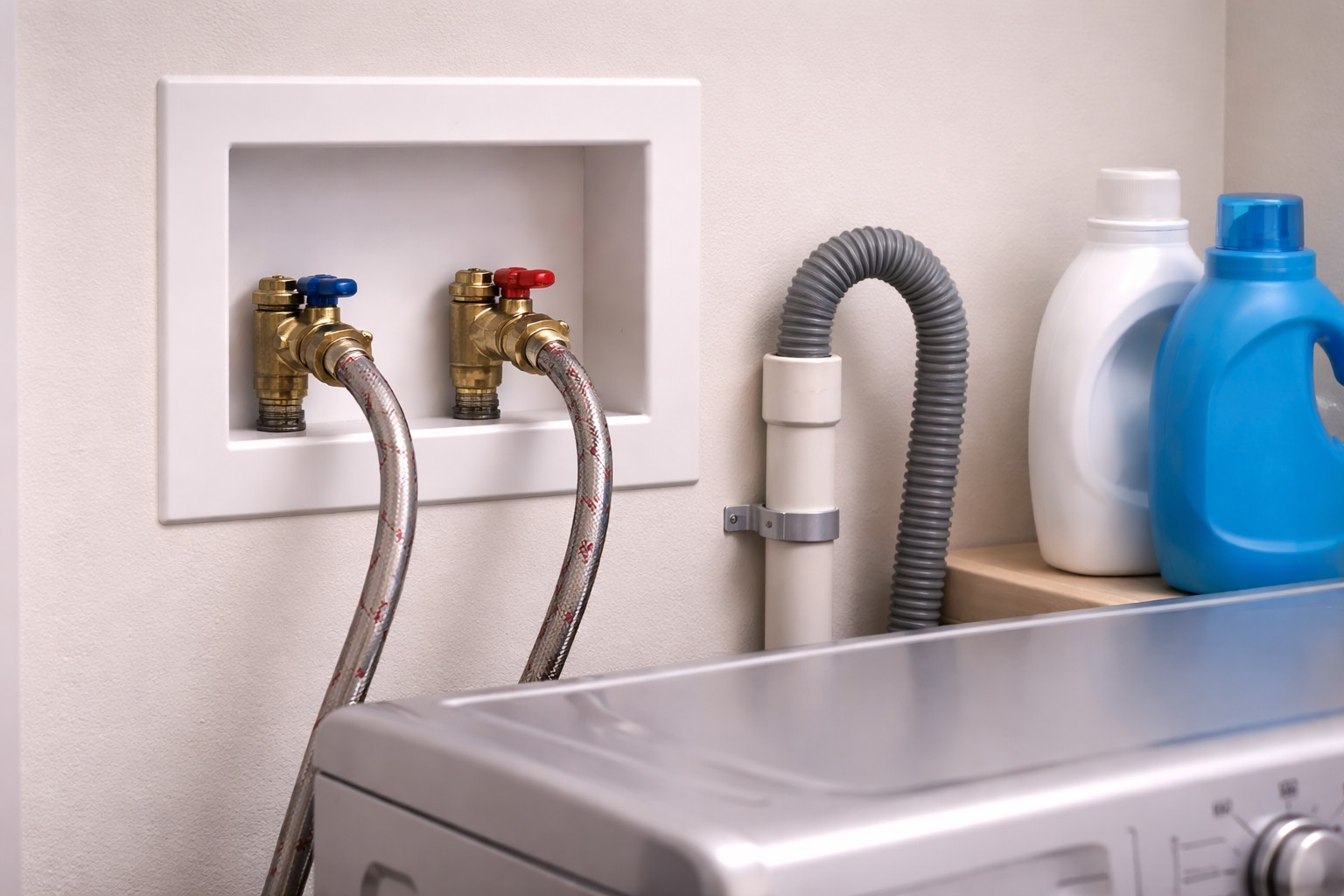
Pressure loss noticed while a washer fills is a demand-related observation, not proof of a failing PRV or an overwhelmed service line. Keep the washer connected and avoid an open-hose bucket test. Record what happened during ordinary use and distinguish slow washer fill from weaker flow at other fixtures.
Useful details to record
- Which fill phase was occurring, model/error information and whether hot/cold scope is already known.
- Other water use at the time and whether nearby fixtures were also affected.
- Hose or stop work, recent supply changes, leakage and existing readings.
What the pattern can tell you
- Only the washer fills slowly. Its actual installation, inlet requirements and parts may be relevant; that differs from whole-house pressure loss.
- Other fixtures weaken during fill. A shared supply/demand assessment may be appropriate without identifying the failed component.
- A hose moves, leaks or bulges. Stop washer use and arrange safe assessment; do not run another cycle for comparison.
What to do next
- Keep the washer inactive for leakage, severe supply changes or temperature instability at other fixtures. Do not force valves or repeatedly start fills to reproduce the fault.
- For an optional cold-water measurement, use only an intact, safely accessible owner test connection whose location in the system is known, with a compatible gauge rated for the actual pressure and temperature. Follow its connection and pressure-release instructions; never loosen a pressurized fitting or use a backflow test cock as a household gauge port. Do not create a new connection to perform this check. A plumber can install or verify the measurement instead.
- Record the gauge location, time, units and whether water was already flowing elsewhere. Static pressure describes a no-flow condition; a running reading describes that specific demand. A hose outlet closest to the street is not necessarily upstream of the regulator or representative of the meter. Compare with the actual equipment limits and local supply requirements rather than a universal household target.
- Do not bypass a pressure regulator, backflow preventer or other protective control to see whether the symptom disappears. A different result after changing the supply arrangement does not prove the removed device was faulty. Approved protected arrangements and qualified device-specific tests are different from an improvised bypass.
- Have the actual washer installation, compatible hoses, supply stops and inlet requirements checked. Any hose disconnection needs correct water isolation, controlled pressure release, dry-safe electrical isolation and the actual service procedure. Do not open an exposed hot or cold supply into a bucket as this generic diagnosis.
- Before any internal service or fitting removal, identify and isolate every supply that can pressurize the section, release trapped pressure through the appropriate controlled outlet and verify depressurization. Account for hot water and possible alternate feeds. Lowering a PRV setting, reducing flow or wearing gloves does not make a pressurized assembly safe to open. If isolation cannot be established, leave it assembled and obtain qualified help.
- Use a plumber for common-supply or control concerns and appliance service for an actual washer fault. Do not prescribe a universal 10–15 psi drop as proof, bypass treatment or protection, or flush hot/cold branches through disconnected lines.
Does a large pressure drop while filling identify which part needs replacement?
No. Demand, gauge location, starting supply and component behavior all matter. Suitable measurements at known points can help a qualified provider distinguish the actual restriction or supply limit. Replacing the washer inlet, PRV or service pipe from one drop alone is speculative.