Quick Answer:
If pressure drops right after you turn the water back on, check the supply pressure at an outdoor hose bib with a gauge, isolate the main components to find where flow is reduced, and run a controlled flush of the lines. Often the cause is air or debris in the service line, a partially closed valve, or a clogged service entry—not a fixture problem.
Why This Happens
- When water is shut off for any length of time, air and loose sediment can enter the pipes. When the water is restored that material can temporarily block screens, valves or regulators.
- A partially closed main shutoff, a stuck pressure-reducing valve (PRV), or an issue at the water meter or service entry can keep pressure low even though plumbing inside the house looks fine.
- If the problem only affects hot water it is often isolated to the water heater or hot side piping. If the whole house pressure jumps up and down, consider the system-wide controls. See Whole house pressure fluctuates randomly and House pressure low only on hot water for related scenarios.
Step-by-Step What to Do
Step 1 — Measure pressure at the hose bib
- Attach a simple water pressure gauge to an outdoor hose bib (spigot) that is supplied directly from the main. Note the reading in PSI.
- Normal residential pressure is commonly between 40–60 psi. A much lower reading at the hose bib indicates a supply or service issue rather than individual fixtures.
Step 2 — Verify main valves and service entry
- Confirm the main shutoff and any curb stop are fully open. Partially closed valves are a common cause after work or shutoffs.
- If your house has a pressure-reducing valve (PRV) near the service entry, check that it is not stuck or set too low.
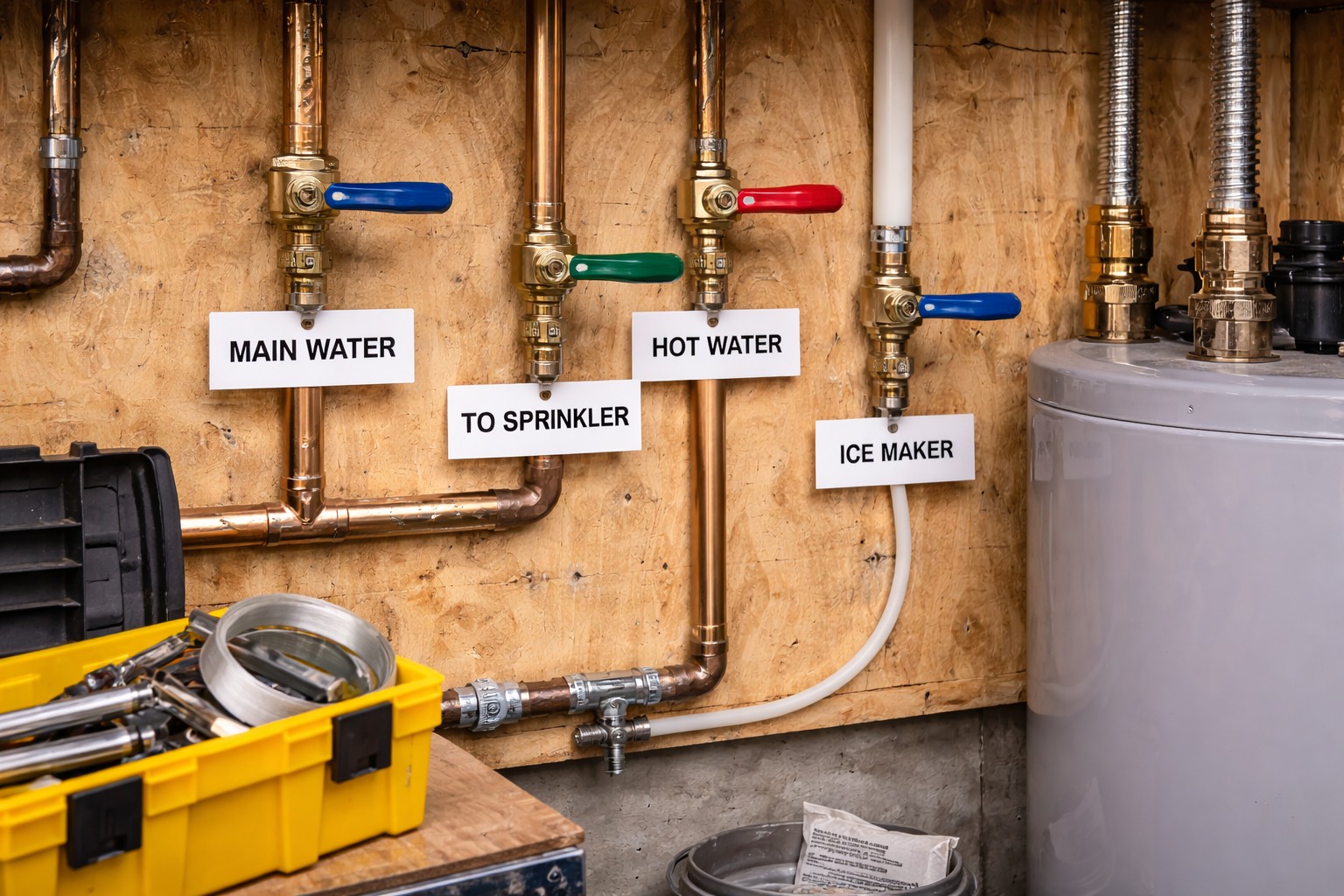
Step 3 — Isolate main components
- Shut off the water to major branches one at a time (for example, hot water heater isolation and each supply branch) and re-check pressure at the hose bib. This narrows whether the restriction is in one branch, the water heater, or the main service.
- If pressure is normal when specific branches are closed, the restriction is likely in the open branch you just tested.
Step 4 — Flush the system appropriately
- After confirming the main is open, open an outdoor hose bib and several indoor fixtures (start with lowest floor fixtures) to flush air and sediment. Run cold water first.
- Flush for several minutes until flow and pressure normalize. If you have a filter or sediment trap at the service entry, check and clean it before concluding the flush.
Step 5 — Check fixtures and aerators last
- Once supply pressure at the hose bib is good, check individual fixtures: remove and inspect aerators and showerheads for debris that can trap when the system is restarted.
- Only after confirming normal supply pressure should you consider replacing or repairing fixtures.
What Not to Do
- Do not immediately replace fixtures without verifying service entry issues.
- Do not force a stuck valve with excessive tools; you can cause damage that creates larger leaks.
- Do not ignore persistent low pressure at the hose bib—treat it as a supply problem rather than a local fixture issue.
When to Call a Professional
- Pressure remains low at the hose bib after flushing and valve checks.
- You find evidence of a leak or a major drop in pressure when the meter is running.
- The PRV or meter-side equipment is suspected to be faulty, or you need the utility’s curb stop accessed and you don’t have the tools or permission to operate it.
Safety Notes
- Turn off power to the water heater before working on hot-water plumbing to avoid scald or electrical hazards.
- Open faucets slowly to avoid water hammer when repressurizing the system.
- If you suspect contamination after a service interruption, disinfect the system per local guidance or consult a pro.
Common Homeowner Questions
- Why is my pressure fine at some taps but low at others? That usually means the restriction is in a branch line or a fixture; isolate branches to find it.
- How long should flushing take after water is restored? Often a few minutes; if pressure doesn’t improve after 10–15 minutes, further investigation is needed.
- Can air in the lines harm my system? Brief air pockets usually only cause sputtering; persistent problems from debris should be cleaned to avoid damage.
For more related articles, see the Whole-House Low Water Pressure hub.