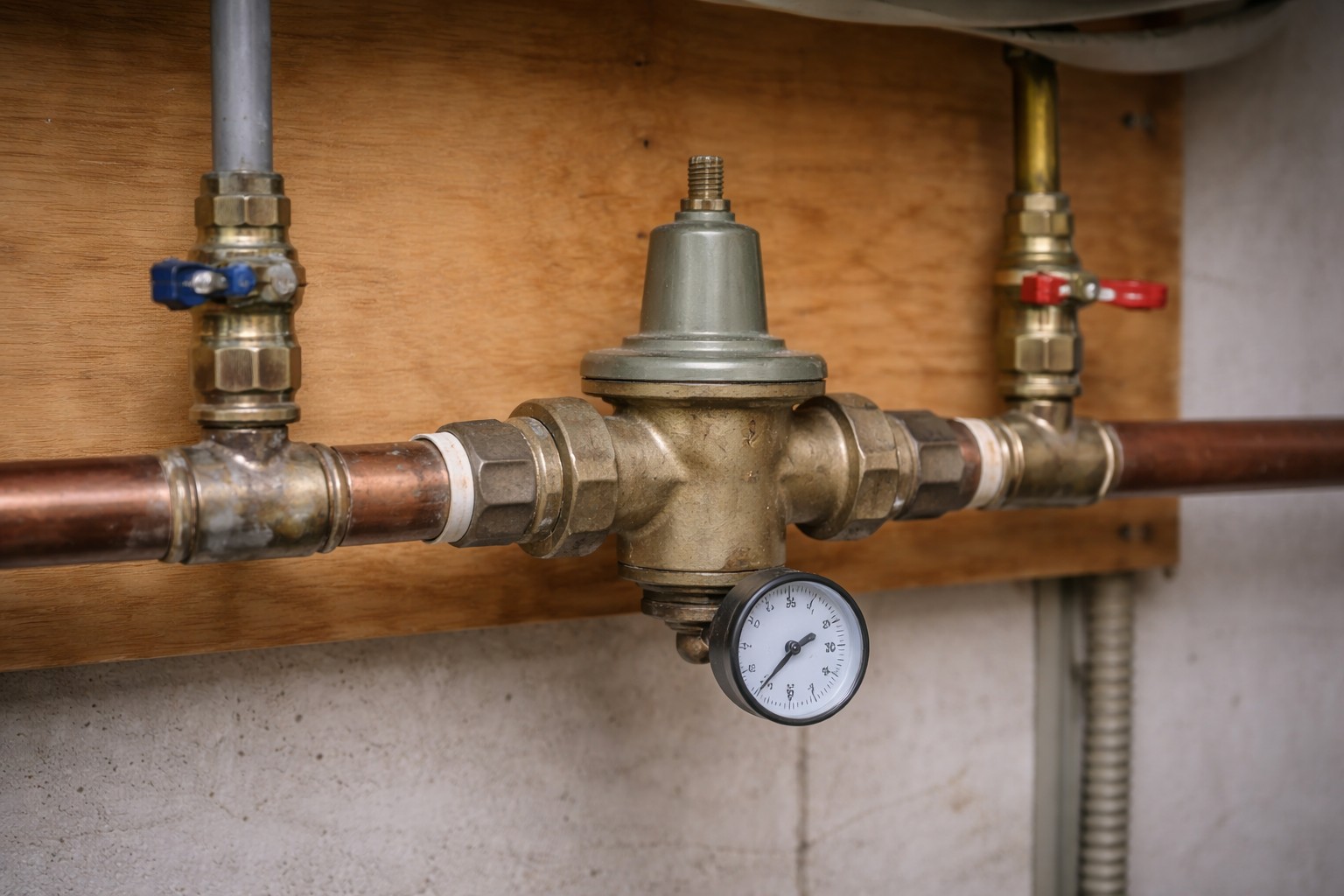
Check for an emergency first
Keep away from wet electrical equipment. Do not touch wet appliances, plugs or switches, or enter water to reach a breaker. When no gas leak is suspected, power may be isolated only from a safely accessible dry location; otherwise call an electrician or emergency help. Wet equipment needs qualified assessment before it is used again.
Random whole-house pressure changes need a short event record and suitable measurements at known points. Do not bypass devices one by one or leave protection out of service for a day. A moving needle at an outside tap does not prove the problem is outside the house.
Useful details to record
- Original event times, duration, ordinary demand and any heating or pump correlation.
- Public supply or well, actual controls and their alerts or service history.
- Gauge range, connection location, readings, leaks and recent work.
What the pattern can tell you
- A gauge changes after the house main is closed. Interpretation depends on which side it measures and the actual arrangement, including trapped or heated water.
- A pump cycles or a heater is active. That history helps a qualified provider distinguish controls and expansion concerns.
- The event appears random. Do not delay reporting severe behavior while waiting for a perfect pattern.
What to do next
- For an optional cold-water measurement, use only an intact, safely accessible owner test connection whose location in the system is known, with a compatible gauge rated for the actual pressure and temperature. Follow its connection and pressure-release instructions; never loosen a pressurized fitting or use a backflow test cock as a household gauge port. Do not create a new connection to perform this check. A plumber can install or verify the measurement instead.
- Record the gauge location, time, units and whether water was already flowing elsewhere. Static pressure describes a no-flow condition; a running reading describes that specific demand. A hose outlet closest to the street is not necessarily upstream of the regulator or representative of the meter. Compare with the actual equipment limits and local supply requirements rather than a universal household target.
- Do not bypass a pressure regulator, backflow preventer or other protective control to see whether the symptom disappears. A different result after changing the supply arrangement does not prove the removed device was faulty. Approved protected arrangements and qualified device-specific tests are different from an improvised bypass.
- Check only an identified owner-operated shutoff whose normal position and operating method are known, without force or repeated cycling. Do not manipulate curb stops, meter valves, utility fittings, backflow test cocks or an unknown valve. Contact the supplier for its equipment and the installer or plumber for household equipment.
- Before any internal service or fitting removal, identify and isolate every supply that can pressurize the section, release trapped pressure through the appropriate controlled outlet and verify depressurization. Account for hot water and possible alternate feeds. Lowering a PRV setting, reducing flow or wearing gloves does not make a pressurized assembly safe to open. If isolation cannot be established, leave it assembled and obtain qualified help.
- Leave pump electrical controls, pressure-tank fittings and backflow test cocks alone. A safely visible indicator or existing log is enough to report; do not enter a pit or create an equipment test.
- Do not make whole-house flushing, hot-water purging or filter bypass the default repair. Follow the actual supplier restoration directions and the actual product service instructions if debris is suspected. Keep drains able to accept the discharge; stop for leakage, backup or severe noise. Do not open several outlets to force a problem clear.
- Contact the supplier about supply concerns and a plumber or qualified well provider for household equipment. Prompt help is appropriate for leaks, severe movement, abnormal discharge or repeated protective alerts.
Does the symptom stopping with a component excluded prove that component failed?
No. Excluding a device changes the system and may remove protection. Suitable tests must preserve the required functions and account for the actual layout and demand. Use the actual evidence before replacing parts.
Related situations
- Low water pressure everywhere suddenly
- Low pressure after main valve replacement
- Whole-House Low Water Pressure