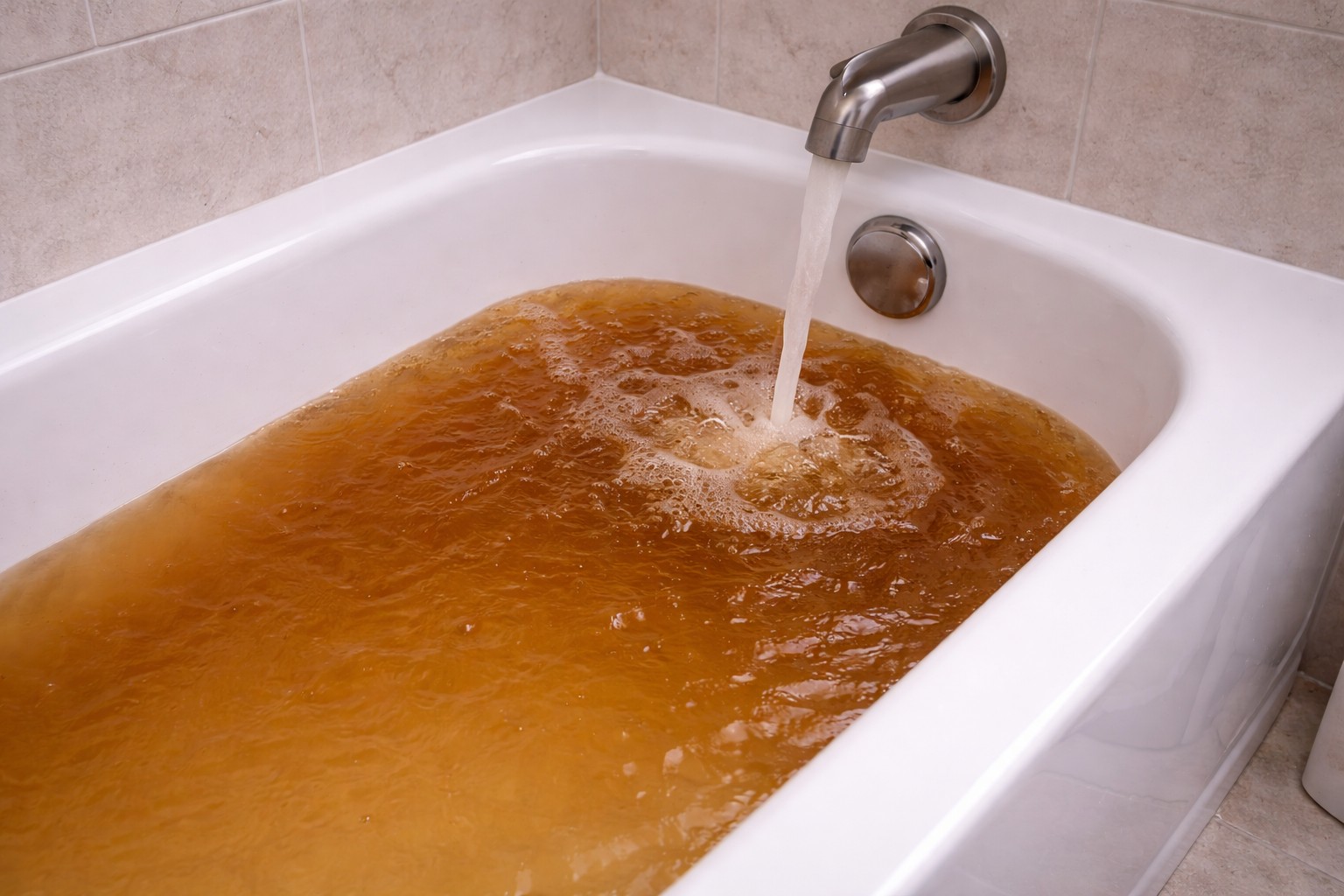
Record where the brown or rusty-looking material appeared: delivered water, a surface stain, toilet contents or an outlet screen. Color and a clearing time do not identify a substance, locate a pipe fault or certify safe use.
Use actual event advice
Keep away from wet electrical equipment. Do not touch wet appliances, plugs or switches, or enter water to reach a breaker. When no gas leak is suspected, power may be isolated only from a safely accessible dry location; otherwise call an electrician or emergency help. Wet equipment needs qualified assessment before it is used again.
For a new, unexplained water-quality change: do not deliberately taste the water. Use bottled water or another known-safe supply for drinking, food preparation, teeth brushing and ice while you contact the supplier. Follow the actual local notice for other uses. Boiling does not make chemically contaminated water safe, and clear appearance or a fading odor does not certify safety.
Some supplier-confirmed sediment events have appropriate routine cold-water restoration directions. That does not make every unexplained brown-water event the same. Follow your actual provider’s notice and report a new concern without a mandatory neighbor comparison, hot sample or prolonged flush.
Separate three questions
Tap water, surface, process, toilet or retained screen material
Actual supplier event, collection question, model and mapped route
Concern-specific advice and completed safe repair/restoration
Sudden or recurring water color
- Brown water from faucets suddenly — New event: report actual observations without clear-color source proof.
- Water clears then turns brown again — Clears then returns: no ten-minute branch-localization test.
- Water turns brown overnight — Overnight: tap nonuse differs from a stored glass.
- Brown water during seasonal changes — Seasonal recurrence: actual supplier event, not calendar-based clearance.
After supply or pipe work
- Rust-colored water after city work — City work: actual notice and restoration advice, no five-minute source verdict.
- Discoloration after pressure surge — Pressure event: distinguish actual pressure evidence from a bang/stream change.
- Discolored water after main shutoff — Main shutoff: no automatic multiple-tap/toilet purge or nonmicrobial reassurance.
- Brown water after plumbing repair — Fixture repair: completed compatible commissioning, no exposed supply bucket test.
- Brown water after replacing pipes — Replacement pipes: retained safe assembly and appropriate source/sampling checks.
After absence, heater work or freezing
- Water turns brown after long vacation — Vacation: actual filled/drained/winterized reopening records.
- Brown water only when hot water used — Hot-only: no outlet-pipe touch as sediment proof.
- Brown water after water heater drain — Heater drain: actual controlled service/refill, not drain-until-clear or inlet pulsing.
- Brown water after freezing weather — Freezing: integrity and water quality are separate before repressurizing.
Where color was noticed
- Rusty water from bathtub only — Bathtub: surface versus delivered water, actual route rather than nearby-sink assumptions.
- Brown water when washing machine fills — Washer fill: no hose cup or empty test fill; source and wash process differ.
- Brown water from upstairs faucets only — Upstairs: reported floor does not establish a failed riser or safe lower tap.
- Brown streaks in toilet bowl — Toilet streaks: surface/tank context is not a drinking-water sample.
- Rust flakes in sink aerator — Aerator flakes: compatible owner care differs from material/source identification.
Sampling and appropriate restoration
For a new unexplained change, contact the supplier; private-well owners can use local health/well-water advice. Ask a state-certified drinking-water laboratory what substances, outlets and collection conditions fit the history. Get its bottles and handling method before sampling. Ask whether first-draw evidence is needed before flushing or outlet care; a household jar or toilet-tank comparison is not a universal test.
A supplier-identified sediment event can have an appropriate cold-water restoration procedure. Use the directions for your actual event and system rather than another city’s timer or outlet choice. Keep plumbing sound and assembled, the receiving drain able to accept the flow, and attend any instructed flush. Stop for leakage, backup or a new hazard. Color clearing alone does not identify material, certify every contaminant or lift an advisory.
Identify equipment before work
Use safely accessible labels/paperwork to distinguish the actual fixture, heater type, treatment and service responsibility. A toilet bowl, nearby sink, upper floor or outdoor outlet is not automatically representative of the whole supply. Intended owner aerator care is different from opening a retained valve, heater or pressure connection.
Internal heater or pressure-boundary service requires the actual model, energy control, cooling, effective every-feed isolation, pressure release, secured accepting discharge and compatible reassembly. Small volume or gloves do not establish cooling or zero pressure. Verify required full refill and air purge before energizing an electric storage heater, then check leakage and protected intended operation. Do not use an anode, relief device, open joint or bypass as a water-quality test.
Browse Water Contamination, Taste & Odor for the wider topic.
Safety sources
- CDC: electrical hazards near water
- CDC: drinking-water advisories
- EPA: certified drinking-water laboratories
- EPA: home testing and laboratory sample directions
- Portland example: report a discolored-water event and follow its actual directions
- Example electric-heater manual: filling and maintenance requirements