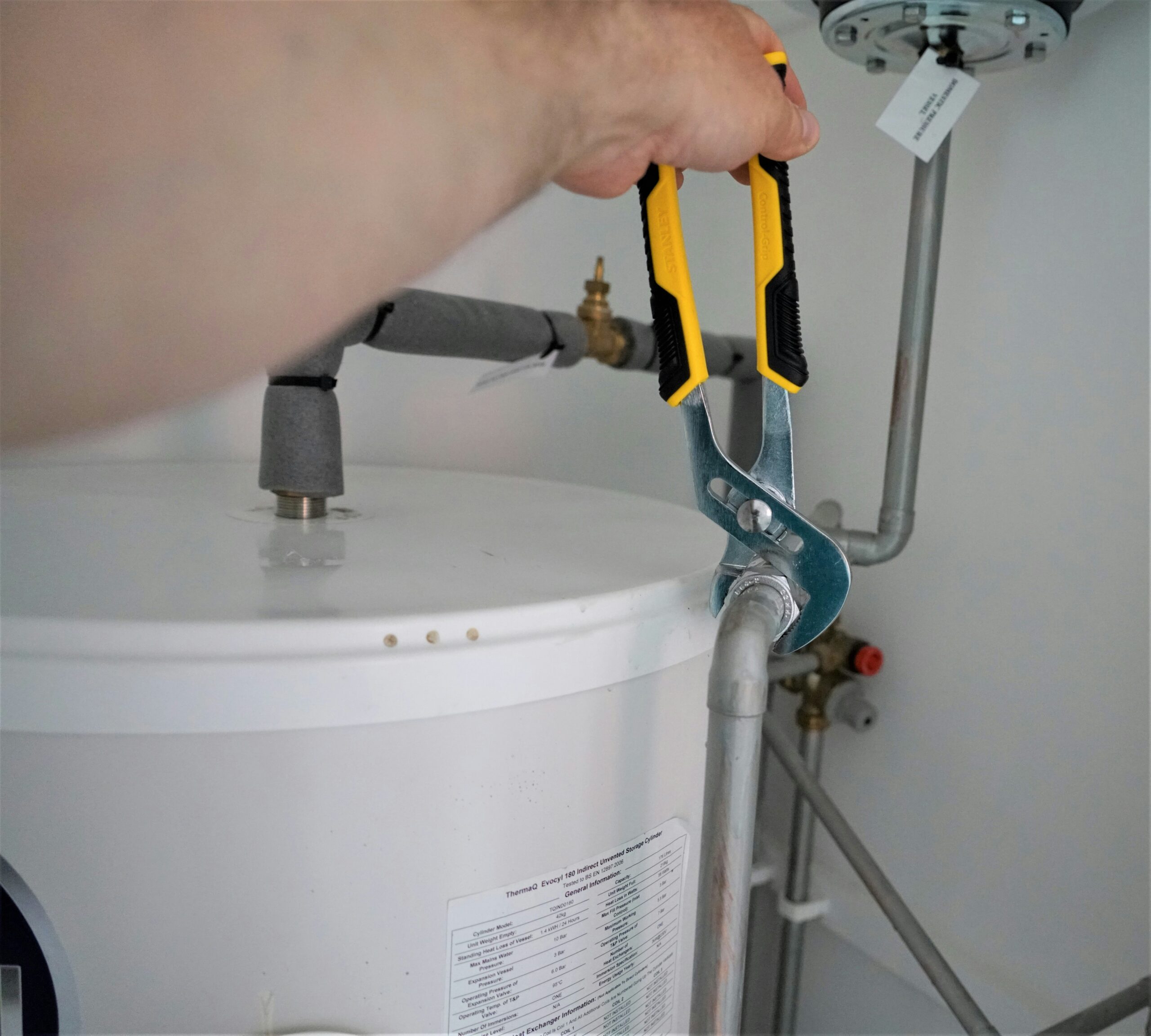
No hot water after restoration needs the actual heater type and startup history. Cold water at a sink proves that outlet has water; it does not establish that a storage tank is full, a tankless heater meets its activation conditions or a tripped circuit is safe to reset.
Check for a heater emergency first
If you smell fuel gas or suspect a gas leak, leave the building or affected area immediately and take others with you. Do not operate switches, plugs, phones, appliances, thermostats or valves in the affected area, light flames, or stay to ventilate or investigate. From a safe location well away, call the local gas emergency service or emergency services. Do not re-enter until responders say it is safe. Plumbing checks and normal maintenance must wait.
If a carbon monoxide alarm sounds or you suspect carbon monoxide exposure, get everyone outside immediately and call emergency services from safety. Carbon monoxide has no smell; an odor comparison cannot rule it out. Do not restart or repeatedly cycle a fuel-burning heater to investigate a possible combustion problem.
Keep away from wet electrical equipment. Do not touch wet appliances, plugs or switches, or enter water to reach a breaker. When no gas leak is suspected, power may be isolated only from a safely accessible dry location; otherwise call an electrician or emergency help. Wet equipment needs qualified assessment before it is used again.
Identify the heater without opening covers
- Record the model, fuel or power type and any safely visible error code from existing labels or paperwork. Do not enter an unsafe area to read them.
- Note whether the heater was drained, winterized, serviced, powered off or left in a special mode. Record who restored it and what commissioning checks were completed.
- Distinguish no hot water at every outlet from a single fixture problem, and no hot flow from normal flow that stays cold. Use the observations already available; do not run an unsafely hot challenge.
Why the heater design matters
- Storage electric heater: heating elements must have the required water coverage. Some controls offer protection, but it must not be assumed. Stopping a draw is not a universal automatic shutdown, and ordinary sink flow does not prove element immersion.
- Gas storage heater: ignition, venting, gas controls and restart requirements depend on the model. A water-side interruption does not by itself prove why a pilot or burner stopped.
- Tankless or other equipment: flow activation, inlet conditions, power and fault handling are product-specific. Do not apply a storage-tank refill rule or a generic recovery period to every heater.
What to do next
- If the equipment was drained or its filled state is unknown, do not energize or restart it to see whether it works. Obtain the installed model’s filling, air-release and commissioning procedure or arrange qualified service. Do not drain it again as a test.
- An approved filling procedure may use a specified hot outlet as evidence while filling. That requires safe temperature, an accepting receiver and the actual sequence before energy is restored; an unrelated cold sink is not the substitute.
- For an existing fault or tripped breaker, record the indication and get the appropriate technician or electrician’s advice. Do not reset an unresolved trip, remove energized covers or repeatedly cycle the heater.
- Only use a normal user control or relighting procedure when the actual manufacturer permits it, the required source and filled/commissioned state are established, and no gas, wet-electrical or unresolved fault concern exists. If those conditions are uncertain, use qualified service.
- After a valid startup, compare behavior with that product’s recovery or operating specifications and current demand. Input rating, mode, tank volume and incoming temperature matter. No fixed hour of waiting certifies normal operation or delays help for leakage or danger.
Useful service-call details
Share the exact model, error code, original water-restoration work, whether the heater was drained, and which outlets have no hot flow versus cold flow. These details help separate a supply-path problem, incomplete startup and a heating fault without assuming one from timing alone.
Related guides
- How to Turn Water Back On After Shutting It Off (Safely)
- Why Your Water Pressure Is Low After Turning the Water Back On
- What to Do If Water Smells or Looks Dirty After a Shutoff
- Air in Pipes After Shutoff
For the wider sequence and device-specific directories, browse Water Entry, Shutoffs & Flow Control Systems.