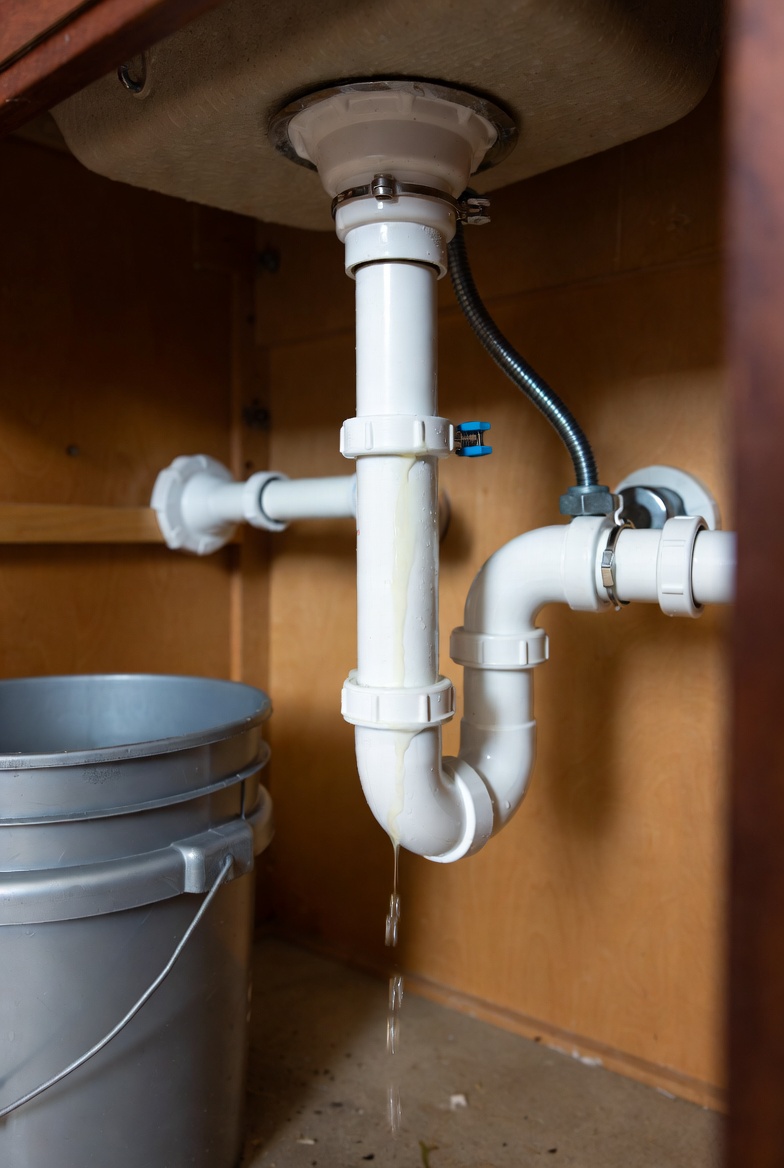
For moisture near a pop-up assembly, preserve the original water path and stop added water for an active leak. A wet pivot nut does not by itself prove its seal is the source or that generic putty is the cure.
For strong, widespread or unexplained gas-like fumes, exposure symptoms, or suspected high sewer-gas concentrations in an enclosed space, leave the building immediately and call the fire department or emergency services from outside. Avoid flames, switches and other ignition sources; do not remain to ventilate, sniff drains or investigate. Smell intensity does not measure the concentration. A faint localized drain odor without those warning signs calls for a different plumbing investigation; it does not automatically establish a fuel-gas leak.
If fuel gas is suspected, leave the building or affected area immediately. Do not operate valves, switches, plugs, appliances or phones there. Call the gas emergency service from a safe location well away, and wait for responders’ clearance.
Keep away from wet electrical equipment. Do not touch wet appliances, plugs or switches, or enter water to reach a breaker. When no gas leak is suspected, power may be isolated only from a safely accessible dry location; otherwise call an electrician or emergency help. Wet equipment needs qualified assessment before it is used again.
For wastewater rising from a drain or affecting several fixtures, stop adding water and keep affected appliances from discharging using only safely accessible dry controls when no gas emergency is suspected. Avoid sewage contact, keep children and pets away and arrange prompt drainage help. Notify building management or the sewer agency as appropriate. Do not run fixtures to locate a shared blockage.
Record the actual behavior
- Original location/rate of water, basin contents and stopper state.
- Actual flange, drain body, pivot and trap arrangement, with recent work.
- Prior products, visible damage and electrical wetting.
Identify the control and water path
Water can travel along components before dripping. Basin loss past the stopper seat differs from external leakage. Flange sealant, drain-body gasket, pivot seat and slip-joint washers are different parts, with model/finish-specific requirements.
On a traditional lift-rod assembly, the external lift rod, strap and spring clip transfer motion. The rod/ball, seat and retaining nut at the drain’s side opening have separate retention and sealing functions. A strap clip is not a substitute for the side-port seal. A push-button latch, lift-and-turn cap or freely removable plug may use a different mechanism. Identify the actual assembly before removal, adjustment or buying parts.
Before opening or another product
If a cleaner may be present, identify the exact product and follow its label. Do not add another cleaner, acid, bleach, ammonia, vinegar or an improvised neutralizer. Do not plunge, snake or open the trap while hazardous residue may remain; tell the provider what was used. A rinse or elapsed time is not proof all residue is gone.
Keep the faucet off and every connected input inactive during service. A supply stop can help prevent accidental faucet use when appropriate, but closing it does not remove water already held in the basin or control every shared wastewater input. Do not scoop or touch unknown treated water, sewage or sharp debris. Have retained water handled appropriately before opening a pivot port or trap; a shallow bowl under the sink may not hold a full basin.
What to do next
- Do not fill a leaking sink repeatedly or loosen a pivot nut after a several-inch hold test while basin water remains.
- Establish retained-water and chemical conditions before intended service. A compressed-looking gasket or damp nut alone does not select a replacement or tightening amount.
- Use actual compatible sealing instructions; do not apply putty, tape or glue by habit or repeatedly torque a nut. Fully refit before modest attended motion/holding/leak checks as appropriate.
Reassemble before water checks
For suitable ordinary owner care on sound identified parts with no chemical, sewage, gas, electrical or damage concern, follow the actual maker’s removable-part and adjustment method. Wipe accessible hair/residue into appropriate waste and clean removed parts separately using a compatible permitted cleaner. Do not force sealed drain-body fittings, apply unidentified penetrating oil, abrade a seat or probe a hidden route. Fully restore every actual side-port seal/retainer and any trap connection before water is introduced. A dry motion check, a modest attended basin-holding check and a small cool-water drainage/leak check answer different questions; use only checks appropriate to a safely accepting fully assembled fixture. Stop for leakage, rise, binding or uncertainty. No repeated full-basin fill or wet test through an open pivot port is required.
Does operating smoothly mean the pivot port is watertight?
No. Dry movement and external sealing are different observations. Stop for leakage, identify the actual path and correct the actual seal/fit rather than tightening until motion changes.
Obtain suitable installer/plumbing help for damaged or corroded parts, inaccessible retained water, an unknown mechanism, continuing leakage or recurrence. The correct replacement depends on actual model, engagement, ball/seat/nut/thread/seal and sink-overflow compatibility, not approximate rod length or a universal hardware kit.
Related guides
- Stopper clogged with hair
- Pop-up stopper won’t close
- Pop-Up Stopper & Linkage Failures
- Bounded ordinary sink-drain care
- Chemical-opener history before another method
Safety sources
- Wisconsin DHS: sewer-gas exposure and emergencies
- Con Edison: suspected gas leaks
- Madison Metropolitan Sewerage District: stop discharge and report sewer backup
- Example drain-opener label: restrictions on plunging, disposal operation and mixing
- Moen example: identify the actual drain and replacement-parts scope
- Moen10790example: separate external motion parts and pivot-port sealing parts
- Kohler example: actual linkage adjustment differs from retained ball-rod removal
- CDC: electrical hazards near water