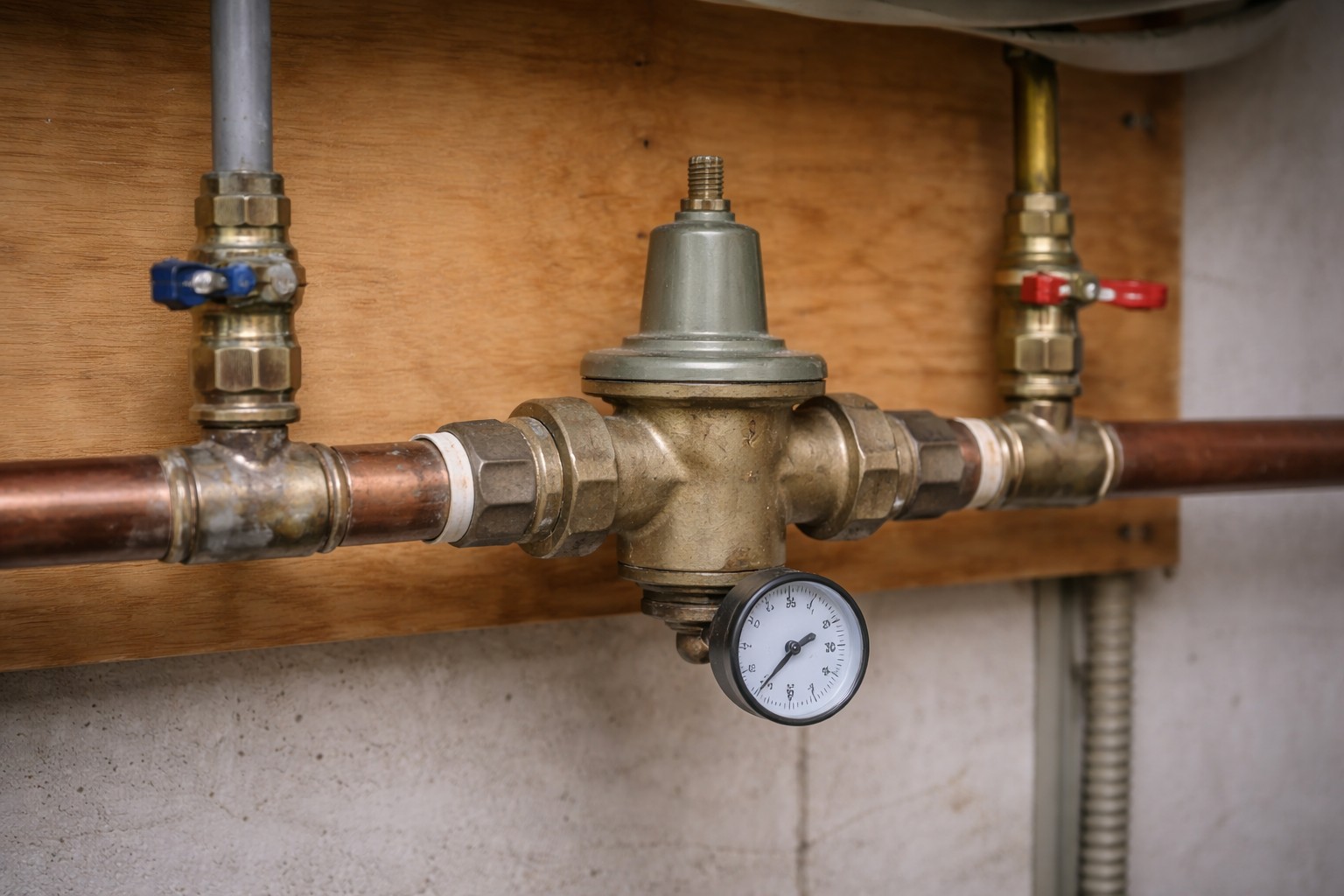
After a pressure-reducing valve was adjusted, record the actual model, prior measured pressure and work performed. Do not turn the screw one arbitrary turn to restore an assumed old setting. Sputtering after the change does not by itself prove that the regulator introduced air or has failed.
Stop for loss of control
For severe pressure behavior, pipe movement, leakage or unsafe output, stop further adjustment and arrange suitable help promptly. Do not continue turning the regulator or flush multiple fixtures to make it settle. Keep away from wet electrical equipment and use only a known safely accessible shutoff for an active supply leak when appropriate.
Keep the original event record
- The valve model, installer or person who adjusted it, target setting and any actual before/after gauge readings.
- Where a reading was taken relative to the regulator and whether it was with no intended demand or during a specified flow.
- The original symptom: gas at an outlet, weak stream, banging, measured pressure rise or visible leak. Flow appearance is not a pressure measurement.
Use measurements within their scope
The cited Watts model requires pressure-gauge verification when its setting is adjusted. That does not mean any outside hose bib is downstream of every regulator. Gauge rating, connection location, pressure/temperature suitability and the demand state matter. A single reading cannot by itself distinguish regulator behavior, supply changes, restriction or thermal expansion.
If an existing installed gauge can be read safely, record its display and conditions without creating a new test. An optional owner gauge connection needs a known safe permitted test point, compatible instrument and its connection/pressure-release procedure. Do not loosen a live fitting, use a backflow test cock or attach equipment to an unknown port. A plumber can establish the measurement instead.
What the service provider should assess
- Actual inlet and outlet pressure behavior, target setting, demand and installation arrangement.
- Whether a no-flow pressure rise involves thermal expansion, pressure creep, debris or another documented condition. The timing alone does not select one.
- The required regulator and downstream protective provisions. Do not bypass a regulator, relief or backflow device to compare results.
- Whether qualified adjustment or repair is justified by the measurements, rather than a guessed screw position.
Before any body or strainer service
Use the actual model procedure to isolate every source, control temperature, release the relevant trapped pressure and verify depressurization. Opening a remote downstream tap does not necessarily unload an upstream chamber or a checked section. Lowering the setting is not isolation. Keep the unit assembled if the pressure boundary is uncertain, and fully reassemble before controlled restoration.
Related guides
- Air blasts from faucet after water restored
- Air sputters after main shutoff used
- Air in upstairs fixtures only
- Why Your Water Pressure Is Low After Turning the Water Back On
- Air in Pipes After Shutoff