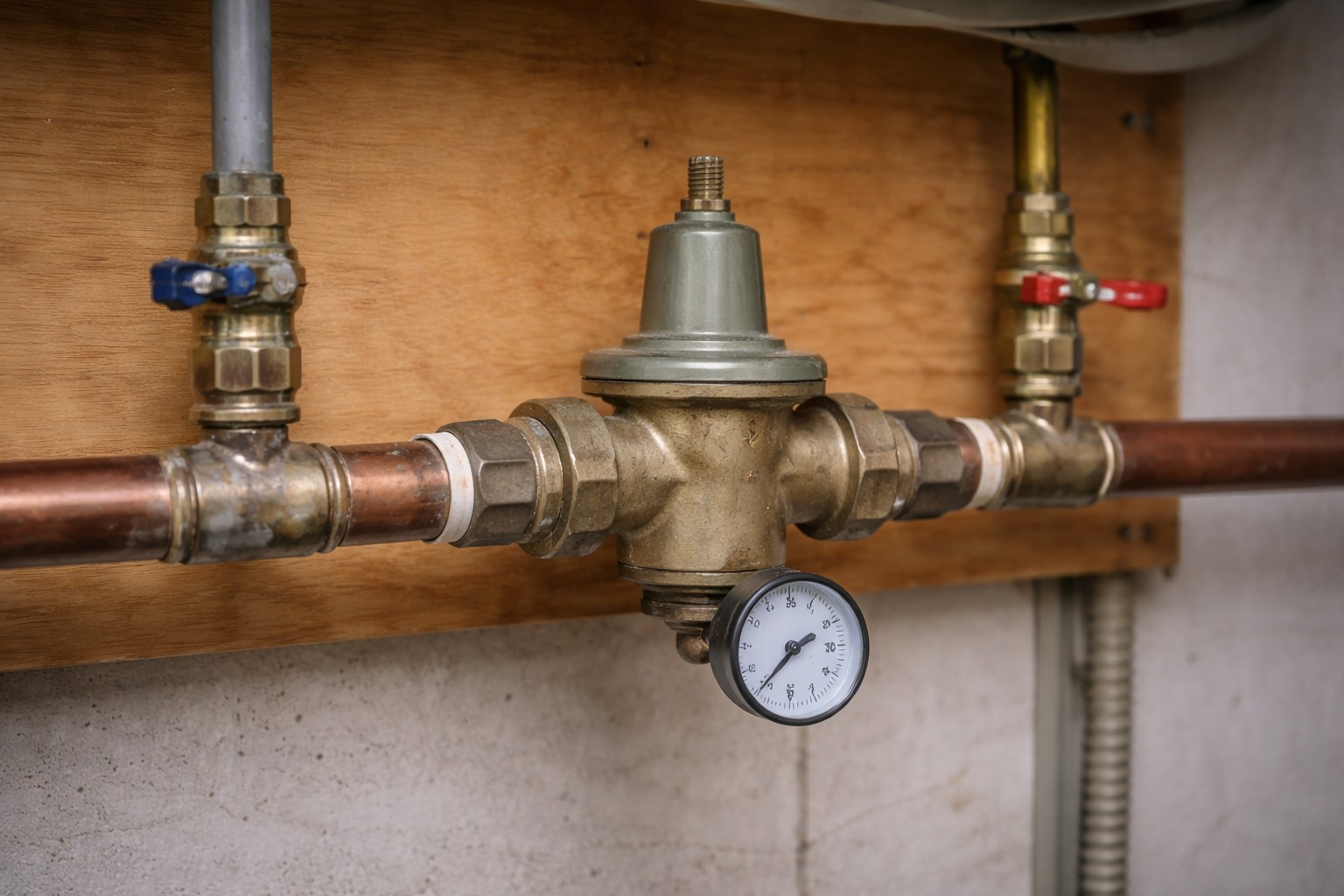
Quick Answer:
Excessive or debris-laden upstream pressure can make a pressure-reducing valve (PRV) fail by allowing pressure to “creep” back up after shutoff or by causing internal damage and leaks. Check the PRV under flow, watch for pressure creep, flush any upstream sediment, and replace the PRV if it won’t hold the setpoint. Also verify the expansion tank charge so normal heating cycles don’t cause spikes.
Why This Happens
A PRV is a mechanical device that holds downstream pressure at a setpoint while the supply may be higher. Two common failure patterns are:
- Upstream pressure is too high or noisy: very high inlet pressure or frequent spikes can stress the regulator and force it past its working range.
- Debris or sediment lodges on the seat: small particles can prevent a tight seal, producing a slow rise in downstream pressure after you shut off flow—called “creep.”
If your area has had recent supply changes, that can raise inlet pressure. For related symptoms, see High pressure after city upgrade.
Step-by-Step What to Do
1. Confirm static and flow pressure
- Attach a reliable pressure gauge to a hose bib or the PRV test port. Note the cold static pressure (no faucets running).
- Open a nearby faucet to create flow and note the pressure under load. This shows whether the PRV holds setpoint during normal use.
- Close the faucet and watch for “creep”—if the pressure rises a few psi or more after shutoff, the PRV isn’t holding.
2. Inspect inlet for debris and flush upstream
- If you see sediment in the water or meter area, flush downstream lines by opening an outside hose bib or other full-flow outlet until water runs clear.
- If flushing doesn’t help and you suspect the meter or service line has debris, contact the water utility for a service-side flush or guidance.
3. Make measured PRV adjustments and test
- If the setpoint is close but slightly off, adjust the PRV in small increments and recheck pressure under flow. Use the gauge each time and record readings.
- Allow a few heating or water-use cycles and re-measure to confirm stability.
4. Replace the PRV if it won’t hold setpoint
- If creep continues after flushing and careful adjustment, the PRV is likely worn or damaged and should be replaced.
- Isolate the valve, relieve pressure, and swap for a correctly sized, rated PRV. If you’re not comfortable doing this, call a licensed plumber.
5. Verify expansion tank charge
- On closed heating systems, a weak or waterlogged expansion tank allows pressure to spike during heating cycles. Check the tank’s air charge at the Schrader valve with a tire gauge.
- Compare the tank charge to the system’s cold fill pressure. If it’s low, add air to match the system pressure (use a hand pump or compressor carefully) or have a pro service the tank.
What Not to Do
- Don’t crank the PRV blindly—use a gauge and adjust in small increments; recheck after heater cycles.
- Don’t remove or work on the PRV while the system is pressurized. Always isolate and relieve pressure first.
- Don’t ignore persistent creep or leaks; they usually get worse and can damage appliances and fixtures.
When to Call a Professional
- If you cannot stop pressure creep after flushing and careful adjustment.
- If inlet pressure is extremely high (well above your expected supply) or fluctuates quickly.
- If the PRV leaks externally, or if replacing the valve requires soldering or complex piping changes.
- If you prefer not to handle expansion tank servicing—especially on older tanks or tanks showing corrosion.
If upstream control systems or automatic devices are tripping, it may relate to supply-side controls—check for issues like High pressure triggers smart shutoff when discussing options with a technician.
Safety Notes
- Always shut off the water supply and relieve downstream pressure before removing a PRV. Open a faucet to bleed pressure.
- Wear safety glasses when draining lines or working near pressurized fittings. Hot water can scald.
- Use the correct replacement PRV size and pressure rating. Incorrect parts can fail or create unsafe conditions.
- If you’re unsure about tools, gas/propane torches, or pipe soldering, hire a pro to avoid fire risk or water damage.
Common Homeowner Questions
- How do I know if the PRV is failing? If downstream pressure rises after shutoff (creep) or you see leaks and the setpoint won’t hold, the PRV is likely failing.
- Can I adjust the PRV myself? Yes, if you have a gauge and feel comfortable making small adjustments, but always test under flow and recheck after cycles; call a plumber if unsure.
- Will replacing the PRV fix high pressure? It fixes problems caused by the PRV itself. If inlet pressure is excessively high, the new PRV may also be stressed—address upstream pressure or consult your water utility.
Related Articles
If you’re troubleshooting a similar symptom, these guides may help:
For the full directory, see High Pressure Causing Fixture Damage.