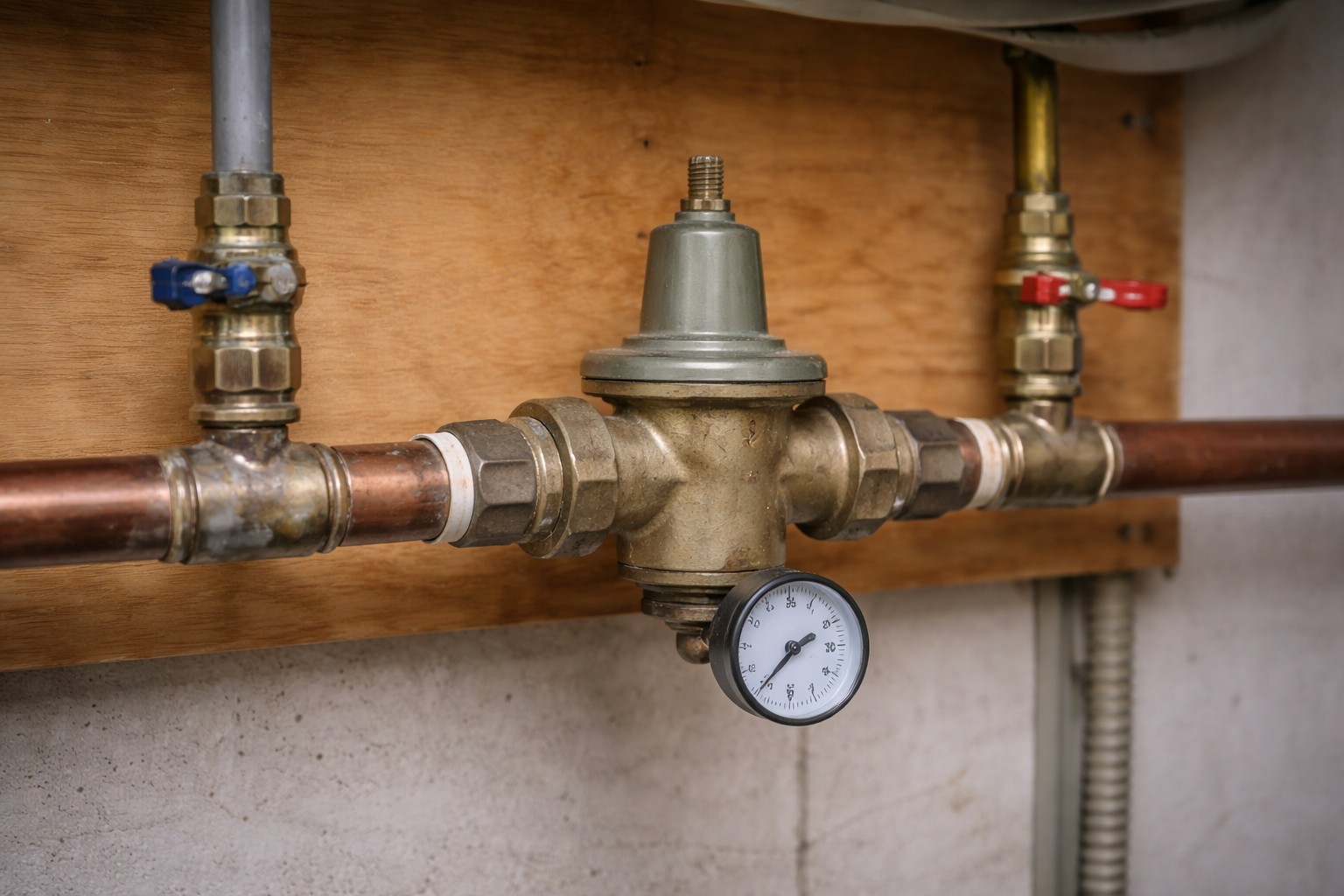
Quick Answer:
If your system pressure spikes when the heater runs, the expansion tank has likely lost its air charge or the bladder is failed. Use a max-needle gauge to confirm when and how high the peaks occur. Depressurize the system, recharge the tank to the cold static pressure, and watch whether it holds air. If water comes from the Schrader valve or pressure spikes continue, replace the tank and verify the correct tank size for your system.
Why This Happens
Heating water makes it expand. In a closed system that expansion needs somewhere to go. An expansion tank provides a cushion of air separated from the water by a bladder or diaphragm. If the tank loses its air charge or the bladder ruptures, the system has no buffer. That lets pressure spike whenever the heater runs. Repeated spikes can overload relief valves, hoses, cartridges, and solenoids, and will eventually cause component failure.
Step-by-Step What to Do
1. Confirm the problem with a max-needle gauge
- Attach a max-needle pressure gauge to the system near the boiler or main fill point (or to the main cold water inlet test port). A max-needle gauge records the highest pressure reached so you don’t miss short spikes.
- Run the heater through a normal cycle and note the peak pressure and exactly when it occurs (during burner on, at the end of a cycle, etc.). This confirms whether pressure peaks coincide with heating.
2. Shut down and depressurize safely
- Turn off the heater or boiler power according to the manufacturer instructions (switch off electrical supply or set the unit to off). Close fuel/gas isolation only if you know how to do so safely; otherwise leave that to a pro.
- Open a hot faucet at a lower elevation to relieve system pressure. Use caution—water may be hot. Confirm pressure on the gauge drops to the cold static reading before proceeding.
3. Check and recharge the expansion tank
- Locate the tank’s Schrader valve (it looks like a tire valve). Remove the cap and press a tire gauge onto it to read the air pre-charge.
- Set the tank air pressure to the system’s cold static pressure (the reading you saw with the system cold). Use a hand pump to add air if needed. This equalizes the tank for proper operation.
- Re-pressurize the system to normal operating cold pressure and monitor. If the tank’s air pressure drops quickly or you see water at the Schrader valve when you depress it, the bladder is leaking and the tank must be replaced.
4. Replace the tank if it fails to hold air or spikes persist
- If water is present at the Schrader or the tank won’t hold the charge, replace the expansion tank.
- When replacing, verify correct sizing for your system. Undersized tanks won’t control pressure well; oversized isn’t usually harmful but a correct match prevents repeated problems.
- After replacement, run the heater and re-check with the max-needle gauge to confirm peak pressures are within safe limits.
What Not to Do
- Don’t live with repeated high peaks—surges can burst hoses and destroy solenoids and cartridges.
- Don’t ignore a pressure relief valve that’s discharging; that’s a sign of unsafe pressure and needs immediate attention.
- Don’t over-inflate the tank above the cold static pressure; that reduces the tank’s useful volume and defeats the purpose.
- Don’t try to jury-rig a temporary fix for a failed bladder (for example, tying an external air bladder to the system). Replace the tank with a proper unit sized for your system.
When to Call a Professional
- If you aren’t comfortable shutting down or depressurizing the heater safely.
- If the tank is leaking at the connection, the Schrader stays wet, or pressure spikes continue after you’ve recharged or replaced the tank.
- If you need a correct tank size calculation for a large or unusual system, or if the relief valve repeatedly opens—have a licensed plumber or heating technician evaluate the system.
Safety Notes
- Always turn the heater or boiler off before working on the plumbing or tank. Follow the manufacturer’s shutdown steps.
- Relieve system pressure before removing fittings. Hot water can cause severe scalds.
- Wear eye protection and gloves when working on pressurized systems. If you smell gas or suspect a gas leak, evacuate and call your utility or emergency services.
Common Homeowner Questions
- How high is too high for system pressure?
Short spikes above the relief valve setpoint (commonly 150 psi for domestic boilers) are unsafe; residential potable systems often should stay under 80–90 psi. Use your max-needle reading as a guide and consult the appliance plate for exact limits. - Can I just add air to the tank and skip replacement?
If the tank holds air and stabilizes pressure, recharging is fine. If the tank loses air or water appears at the Schrader, replacement is required. - Why did the tank fail?
Common causes are a ruptured bladder, corrosion, or a long period without the correct pre-charge. Age and temperature cycling accelerate failure.
If you notice related symptoms such as **Pressure increases after long hot shower** or frequent cycling where the **Pressure builds overnight when heater runs**, follow the steps above and consider professional help if the problem continues.
Related Articles
If you’re troubleshooting a similar symptom, these guides may help:
For the full directory, see Thermal Expansion Pressure Behavior.