Quick Answer:
If system pressure rises when the water heater fires, the piping has become a closed system — an incoming pressure reducer, backflow preventer or smart shutoff is preventing expansion water from leaving the house. Confirm the pressure rise with a max-needle gauge, then install or repair a correctly sized expansion tank and set its precharge to the cold static pressure. After that, verify the pressure-reducing valve (PRV) setting.
Why This Happens
- Cold water in a closed piping system expands when heated by the water heater. That extra volume raises overall system pressure.
- If there is a PRV, backflow preventer, or a smart shutoff device on the service line, the system becomes closed and the rising volume has nowhere to go.
- Without an expansion tank or with a failed/undersized tank, the pressure increases until a relief device opens or other components are stressed.
Step-by-Step What to Do
Step 1 — Confirm the system is closed
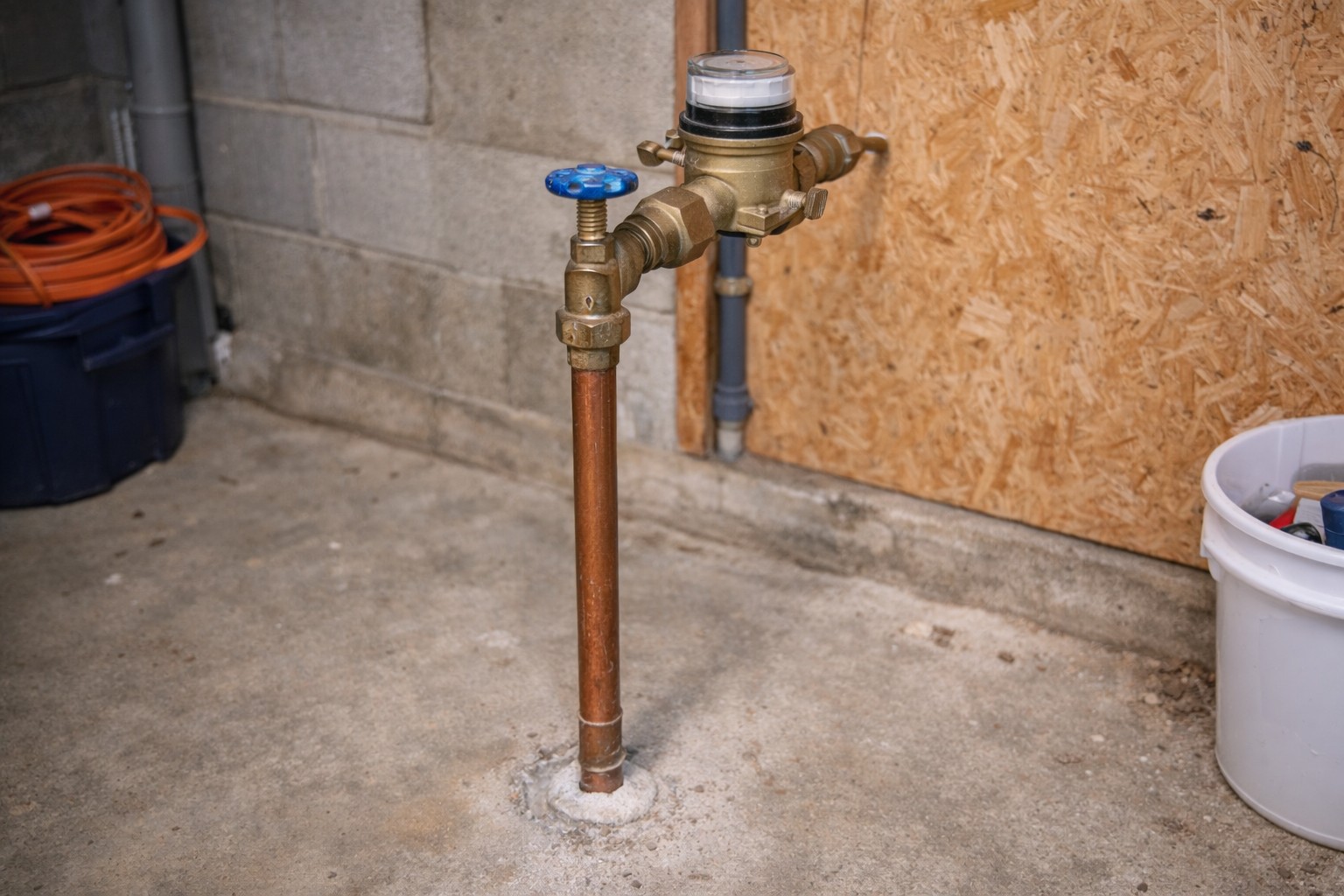
- Check the service line for a pressure-reducing valve (PRV), a backflow preventer, or a smart shutoff device. Any of these can stop expansion water from returning to the supply.
- Look for evidence: the PRV body at the meter, a spring-loaded backflow assembly, or a visible shutoff with electronics. If you’re unsure, photograph and note locations for a pro.
Step 2 — Install a max-needle gauge and reproduce the problem
- Attach a reliable pressure gauge with a max or “peak” needle to an accessible hose bib or a test port. Do not use appliance pressure gauges that don’t show peak pressure.
- Start a hot-water demand (run a faucet or cycle the heater) or simply let the heater run through a normal cycle. Watch whether the gauge rises above the normal static pressure during heating.
- If pressure climbs when the heater heats, that confirms thermal expansion in a closed system.
Step 3 — Check the expansion tank and replace or size one correctly
- Locate the expansion tank near the water heater or on the cold inlet. Tap it: a hollow sound usually indicates air space; a dull thud suggests waterlogged.
- If the tank is waterlogged or failed, repair or replace it. If you suspect a tank problem, read about **Thermal expansion tank waterlogged symptoms** for what to look for.
- Select a tank sized for your heater and household. If you’re seeing large pressure swings, you may be dealing with **Expansion tank undersized problems** and need a larger or additional tank.
Step 4 — Set the expansion tank precharge to cold static pressure
- Shut off water to the house and drain enough to drop system pressure to near zero, or isolate the tank using a valve if available.
- Check the tank’s air precharge with a tire-pressure gauge at the tank’s Schrader valve and adjust the air charge to match the cold static system pressure (usually the water meter pressure). For example, if your static pressure is 60 psi, set the tank precharge to 60 psi.
- Restore water, repressurize, and verify the tank accepts expansion without becoming fully waterlogged.
Step 5 — Verify and reset PRV setpoint afterward
- After the tank is installed and precharged, recheck service pressure with the max-needle gauge during a heating cycle.
- Adjust the PRV if necessary to the intended setpoint (common settings are 50–60 psi), but don’t use the PRV as a substitute for an expansion tank.
- Confirm that pressure no longer climbs dangerously during heating and that the T&P relief valve is not opening under normal operation.
What Not to Do
- Don’t crank the PRV way down as a band-aid. Bad PRV settings can create other problems and won’t fix expansion without a tank.
- Don’t disable or tape over relief valves or safety devices to stop leaks — that creates a serious hazard.
- Don’t ignore repeated T&P relief discharges; that’s a symptom the expansion issue is not resolved.
When to Call a Professional
- Call a licensed plumber if you can’t identify the closed device (PRV/backflow/smart shutoff) or if the service line hardware needs replacement.
- Hire a pro for proper expansion tank sizing when you have a large water heater (tankless combined with loops, commercial-sized heaters, or unusually high static pressure).
- If the T&P relief valve discharges persist after installing an expansion tank, or if you suspect the water heater’s internal components are failing, call a technician right away.
Safety Notes
- Before working on the heater or tank, turn off the gas or electric power to the water heater and shut off the cold-water supply if you will drain or depressurize the system.
- Relieve hot-water pressure carefully at a faucet — open a hot tap slowly to avoid scalding.
- If you are uncomfortable with any step, or the system involves gas piping or complicated backflow assemblies, stop and call a professional.
Common Homeowner Questions
- Why does the pressure only rise when the heater runs?
Heating water increases its volume. In a closed system with no place for expansion, pressure rises only when the heater raises the water temperature. - Will a bigger expansion tank always fix it?
Often yes if the current tank is undersized, but the tank must be sized correctly and precharged to the cold static pressure to work properly. - Can a failing PRV cause this?
A leaking PRV can cause pressure issues, but a closed PRV or backflow preventer that blocks flow back to the street is what creates the closed system that amplifies thermal expansion.
Related Articles
If you’re troubleshooting a similar symptom, these guides may help:
For the full directory, see Thermal Expansion Pressure Behavior.