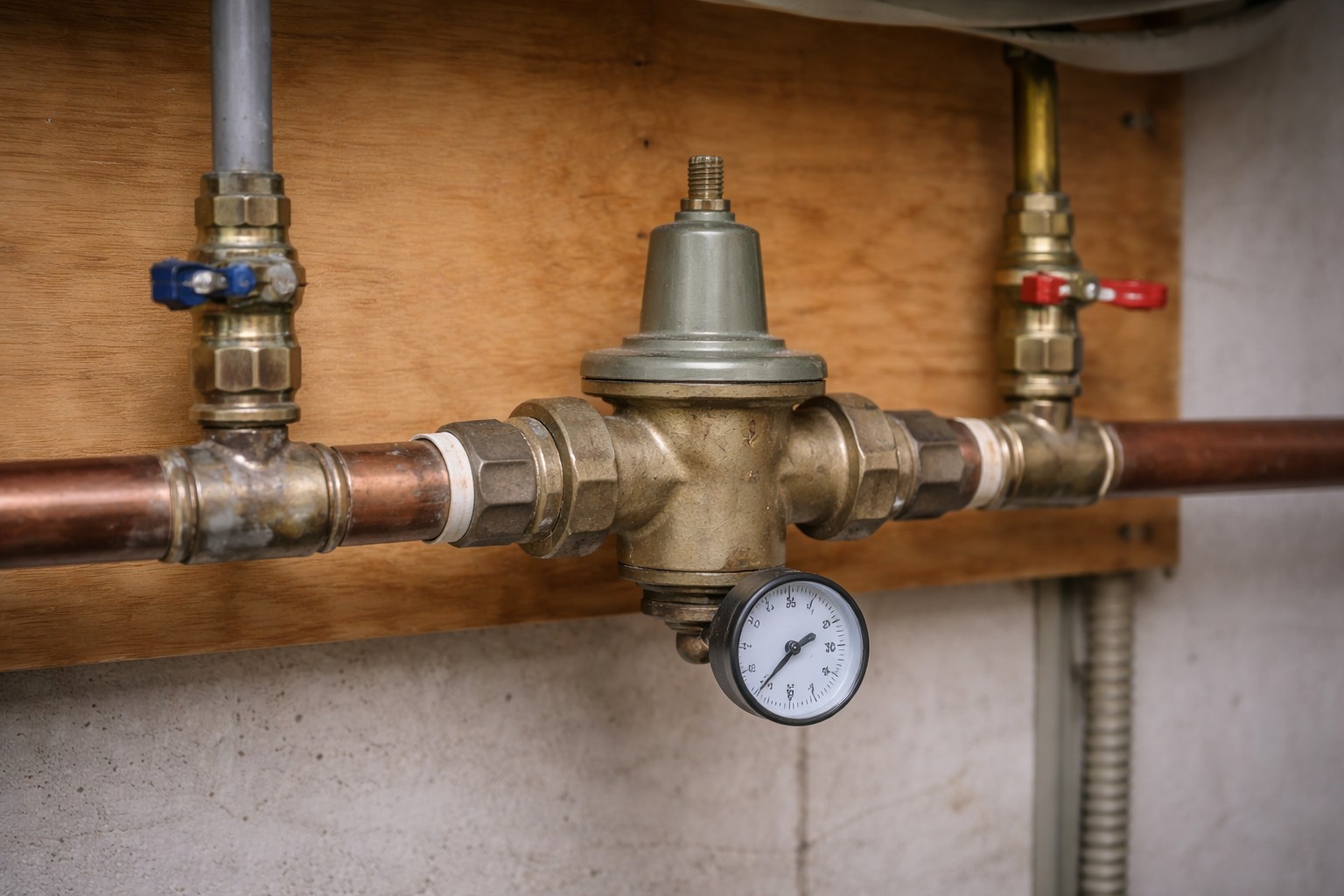
Quick Answer:
When only the hot side shows pressure spikes while the cold remains stable, the problem almost always sits on the heater side: trapped thermal expansion, a closed check/backflow device, a mixing valve or recirculation component, or a fixture-level crossover. Start by comparing hot and cold behavior at the same fixture, inspect check valves and the expansion tank at the heater, then retest. If spikes persist only on hot, check the fixture cartridge or a stuck one-way valve.
Why This Happens
Hot water expands when heated. In a closed plumbing system that has a one-way device (check valve, backflow preventer, or pressure-reducing valve) or a recirculation loop, that expansion has nowhere to go and raises system pressure on the heater side. A failing or uncharged expansion tank can’t absorb the extra volume. Single-handle faucets, mixing valves, and recirculation check valves can also cause pressure differences that show up only on hot lines.
For these reasons homeowners often find that the issue is not the municipal supply but something tied to the heater or its attachments — see Water heater causes system over-pressure and also consider the pattern described in Pressure normal cold but high when hot.
Step-by-Step What to Do
Compare hot vs cold behavior at the same fixture
- Pick one fixture and test cold-only, then hot-only. Turn the handle fully on and off a few times and note noise, hammer, or pressure pulses.
- If you have an inline pressure gauge or a hose bib available, test pressure on cold and hot separately to confirm the difference numerically.
- Document when spikes occur (e.g., when other appliances run, when faucet is opened or closed, or only when water heats).
Inspect for check valves at the heater cold inlet
- Look at the cold-water inlet to the water heater for a check valve, backflow preventer, or pressure-reducing valve. These devices can isolate the heater side from the rest of the system.
- If one is present, it can trap expanded hot water and cause spikes. Do not remove or alter these devices without isolating and depressurizing the system; if in doubt, photograph the setup and call a plumber.
Check mixing valves and recirculation systems
- Mixing (tempering) valves that blend hot and cold can stick or fail and cause odd hot-side pressure behavior.
- If you have a recirculation loop or pump, inspect its check valve and controls—recirc components can create one-way isolation that traps pressure on the hot side.
Confirm expansion tank charge and placement, then retest
- Locate the expansion tank (usually near the water heater). Check that it is properly mounted on the hot side and that it has an air charge at its Schrader valve roughly equal to the static system pressure.
- Before touching the tank: shut off water to the heater, relieve system pressure, and allow water to cool. If you can safely use a tire gauge, compare tank air pressure to the static line pressure. If you’re not comfortable, have a pro check it.
- After confirming or correcting the expansion tank, restore the system and retest for hot-only spikes.
If spikes still occur only on hot, check the fixture for a stuck check/cartridge crossover
- Single-handle faucets and some cartridge-style fixtures have internal check valves or cartridges that can stick and allow pressure to build or transfer improperly.
- Remove the cartridge or have a technician inspect the fixture for crossover or stuck checks. Replacing a faulty cartridge often resolves hot-only spikes localized to one fixture.
What Not to Do
- Don’t assume the city caused it if only hot behaves badly. Heater-side checks and expansion are the usual cause.
- Do not open the water heater temperature-pressure (T&P) relief valve to try to relieve pressure as a diagnostic—this can discharge hot water and create a hazard.
- Don’t remove or bypass check/backflow devices or the expansion tank without isolating, depressurizing, and understanding local code — these devices protect the system and supply.
When to Call a Professional
- If you find a check valve/backflow preventer at the heater and are not experienced removing or testing it.
- If the expansion tank appears failed (leaking, waterlogged, or you can’t verify the air charge safely).
- If spikes continue after the basic checks, or if you see T&P relief valve discharge, repeated noisy hammer, or sustained high pressure that risks plumbing damage.
Safety Notes
- Always shut off water and relieve pressure before disconnecting fittings or working on the heater or expansion tank.
- Turn off electrical power to an electric heater at the breaker, or for gas heaters, follow safe pilot shutdown procedures before doing work that could expose hot parts.
- Allow water to cool before draining or opening hot lines to avoid scalding. When in doubt, stop and call a licensed plumber.
Common Homeowner Questions
- Why does only the hot water spike but cold stays steady? Hot-side thermal expansion combined with a one-way device, faulty expansion tank, mixing valve, or recirculation setup usually isolates the heater side and causes spikes.
- Can I recharge the expansion tank myself? You can check the air charge with a gauge, but if you must drain or replace the tank, follow safety steps or hire a plumber if you’re unsure.
- Will a stuck faucet cartridge cause system-wide spikes? A stuck cartridge usually affects that fixture, but if multiple fixtures show hot-only spikes, the source is likely at the heater or a system-level device.
Related Articles
If you’re troubleshooting a similar symptom, these guides may help:
For the full directory, see Thermal Expansion Pressure Behavior.