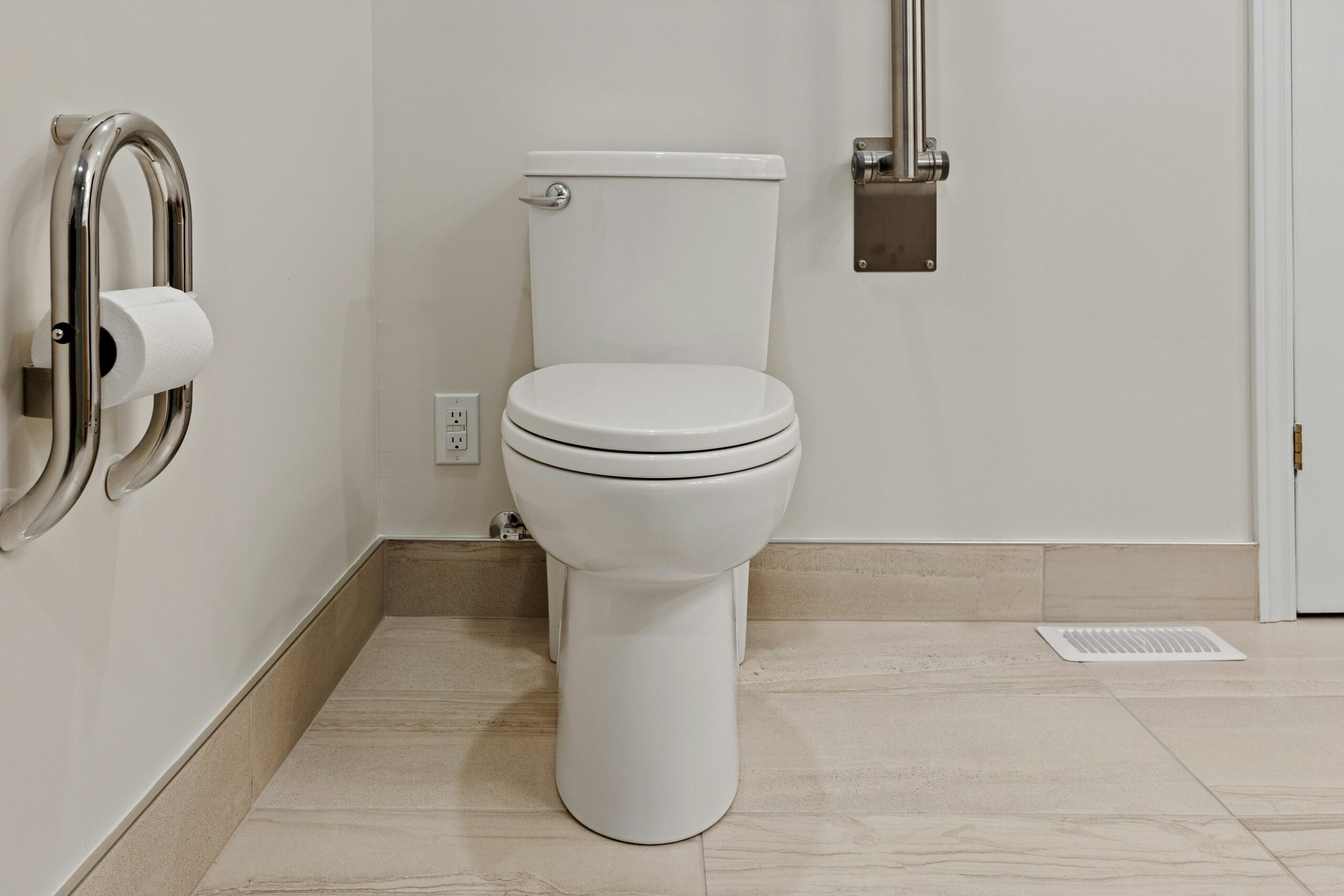
Water around a toilet base needs prompt containment and its actual source traced. A drain seal, tank or supply leak, condensation, a crack or tracking water can contribute; post-flush wetness is not proof of a wax-ring failure.
Safe state before service or another flush
Keep away from wet electrical equipment. Do not touch wet appliances, plugs or switches, or enter water to reach a breaker. When no gas leak is suspected, power may be isolated only from a safely accessible dry location; otherwise call an electrician or emergency help. Wet equipment needs qualified assessment before it is used again.
For strong, widespread or unexplained gas-like fumes, exposure symptoms, or suspected high sewer-gas concentrations in an enclosed space, leave the building immediately and call the fire department or emergency services from outside. Avoid flames, switches and other ignition sources; do not remain to ventilate, sniff drains or investigate. Smell intensity does not measure the concentration. A faint localized drain odor without those warning signs calls for a different plumbing investigation; it does not automatically establish a fuel-gas leak.
If fuel gas is suspected, leave the building or affected area immediately. Do not operate valves, switches, plugs, appliances or phones there. Call the gas emergency service from a safe location well away, and wait for responders’ clearance.
For wastewater rising from a drain or affecting several fixtures, stop adding water and keep affected appliances from discharging using only safely accessible dry controls when no gas emergency is suspected. Avoid sewage contact, keep children and pets away and arrange prompt drainage help. Notify building management or the sewer agency as appropriate. Do not run fixtures to locate a shared blockage.
If a cleaner may be present, identify the exact product and follow its label. Do not add another cleaner, acid, bleach, ammonia, vinegar or an improvised neutralizer. Do not plunge, snake or open the trap while hazardous residue may remain; tell the provider what was used. A rinse or elapsed time is not proof all residue is gone.
Stop use and keep the existing evidence
Stop flushing or using a toilet with active leakage, instability or an uncertain floor. A known effective safely accessible supply control can stop incoming tank water; stored water and shared wastewater still require control. Photograph existing wetness from dry safe access, noting original flush/refill timing and the first visible wet point. Do not flush again or deliberately rock the toilet to establish a cause.
Different water paths need different repair
Identify the actual toilet and fill/flush system before adjusting parts. A conventional open gravity tank, sealed pressure-assisted vessel, flushometer, pump/electronic toilet and concealed cistern need different procedures. Do not open a pressure vessel, remove a cartridge or apply a gravity-tank recipe to an unknown system. A porcelain-lid observation is different from opening a pressure-retaining valve cap. Handle a permitted removable lid carefully and set it on a stable protected surface.
Water can track from tank bolts, a connector or the rear of the fixture. Condensation can coexist with a leak; a cold tank or humid day does not clear the seal. Actual cracks, mounting, flange and subfloor condition must be assessed rather than assumed from the puddle’s location. A secure-looking bowl does not certify the concealed seal.
Support and reseating are not a nut test
Do not repeatedly tighten bolts or pull the fixture down onto an uneven floor. Actual compatible seals, flange condition, support, bolt limits and model installation requirements matter. A loose mounting bolt and damaged drain seal can require more than one correction. Toilet removal can involve heavy porcelain, retained wastewater, exposed drainage and hidden floor damage; use appropriate qualified help if access, lifting or conditions are uncertain.
Finishing and cleanup
Do not caulk over an unresolved leak to hide it. Correct finishing after an actual repaired, dry and stable installation is a separate model/site requirement; not every properly finished base is wrong. Control the water source and electrical, sewage, mold and structural hazards before drying or material removal. A simple mask or towels do not certify cleanup safe. Do not cover wet or unassessed flooring.
Return after the actual correction
A justified functional check needs sound fully secured assembly, a known accepting bowl/drain, no hazardous residue, controlled connected inputs and safe attendance. Use the actual model’s procedure and stop immediately for rising water, external leakage, failure to shut off or abnormal behavior. Do not keep flushing to reproduce a known overflow, leak or unknown receiving problem.
A necessary controlled check needs the planned safe receiving/source state and accessible observation without renewed hidden damage. Record repair and drying evidence; a short dry interval or a single successful flush does not certify the whole floor.
Related situations
- Leakage below a floor after use
- Tank-side running and overflow observations
- Overflow can wet the area around a base
Browse the broader Toilet Fill, Flush & Bowl Dynamics directory. Choose a guide from the actual event and system.
Safety sources
- CDC: electrical hazards near water
- Kohler: gravity, pressure-assisted and pump flush/refill cycles
- Wisconsin DHS: sewer-gas exposure and emergencies
- Con Edison: suspected gas leaks
- Madison Metropolitan Sewerage District: stop discharge and report sewer backup
- Example drain-opener label: restrictions on plunging, disposal operation and mixing
- EPA: source correction, drying and appropriate cleanup help