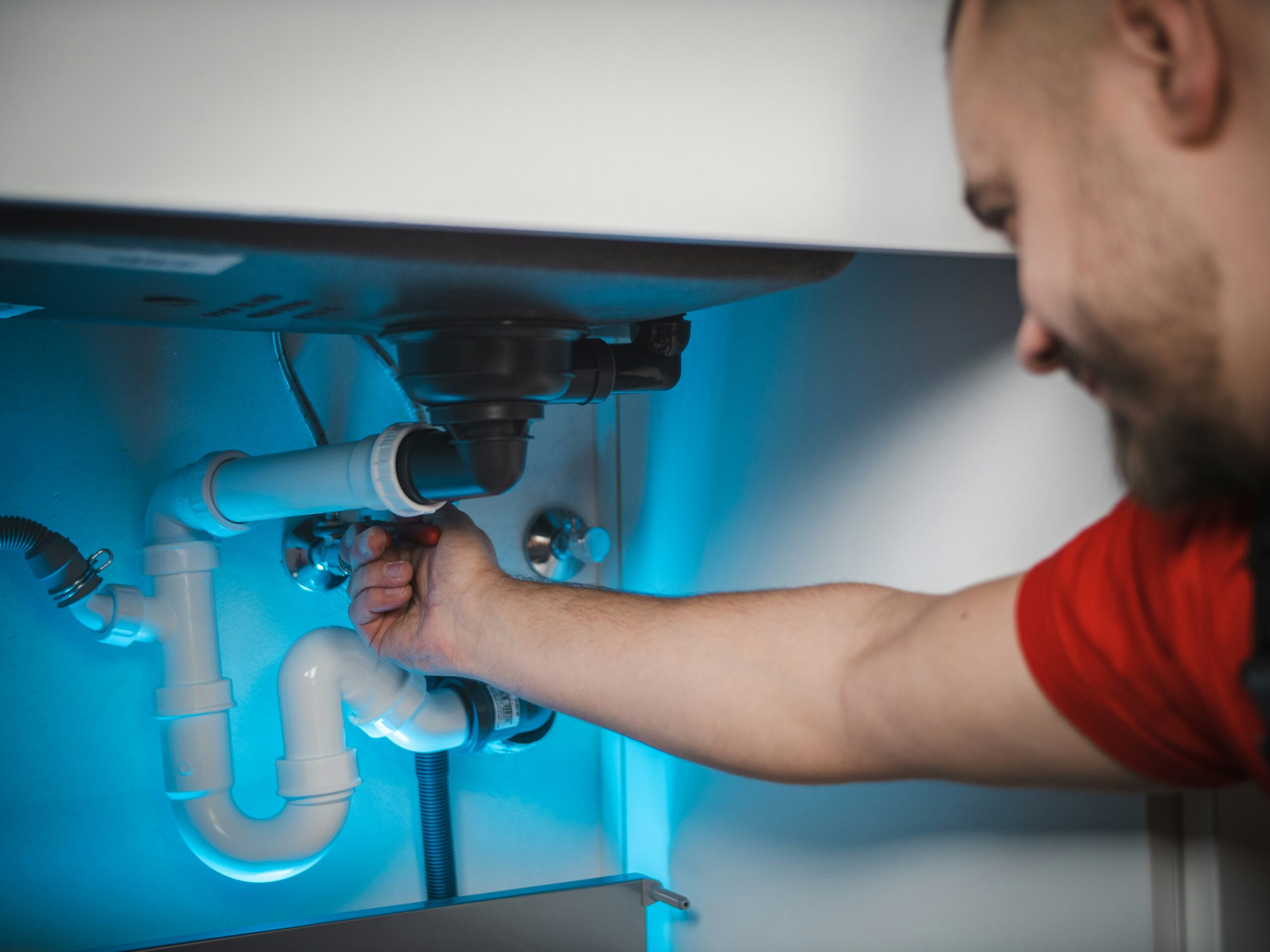
Water in a sink cabinet identifies where it was found, not where it began. It can track from a faucet, deck, rim or hose as well as escape from a supply, appliance or drain connection; do not start another leaking use to prove the source.
Safety before more water or service
Keep away from wet electrical equipment. Do not touch wet appliances, plugs or switches, or enter water to reach a breaker. When no gas leak is suspected, power may be isolated only from a safely accessible dry location; otherwise call an electrician or emergency help. Wet equipment needs qualified assessment before it is used again.
For strong, widespread or unexplained gas-like fumes, exposure symptoms, or suspected high sewer-gas concentrations in an enclosed space, leave the building immediately and call the fire department or emergency services from outside. Avoid flames, switches and other ignition sources; do not remain to ventilate, sniff drains or investigate. Smell intensity does not measure the concentration. A faint localized drain odor without those warning signs calls for a different plumbing investigation; it does not automatically establish a fuel-gas leak.
If fuel gas is suspected, leave the building or affected area immediately. Do not operate valves, switches, plugs, appliances or phones there. Call the gas emergency service from a safe location well away, and wait for responders’ clearance.
For wastewater rising from a drain or affecting several fixtures, stop adding water and keep affected appliances from discharging using only safely accessible dry controls when no gas emergency is suspected. Avoid sewage contact, keep children and pets away and arrange prompt drainage help. Notify building management or the sewer agency as appropriate. Do not run fixtures to locate a shared blockage.
If a cleaner may be present, identify the exact product and follow its label. Do not add another cleaner, acid, bleach, ammonia, vinegar or an improvised neutralizer. Do not plunge, snake or open the trap while hazardous residue may remain; tell the provider what was used. A rinse or elapsed time is not proof all residue is gone.
Never put hands or fingers into a disposer, even after power is disconnected. Use only the actual model’s permitted tools and maintenance procedure, with dry-safe electrical isolation before service. Not every splash guard is removable; do not pry one out or reach through it. Keep the unit inactive for a leak, jam, unknown object, chemical residue or unsafe electrical condition.
Contain the actual event
Stop affected use and keep connected appliances inactive. Use an appropriate known safe homeowner source control for an active supply leak and obtain prompt help for ineffective control, wet electrical equipment or hidden damage. A supply stop does not isolate shared wastewater. Do not put hands near a wet disposer, outlet or dishwasher connection. Drying and inspection come after those hazards are addressed.
Keep existing observations
- First visible wet point and any route down a hose, body, tailpiece or cabinet wall.
- Whether the original event was faucet use, basin drainage, appliance fill/discharge or idle time.
- Actual parts, recent work, prior cleaners, standing water and damage. Note a missing observation rather than creating a large new discharge.
Pressure and timing are different evidence
Supply hoses and their upstream joints can remain pressurized when the faucet is off. Gravity drains receive discharge, while a connected appliance may pump into them. Faucet-on timing can include supply, splash and drain flow simultaneously; it does not separate those paths. A deliberately separated captured observation needs a suitable planned method and safe receiving capacity; do not improvise by disconnecting a hose or running water through an open drain.
Use the correct service boundary
Before opening a cartridge retainer, supply hose or another pressure-retaining part, identify the actual model and every feed. Establish effective source isolation, controlled pressure release and verification at the serviced segment; a closed suspect stop or dry drain is not proof. Use compatible approved parts and secure retaining components before attended restoration and the actual leak/function checks. Maker-prescribed captured flushing can have a temporary source-on step; follow that complete identified procedure and source-off refitting, not a generic uncapped-valve test.
For a sound accessible owner-serviceable trap with only ordinary cool wastewater, first control every connected faucet, appliance and other input. Account for water retained in the basin and trap and provide adequate safe containment before opening a joint or pivot port. Exclude hazardous residue, shared return, gas, wet electrical equipment and damaged or uncertain parts. Follow the actual assembly instructions for compatible seals, alignment, support and tightening without force. Fully reassemble before a small attended cool-water leak check; never run a faucet into a disconnected drain or adjust a joint during discharge. A bucket does not isolate upstream wastewater. Ordinary gravity-trap care does not automatically require closing the house main.
For a supply connection use its actual approved sealing method and tightening limit; for a drain joint use the correct washer, alignment and support. Do not apply generic extra turns, sealant or clamps to every connection. Cracks, corrosion, damaged threads, unstable pipework or a wet hidden wall need appropriate assessment.
Dry and verify appropriately
Correct the water source and arrange suitable drying/cleanup for the actual sewage, material and electrical conditions. Do not cover unassessed wet cabinet or flooring. A towel tray or a short dry interval does not certify hidden damage repaired.
A justified check after correction needs fully secured sound assembly, a known accepting drain, controlled connected inputs, safe temperature and no hazardous residue. Begin with the actual procedure’s appropriately small attended discharge and stop for rise, leakage or movement. Do not run several fixtures or a full appliance cycle just to reproduce an unresolved backup or hidden leak. Calling for help does not depend on completing these checks.
Related situations
For broader topics, browse Bathroom Sink Mechanics & Drainage or Kitchen Sink & Food Waste Plumbing. Choose the actual fixture and event; these are broader directories, not a diagnosis.
Safety sources
- CDC: electrical hazards near water
- Wisconsin DHS: sewer-gas exposure and emergencies
- Con Edison: suspected gas leaks
- Madison Metropolitan Sewerage District: stop discharge and report sewer backup
- Example drain-opener label: restrictions on plunging, disposal operation and mixing
- Moen disposer example: safety and dishwasher-connection instructions
- Oatey HDC9682 example: compatible trap parts and full assembly before checking
- Moen bathroom example: water can track from a handle to the base
- EPA: correct the water source and dry affected materials appropriately