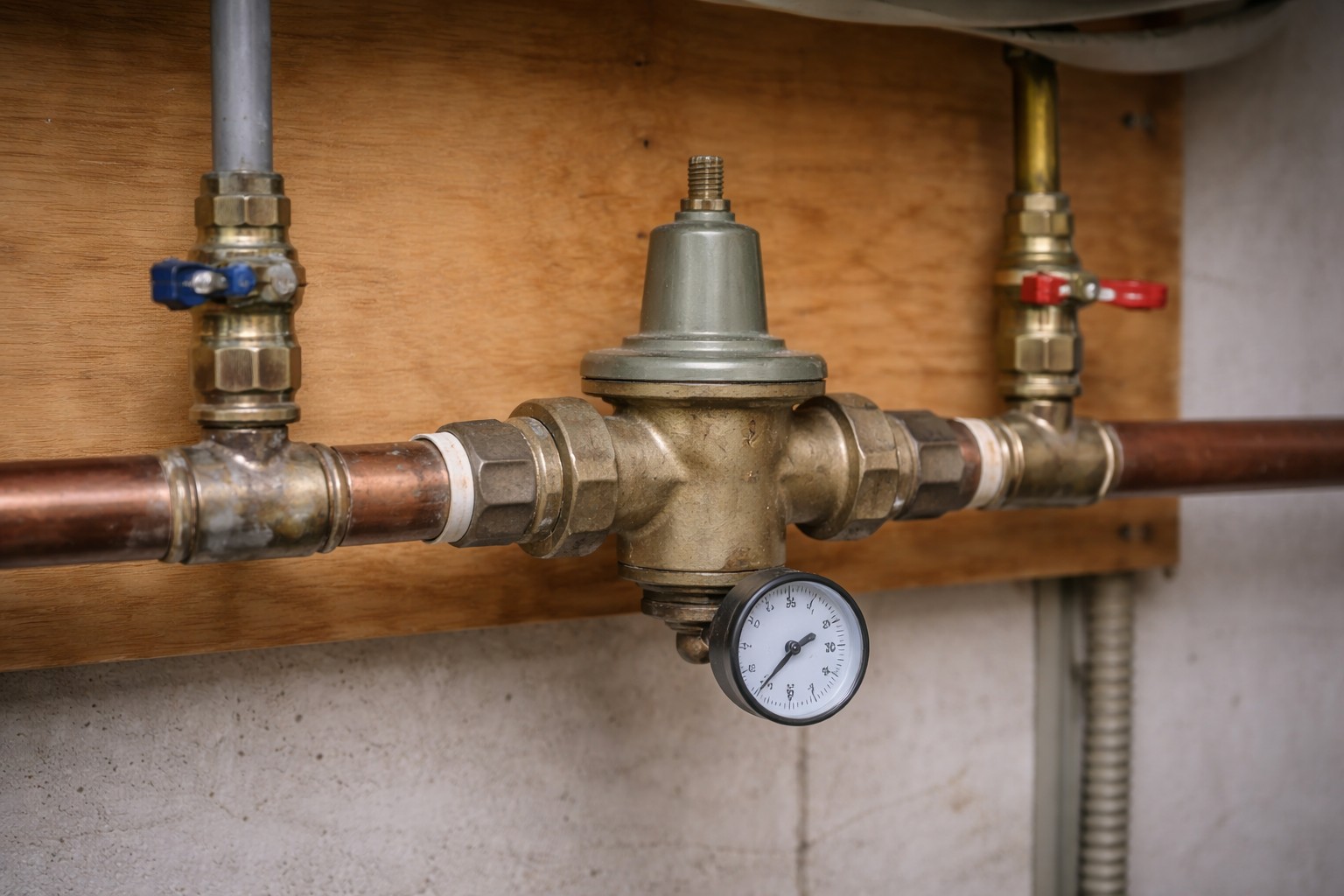
Unstable pressure after a PRV adjustment needs the actual model, setting history and pressure zones preserved. Do not keep turning a small valve or wait hours for damaging pressure to “reseat.”
Stop damage before measuring
If fuel gas is suspected, leave the building or affected area immediately. Do not operate valves, switches, plugs, appliances or phones there. Call the gas emergency service from a safe location well away, and wait for responders’ clearance.
Keep away from wet electrical equipment. Do not touch wet appliances, plugs or switches, or enter water to reach a breaker. When no gas leak is suspected, power may be isolated only from a safely accessible dry location; otherwise call an electrician or emergency help. Wet equipment needs qualified assessment before it is used again.
Stop affected use for violent spray, active leakage, severe movement, unsafe temperature or a damaged/over-range instrument, and obtain prompt appropriate help. Use a known effective safely accessible homeowner control without force where suitable. Do not wait overnight, complete a timing log or exceed a generic pressure threshold before calling. Keep away from hot relief discharge; never cap, plug or disable a relief outlet.
Keep the original event
- Who changed what, actual regulator/model, original and current measured values where recorded.
- Gauge locations, active loads, source notices and timing of immediate versus gradual changes.
- Leaks, appliance alerts, thermal/expansion equipment and any required shared services.
Paired measurements need an actual protected layout
Simultaneous appropriate upstream/downstream measurements under the same known condition can help assess behavior. Do not create a service port or assume a nearby hose bib is on the needed side. Closing downstream and opening a drain changes the test boundary; it does not by itself decide whether the regulator or house is the cause.
Stop arbitrary readjustment
Small increments, a small valve or a comfortable operator do not establish a safe target. Actual manufacturer instructions and measured source/downstream conditions govern a permitted external setting check; unstable behavior needs appropriate qualified diagnosis. Do not automatically restore an old screw position or promise time alone will settle the valve. Temporary appliance isolation also requires the actual equipment’s safe state; installing new shutoffs is not an improvised protective test.
Use measurements within their limits
A sound existing gauge or actual approved owner test connection can provide useful evidence if its location, pressure/temperature rating and connection/release method are known. No improvised port, live fitting or backflow test cock. Record actual gauge position relative to source, regulator and takeoffs, time, units and active demands. A capped outlet does not flow there; static and flowing readings describe different conditions. A basic dial or retained-maximum indicator may miss or understate a fast transient, and a recorded peak alone does not give its time, duration or cause. A steady remote reading does not exclude a brief event elsewhere.
Protection and service boundaries
Keep regulators, required backflow protection, expansion control, relief functions and fire/shared services effective. Closing a downstream valve does not remove the regulator from the circuit or prove it faulty if a symptom stops. Isolation changes the flow and pressure boundaries and may create a closed heated volume. Appropriate identified isolation for damage control or qualified model testing is different from an improvised overnight or bypass experiment.
Before any retained pressure part is opened, independently isolate every feed that can pressurize that segment, control temperature, release pressure through a suitable controlled outlet and verify depressurization there. A remote quiet tap, lower PRV setting or zone-off command is not proof. Keep it isolated during removal/refitting and secure compatible parts before attended restoration. Any model-permitted external regulator adjustment needs its actual instructions, measured target and safe system limits; a small valve, comfort with tools or body stamp is not enough.
What to do next
Use existing observations to give the appropriate utility, plumber, irrigation or well provider the event and actual system details. Suitable simultaneous measurements at identified points and appropriate recording response can guide assessment. Timing, disappearance after closure or a replacement part alone does not identify the failed component or certify the rest of the system. Do not recreate damaging events to finish a checklist.
Related situations
- Water pressure suddenly spikes at night
- Pipes bang after pressure surge
- Pressure Spikes & Sudden Surges
- Pressure gauge shows sudden jumps
- Pressure spike breaks washing machine hose
Safety sources
- Con Edison: suspected gas leaks
- CDC: electrical hazards near water
- Watts 25AUB example: actual measured pressure and regulator service
- Watts IWTG: water-pressure gauge and retained maximum indicator
- EPA: cross-connections and maintaining appropriate protection
- Watts PLT-35 example: qualified service and zero-water-pressure precharge requirement