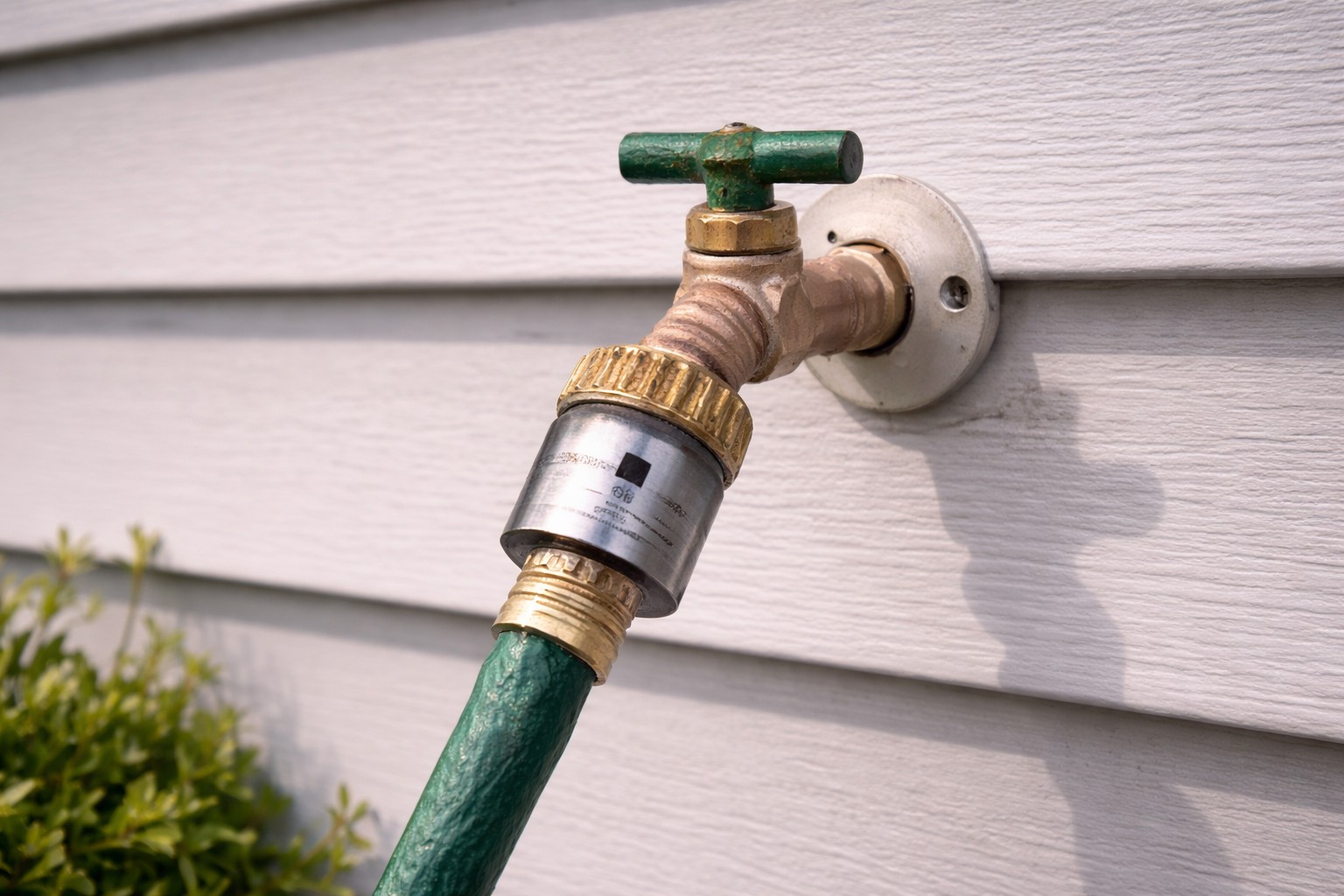
Check for an emergency first
Keep away from wet electrical equipment. Do not touch wet appliances, plugs or switches, or enter water to reach a breaker. When no gas leak is suspected, power may be isolated only from a safely accessible dry location; otherwise call an electrician or emergency help. Wet equipment needs qualified assessment before it is used again.
A household pressure drop during irrigation needs the actual irrigation demand and connection layout assessed. Pausing irrigation can be a sensible immediate step, but pressure recovery does not prove a dirty backflow preventer or inadequate pipe size. Do not open test cocks, bypass protection or flush a tie-in to investigate.
Useful details to record
- Which scheduled zone was already operating and whether a leak or unusual spray was visible from safety.
- Whether the irrigation uses the same supply, a separate meter or a pump, if known.
- The original household symptom, existing readings and any recent irrigation work.
What the pattern can tell you
- Pressure improves when an ordinary irrigation program is paused. That associates the symptom with the operating conditions; it does not locate a failed part.
- One zone differs from the others. Give the irrigation provider that history without staging every zone or digging for a leak.
- The pump or electrical area is wet. Keep clear; do not touch controls or enter water to disconnect equipment.
What to do next
- Pause the ordinary irrigation program using safely accessible dry controls if no gas emergency is suspected. Keep it off for visible leakage or severe household pressure/temperature changes and arrange service.
- For an optional cold-water measurement, use only an intact, safely accessible owner test connection whose location in the system is known, with a compatible gauge rated for the actual pressure and temperature. Follow its connection and pressure-release instructions; never loosen a pressurized fitting or use a backflow test cock as a household gauge port. Do not create a new connection to perform this check. A plumber can install or verify the measurement instead.
- Record the gauge location, time, units and whether water was already flowing elsewhere. Static pressure describes a no-flow condition; a running reading describes that specific demand. A hose outlet closest to the street is not necessarily upstream of the regulator or representative of the meter. Compare with the actual equipment limits and local supply requirements rather than a universal household target.
- Do not bypass a pressure regulator, backflow preventer or other protective control to see whether the symptom disappears. A different result after changing the supply arrangement does not prove the removed device was faulty. Approved protected arrangements and qualified device-specific tests are different from an improvised bypass.
- Leave backflow test cocks, relief openings and assembly isolation/test procedures to appropriately qualified personnel under the actual local program. A brief discharge from a test cock is not a household blockage check.
- Check only an identified owner-operated shutoff whose normal position and operating method are known, without force or repeated cycling. Do not manipulate curb stops, meter valves, utility fittings, backflow test cocks or an unknown valve. Contact the supplier for its equipment and the installer or plumber for household equipment.
- Have a suitable irrigation professional and plumber assess actual zone demand, leaks, available supply and required protection. Do not enlarge nozzles, remove checks, increase PRV pressure or flush into an open tie-in as the default remedy.
Can I bypass the backflow preventer briefly if I understand the risks?
No. Understanding the risk does not maintain protection for drinking water. Use the actual approved protected arrangement and qualified testing. If a water-quality concern follows irrigation, stop suspect use and contact the supplier promptly rather than tasting or simply flushing it clear.
Related situations
- Low pressure after new appliance install
- Pressure loss after long vacation
- Whole-House Low Water Pressure