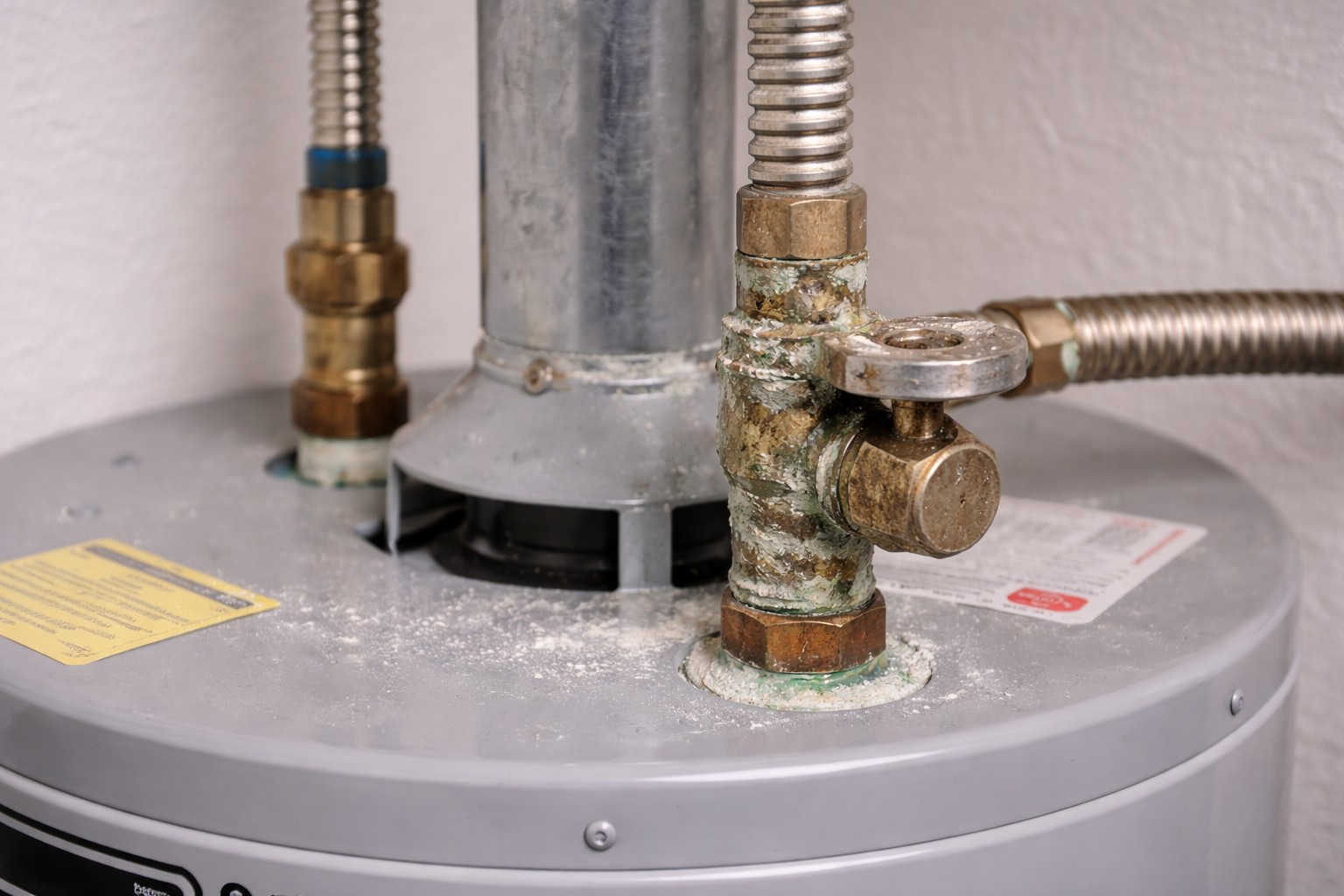
Check for an emergency first
If you smell fuel gas or suspect a gas leak, leave the building or affected area immediately and take others with you. Do not operate switches, plugs, phones, appliances, thermostats or valves in the affected area, light flames, or stay to ventilate or investigate. From a safe location well away, call the local gas emergency service or emergency services. Do not re-enter until responders say it is safe. Plumbing checks and normal maintenance must wait.
If a carbon monoxide alarm sounds or you suspect carbon monoxide exposure, get everyone outside immediately and call emergency services from safety. Carbon monoxide has no smell; an odor comparison cannot rule it out. Do not restart or repeatedly cycle a fuel-burning heater to investigate a possible combustion problem.
Keep away from wet electrical equipment. Do not touch wet appliances, plugs or switches, or enter water to reach a breaker. When no gas leak is suspected, power may be isolated only from a safely accessible dry location; otherwise call an electrician or emergency help. Wet equipment needs qualified assessment before it is used again.
If reduced delivery is noticed only when the heater runs, record exactly what runs: a storage heater’s heating cycle, a tankless burner or a recirculation pump. Those systems behave differently. Timing does not show whether the heater caused the flow change or reacted to it, and a weaker stream does not measure pressure.
Useful details to record
- The heater type and model and which visible operating indicator or normal sound coincided with the event.
- Whether one fixture or several were affected, and any temperature change already noticed.
- Existing error codes, pump schedules, service records or accessible gauge readings with their locations.
What the pattern can tell you
- The unit is tankless. Give the model and displayed code to its service provider. Do not assume a storage-tank purge or an internal sensor replacement applies.
- A recirculation event coincided. Preserve the existing schedule or log. Do not disable the pump, check valve or protective controls to see whether flow improves.
- Only one mixed fixture was affected. Its control path may be relevant. Opening another cold tap is not proof of a crossover or a safe remedy for unstable bathing water.
What to do next
- Avoid a shower or outlet that has become unpredictably hot. Respond to suspected gas, carbon monoxide or wet electrical hazards before operating equipment.
- Give the technician the timing and model-specific observations. Do not run hot water repeatedly or force burner cycles to demonstrate the fault.
- Do not open an unidentified strainer, remove a check valve or move a tempering setting. Internal service requires the exact unit procedure and appropriate isolation, cooling and pressure relief.
- If normal owner maintenance is appropriate for identified equipment, follow that procedure. A tank flush, a tankless service process and a pump adjustment are different tasks; choose one only after the relevant assessment.
Should I turn the pump off or open the cold tap as a test?
Do not use those changes to bypass the system’s intended water or temperature management. They can change several conditions at once and do not identify a failed component. Keep the event record and have the actual system tested under controlled conditions.
Related situations
- Hot water pressure drops mid-shower
- Hot water pressure weak but cold fine
- Pressure Fluctuates Only on Hot Water