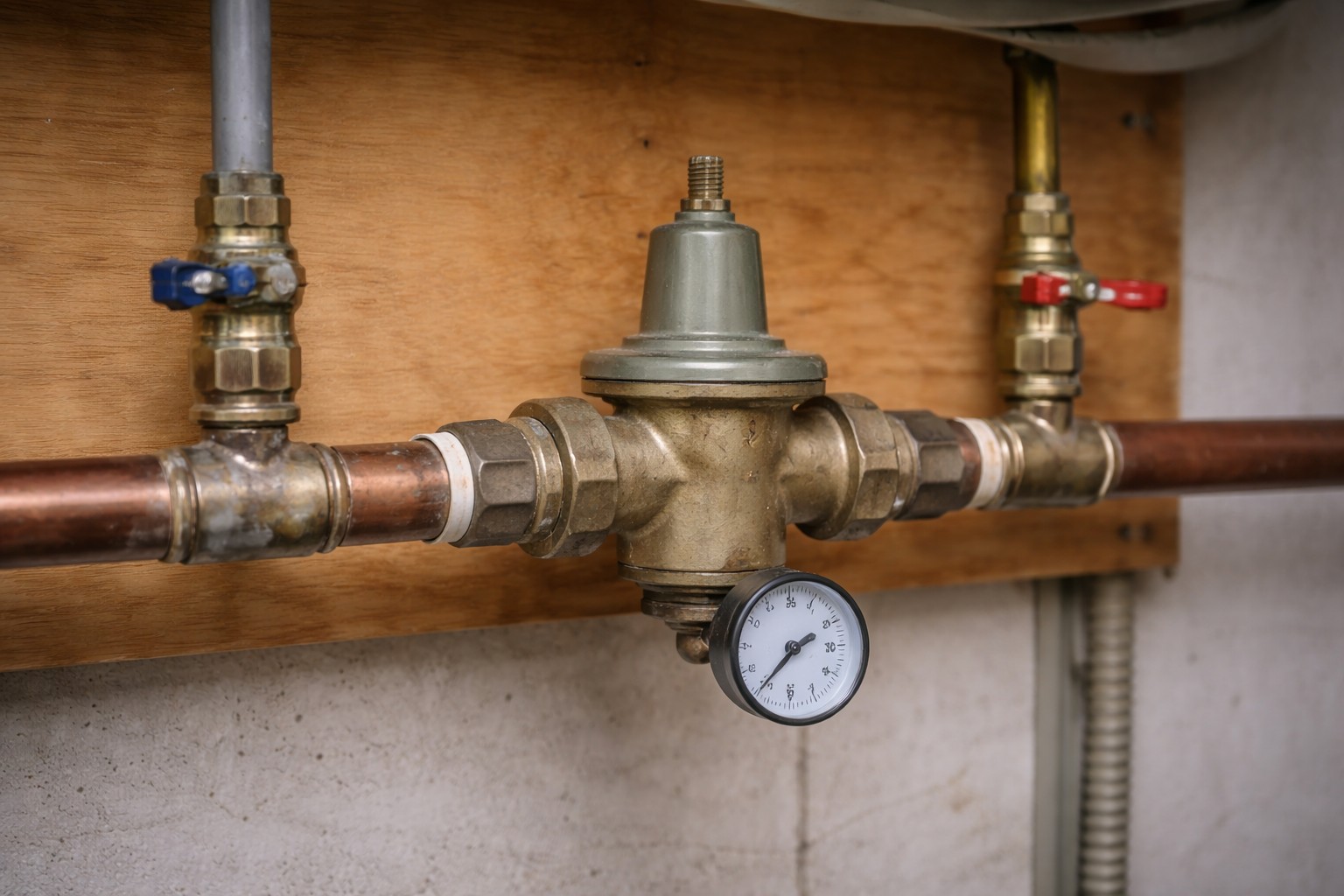
Hot water noticed at a cold tap needs the actual mixing/return layout and original temperature record. A reversed or faulty PRV does not create a hot-to-cold connecting path by itself.
Safety and appropriate use
If fuel gas is suspected, leave the building or affected area immediately. Do not operate valves, switches, plugs, appliances or phones there. Call the gas emergency service from a safe location well away, and wait for responders’ clearance.
Keep away from wet electrical equipment. Do not touch wet appliances, plugs or switches, or enter water to reach a breaker. When no gas leak is suspected, power may be isolated only from a safely accessible dry location; otherwise call an electrician or emergency help. Wet equipment needs qualified assessment before it is used again.
Avoid an outlet that can deliver an unexpected hot burst; warn other users and do not reproduce the event with bare skin, a shower or hottest-tap samples. For a suspected non-potable connection or water-quality incident, stop affected use and contact the water supplier promptly for restrictions. A repaired device and water-quality clearance are separate. Do not delay appropriate emergency containment or help merely to preserve a symptom. Use only an identified permitted owner emergency control from safe dry access without force; leave unknown utility/shared/fire or protected-system valves to their responsible provider.
Keep the original evidence
- Original ordinary outlet/setting and whether it followed work or a reported supply event.
- Known heater, mixing and recirculation model/installation record without opening panels.
- Existing scald-risk event, leak or water-quality concern without another temperature trial.
What it does and does not prove
Some approved recirculation designs intentionally return cooled hot-line water through a thermostatic path into the cold line. That example does not clear unexpected hot bursts or establish normal behavior for this installation. Pressure conditions require an actual connected path to cause crossover.
What to do next
- Avoid the affected outlet and ask the installer/plumber to identify actual intended versus unintended connections and protection.
- Do not attach gauges at meter/hot test ports or recreate a pressure event by snapping valves.
- Do not close a recirculation supply/return or change pump controls to prove a check fault. Changed behavior after isolation does not uniquely locate the path.
- Have any regulator orientation or installation issue assessed under its actual model; do not flip it as a hot/cold cure without a demonstrated connection.
Actual connection and protection assessment
Have the actual supply, return, mixing and non-potable connections identified before selecting tests or parts. Ordinary pressure/temperature interaction between fixtures does not prove unintended reverse flow. A valve response can change demand and connected paths without uniquely locating the cause. Keep required regulation, backflow and temperature protection effective; no open test cock, meter-side gauge, improvised bypass, relief-valve shortcut or repeated-load experiment is a general owner diagnostic.
Controlled service and startup
Any justified internal work needs the actual model, every feed/return and energy source, effective isolation, controlled pressure release and verification, appropriate cooling and a secured accepting discharge route. An open faucet or closed suspect stop does not establish every pressure boundary. Fully refit compatible retained parts before restoring pressure. A drained/opened electric storage heater needs verified full fill and the required air purge before energy; no universal gas-pilot position or timer replaces its procedure.
Does a backwards regulator alone explain hot water in a cold line?
It can be an installation issue, but a physical mixing/return connection and relevant conditions must also be established. Do not infer that path from orientation alone.
Related guides
- Cold water entering hot side
- Backfeeding between fixtures
- Flow Direction Reversal & Cross-Connection Issues
Safety sources
- Example electric-heater manual: filling and maintenance requirements
- Con Edison: suspected gas leaks
- CDC: electrical hazards near water
- EPA: cross-connection indicators, protection and incident response
- Watts HWRS-WH example: an intentional thermostatic cold-return path
- Watts25AUBexample: actual regulator model and service requirements