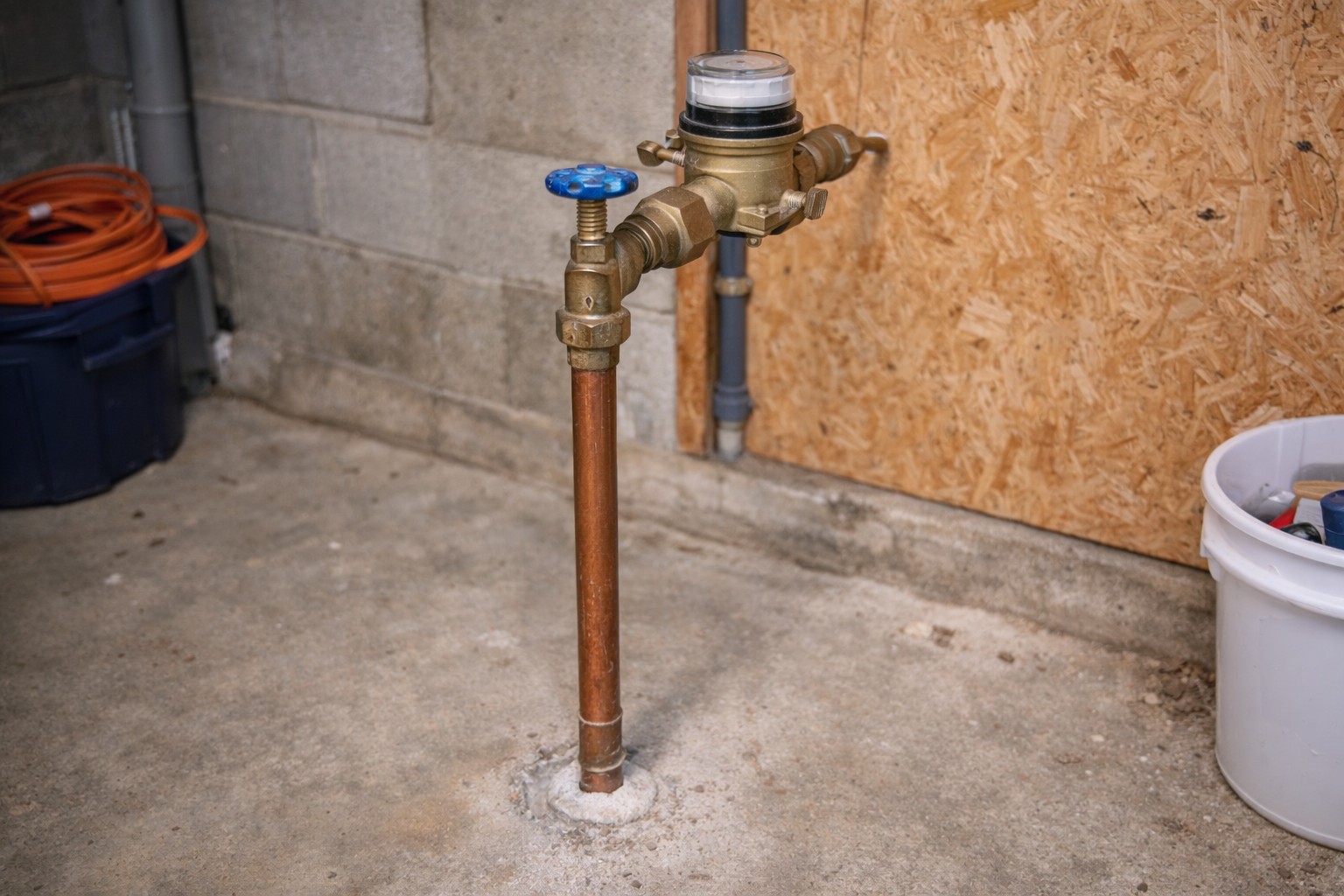
Weak upstairs hot delivery needs the original floor and hot/cold scope recorded with actual elevation and distribution. A good downstairs hot stream does not prove an upper riser or manifold restriction.
Protect people before a comparison
Avoid the affected bathing outlet for unstable or unexpectedly hot delivery. Do not put a person under a shower, touch unknown hot water or force another pressure event to demonstrate it. Leakage, relief discharge or severe change needs prompt appropriate service without a failed test first.
If fuel gas is suspected, leave the building or affected area immediately. Do not operate valves, switches, plugs, appliances or phones there. Call the gas emergency service from a safe location well away, and wait for responders’ clearance.
If a carbon monoxide alarm sounds or you suspect carbon monoxide exposure, get everyone outside immediately and call emergency services from safety. Carbon monoxide has no smell; an odor comparison cannot rule it out. Do not restart or repeatedly cycle a fuel-burning heater to investigate a possible combustion problem.
Keep away from wet electrical equipment. Do not touch wet appliances, plugs or switches, or enter water to reach a breaker. When no gas leak is suspected, power may be isolated only from a safely accessible dry location; otherwise call an electrician or emergency help. Wet equipment needs qualified assessment before it is used again.
Record the original event
- Original upstairs outlets, intended settings and safe downstairs observations already known.
- Actual heater, mixer, recirculation and branch layout from records, not a guessed hidden path.
- Existing measured conditions, work, leakage or unsafe temperature without another helper test.
What the evidence establishes
Different elevation, route, fixture and demand affect delivery. A heater starting or stopping with a tap can be a response to use. Neither that timing nor a normal downstairs outlet uniquely selects a heater or upstairs pipe repair.
What to do next
- Do not run multiple upstairs hot fixtures or a downstairs comparison to recreate weakness, or use your hand to establish safe temperature.
- Do not open unidentified manifold/heater controls, turn off recirculation or alter a mixer to compensate.
- Use actual intended outlet care only where safe; failure to improve does not prove a concealed branch blockage.
- Give the provider actual models, original scope and mapped measurement conditions. Do not cut a wall, drain a heater or replace a riser from this location pattern alone.
Before any service or setting change
Before any internal service or fitting removal, identify and isolate every supply that can pressurize the section, release trapped pressure through the appropriate controlled outlet and verify depressurization. Account for hot water and possible alternate feeds. Lowering a PRV setting, reducing flow or wearing gloves does not make a pressurized assembly safe to open. If isolation cannot be established, leave it assembled and obtain qualified help.
Actual heater service needs its model, safe energy isolation, cooling, every-feed water isolation, pressure release and secured accepting discharge path. A small hot sample, gloves or a short draw does not prove cooling. Do not restore supply into exposed or loosely held parts for a bucket test. A prescribed construction or service flush needs its complete retained/control/capture method and source-off refitting step. Fully reassemble before pressure restoration and verify leakage, intended operation and delivered temperature/protection. Refill and purge an electric storage tank as directed before power; tankless and recirculation equipment need their own procedures.
Do not bypass a pressure regulator, backflow preventer or other protective control to see whether the symptom disappears. A different result after changing the supply arrangement does not prove the removed device was faulty. Approved protected arrangements and qualified device-specific tests are different from an improvised bypass.
Check only an identified owner-operated shutoff whose normal position and operating method are known, without force or repeated cycling. Do not manipulate curb stops, meter valves, utility fittings, backflow test cocks or an unknown valve. Contact the supplier for its equipment and the installer or plumber for household equipment.
Does normal ground-floor hot delivery certify the upper branch is at fault?
No. It is a useful original observation with limits. Actual elevation, paths, demand and protected control behavior must support the finding.
For persistent changed delivery, give the installer or qualified plumbing/heater provider the actual model, work record, original phase and existing readings. A hot stream’s strength, a heater sound and a simultaneous clock event are observations; they are not interchangeable pressure, temperature or failed-part measurements. Appropriate safe intended fixture outlet care can be useful under its actual instructions, but it does not authorize retained cartridge, heater-screen or protective-device service.
Related guides
- Hot water pressure drops mid-shower
- Hot water pressure weak but cold fine
- Pressure Fluctuates Only on Hot Water
Safety sources
- Con Edison: suspected gas leaks
- CDC: carbon monoxide alarms and wet electrical devices
- CDC: electrical hazards near water
- Example electric-heater manual: filling and maintenance requirements
- A. O. Smith: water-heater maintenance and refill before restart
- Watts: LF1170/LFL1170 master tempering-valve instructions and limits
- Watts 25AUB example: regulator service, pressure measurement and limitations
- EPA: cross-connections and maintaining appropriate protection
- BrassCraft: water supply stop instructions