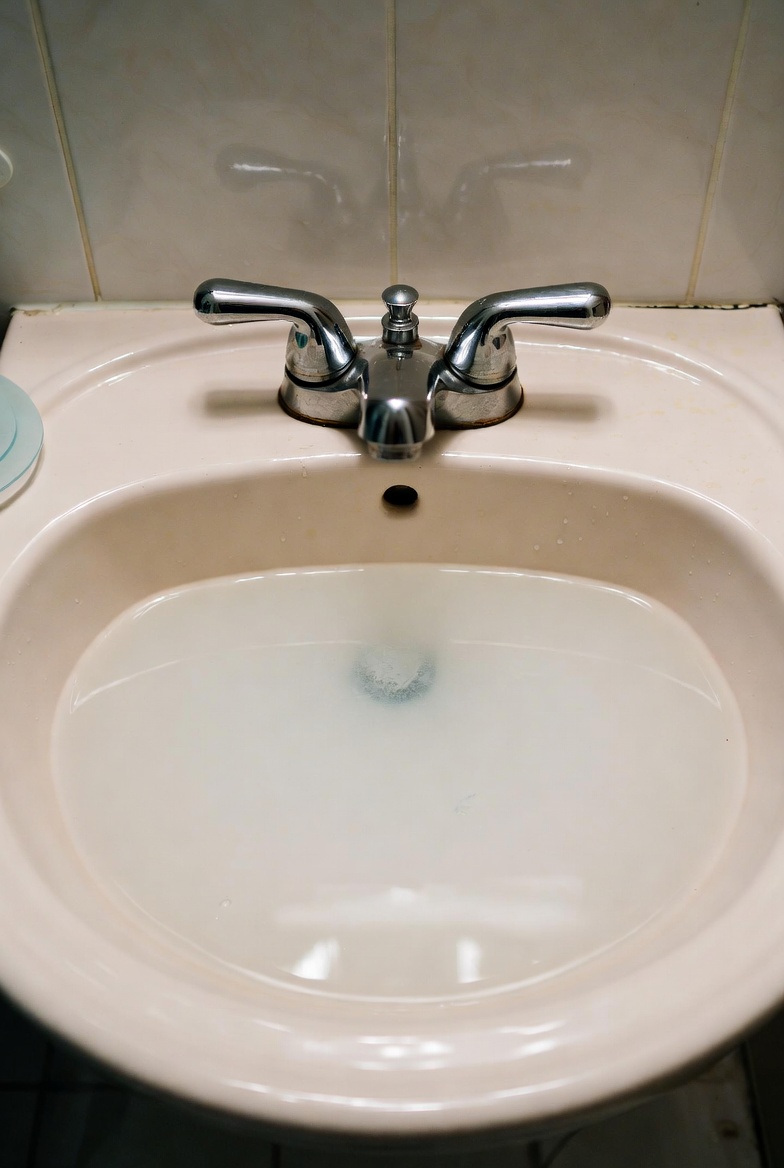
Check for an emergency first
For strong, widespread or unexplained gas-like fumes, exposure symptoms, or suspected high sewer-gas concentrations in an enclosed space, leave the building immediately and call the fire department or emergency services from outside. Avoid flames, switches and other ignition sources; do not remain to ventilate, sniff drains or investigate. Smell intensity does not measure the concentration. A faint localized drain odor without those warning signs calls for a different plumbing investigation; it does not automatically establish a fuel-gas leak.
If fuel gas is suspected, leave the building or affected area immediately. Do not operate valves, switches, plugs, appliances or phones there. Call the gas emergency service from a safe location well away, and wait for responders’ clearance.
Keep away from wet electrical equipment. Do not touch wet appliances, plugs or switches, or enter water to reach a breaker. When no gas leak is suspected, power may be isolated only from a safely accessible dry location; otherwise call an electrician or emergency help. Wet equipment needs qualified assessment before it is used again.
Intermittent cross-flow that returns after a period of normal drainage deserves a recurrence history. Temporary improvement after plunging or trap cleaning does not prove the shared path is clear. Do not dismiss the next episode or reproduce it with more fixtures to identify a branch.
Useful details to record
- What was cleaned or repaired, what material was actually removed and how long normal drainage lasted.
- The fixtures and ordinary appliance phases associated with each recurrence.
- Whether wastewater, strong odors, leaks or other affected drains were already observed, and any chemical use.
What the pattern can tell you
- It returned after local cleaning. Tell the provider exactly what improved and for how long. A local intervention may not address the underlying path or installation.
- Several fixtures are involved. Stop affected use and arrange assessment of the shared system rather than repeatedly clearing each trap.
- It coincides with an appliance discharge. Preserve that timing; it does not identify a pump fault, check valve or vent requirement by itself.
What to do next
- Before using a tool, ask whether a drain opener or other chemical was added. If so, follow the exact product label and tell the plumber what was used. Do not plunge, snake, open the trap, run the disposal or try a neutralizer while hazardous residue may remain. Waiting a generic number of hours or rinsing by guesswork does not establish that the drain is safe to handle.
- Avoid further discharge during a backup and keep people away from sewage. Use the emergency boundary above for strong gas-like fumes or exposure symptoms.
- For an isolated plain-water sink problem without hazards, remove surface debris if appropriate; use the linked kitchen guide rather than escalating blindly to repeated or powered clearing.
- Do not add a check valve, change an air gap or open a roof vent to prevent recurrence by guesswork. Have the actual required arrangement checked.
- Give the plumber the recurrence and service record. Ask what observations support a local clearing, an installation correction or a deeper inspection; a camera or a particular repair is not automatically required in every case.
Is normal drainage between episodes evidence that no repair is needed?
No. It shows the symptom was absent under those conditions, not that the cause was removed. A useful follow-up checks the original problem and the actual shared path, while keeping chemical, sewage and overflow hazards out of repeated tests.
Related situations
- Sink backs up into clean bowl
- Left bowl backs up when right drains
- Double-Bowl Sink Cross-Flow Issues