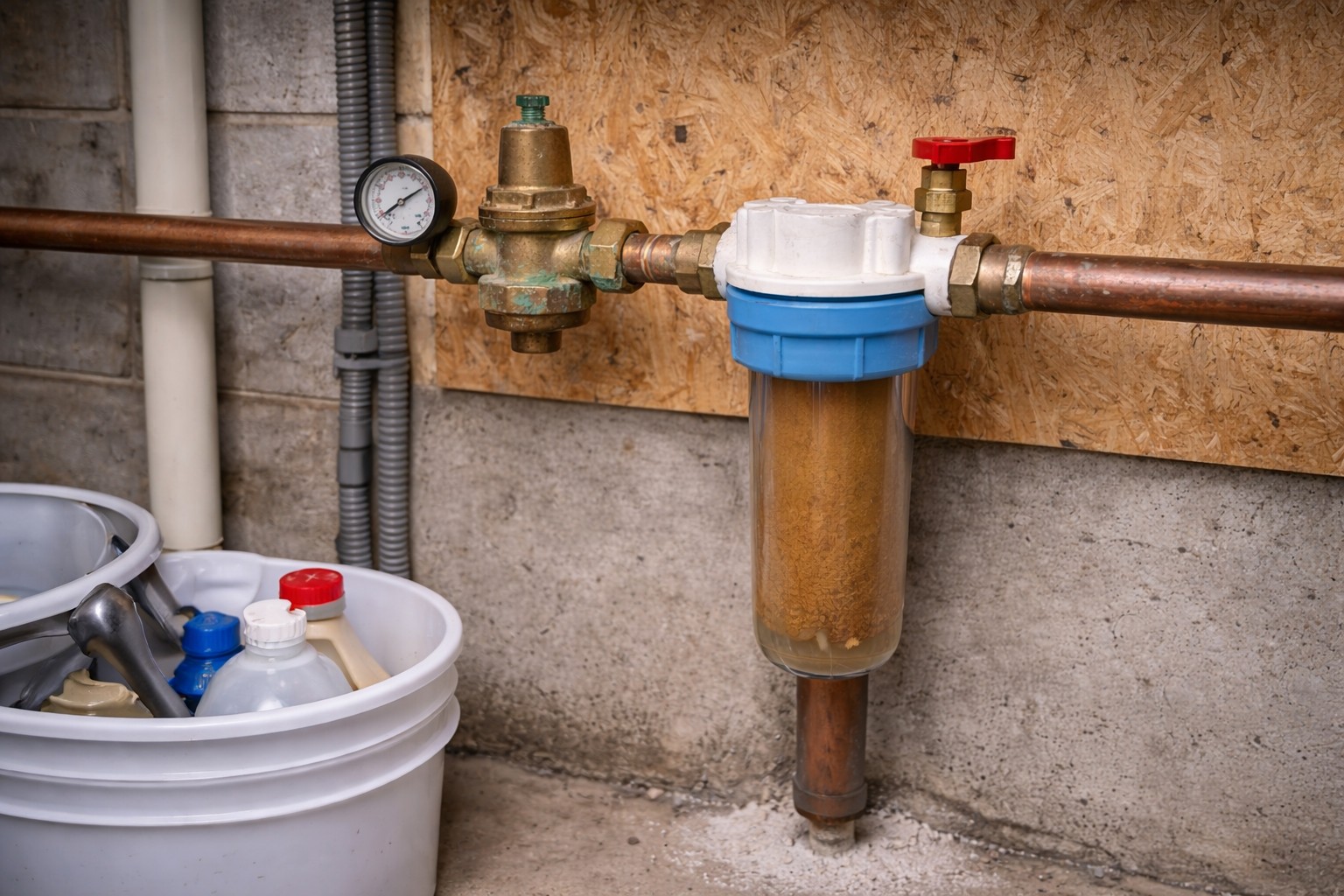
This guide starts with a pressure-drop observation when a branch or appliance was used. Treat the suggested cross-connection as a hypothesis until actual connecting-path and direction evidence supports it.
Safety and appropriate use
If fuel gas is suspected, leave the building or affected area immediately. Do not operate valves, switches, plugs, appliances or phones there. Call the gas emergency service from a safe location well away, and wait for responders’ clearance.
Keep away from wet electrical equipment. Do not touch wet appliances, plugs or switches, or enter water to reach a breaker. When no gas leak is suspected, power may be isolated only from a safely accessible dry location; otherwise call an electrician or emergency help. Wet equipment needs qualified assessment before it is used again.
Avoid an outlet that can deliver an unexpected hot burst; warn other users and do not reproduce the event with bare skin, a shower or hottest-tap samples. For a suspected non-potable connection or water-quality incident, stop affected use and contact the water supplier promptly for restrictions. A repaired device and water-quality clearance are separate. Do not delay appropriate emergency containment or help merely to preserve a symptom. Use only an identified permitted owner emergency control from safe dry access without force; leave unknown utility/shared/fire or protected-system valves to their responsible provider.
Keep the original evidence
- Existing affected branch/outlet and ordinary demand event.
- Suitable known-point gauge information with static versus flowing state.
- Actual supply/return/protection layout and any work or quality concern.
What it does and does not prove
Pressure recovering after a branch closes can simply reflect lower demand. It does not prove that branch contains a cross-connection. A pressure gauge records pressure at its point, not the direction of water through every connected pipe.
What to do next
- Have the actual supply, regulation and branch demand assessed without opening all outlets or operating unknown controls.
- Do not close boiler, treatment, heater-bypass or irrigation valves one by one, run appliances or repeat temperature/smell tests to declare a source.
- Keep protection effective and use appropriate controlled model-specific measurements when selected by the provider.
- For a direction-of-flow question, use the related reversal-evidence guide. Do not call a pressure change a measured reverse-flow result.
Actual connection and protection assessment
Have the actual supply, return, mixing and non-potable connections identified before selecting tests or parts. Ordinary pressure/temperature interaction between fixtures does not prove unintended reverse flow. A valve response can change demand and connected paths without uniquely locating the cause. Keep required regulation, backflow and temperature protection effective; no open test cock, meter-side gauge, improvised bypass, relief-valve shortcut or repeated-load experiment is a general owner diagnostic.
Does pressure returning when a branch is closed locate a cross-connection?
It shows changed operating conditions. Actual mapped connections and appropriately controlled findings must establish any unintended transfer.
Related guides
- Water heater backflow symptoms
- Pressure loss due to flow reversal
- Flow Direction Reversal & Cross-Connection Issues
- How to detect cross-connection