After valve or cartridge replacement, check the actual part and commissioning record before another replacement. Similar appearance or a matching stem does not establish compatibility with the installed body and revision.
For safe first response and service boundaries, start with Temperature Unstable After Valve Replacement: First Checks.
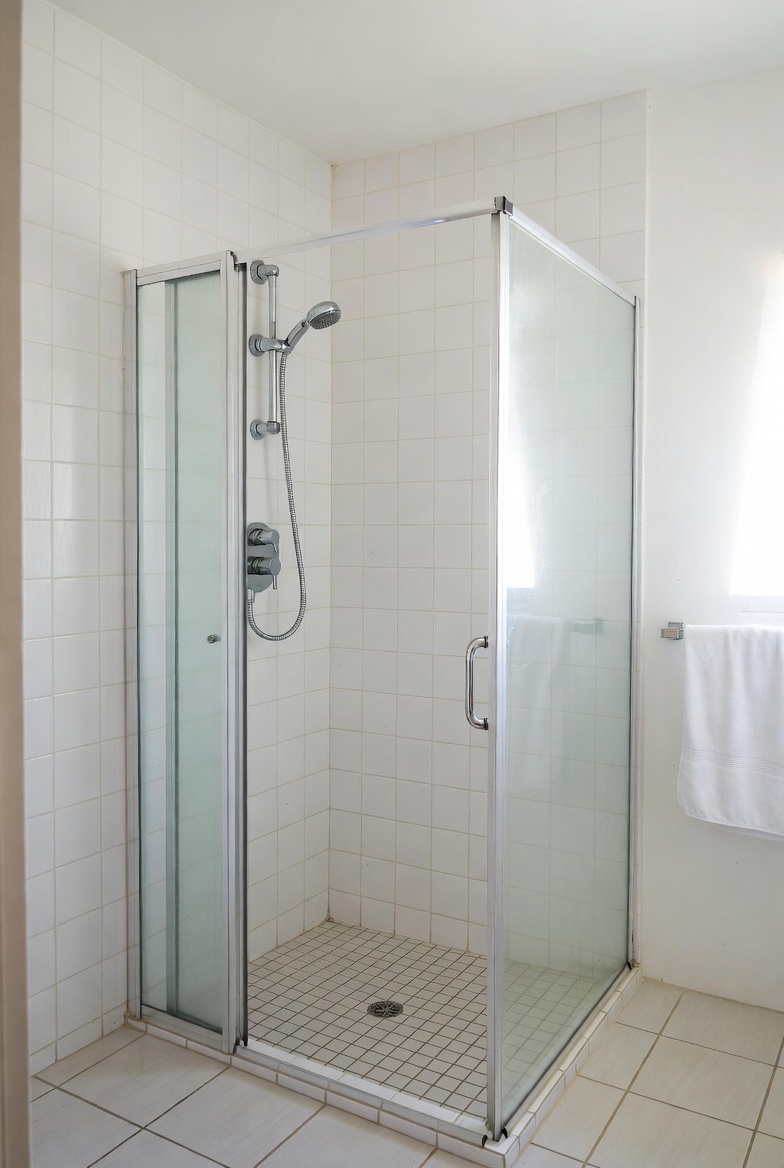
The shower-enclosure photograph provides fixture context. It does not identify the installed valve body, replacement part or delivered temperature.
Stop unsafe bathing before investigating
For unexpected hot surges or unpredictable temperature, move out of the spray and stop bathing. Stop flow only from a safely reachable control without crossing dangerous water or risking a fall. Keep the shower out of bathing use until assessed and restored. A lower starting setting or separate appliance schedule does not certify protection.
If heater concerns include gas or carbon monoxide
For suspected fuel gas, leave without operating valves, switches, appliances or phones in the affected area. Call the gas emergency service from well away and wait for clearance. A CO alarm or suspected CO exposure requires everyone outside and an emergency call from safety. CO has no odor; do not cycle a heater to investigate.
A record you can use
- Installed body and replacement
- Keep the actual body/model/revision identification and the old and new part numbers from existing paperwork. A box, receipt or similar stem identifies a supplied part; ask how its compatibility with the installed body was confirmed.
- Completed assembly
- Keep the installer’s existing record of orientation, seals, secure retention and required operating/limit parts. Missing documentation is a question for the installer; this record does not require opening trim or inspecting a live valve.
- Commissioning evidence
- Keep the date, actual outlet, measured delivered temperature and conditions from the completed commissioning record. A temperature setting, part number or “tested” note without those details is a different kind of evidence.
- Open question and return to bathing
- Write down what remains unverified and who is handling it. Ask how the actual model’s required checks were completed. Do not fill a blank by standing in the spray, moving a limit stop or repeating an unstable event.
This is a record of existing identification and completed work, not a cartridge-fitting or temperature-adjustment procedure.
Fictional example: “A replacement-part receipt is available. The installed body revision and commissioning measurements have not been supplied. The original hot surge was reported after the repair.” This is a compatibility and handover question; it does not prove the part is wrong or safe.
Keep the existing record
- Actual valve-body identification, old/new part numbers and installation instructions, with any retained components.
- Orientation, seals and retention recorded during the work, and the original post-repair temperature behavior.
Fit includes the protection parts
The maker’s indexing, seals, retainer/bonnet and limit-stop assembly matter, as do correct hot/cold connections. A permitted temporary test handle must still provide the required control and limiting function. Do not operate a partly retained cartridge, omit a disc or infer the correct limit direction from a different series.
Do not substitute generic cleaning or lubrication
Use only the exact approved cleaner, lubricant and parts; “plumber-approved silicone” is not universal material compatibility. A nearby open hot tap may not release pressure trapped at the worked segment. Re-isolate and verify local pressure before another cartridge change after a live test. Persistent instability does not prove the new part defective, and an hour of work is not a safe-use deadline.
Pressure balancing responds to inlet-pressure differences; thermostatic control responds to mixed-water temperature within its operating limits. They are not interchangeable names for every cartridge. A pressure-balanced valve does not necessarily compensate for changed inlet temperature. Rotation may change temperature without providing independent volume control. Use the actual model sheet before interpreting a low-flow test or changing a limit stop. Do not defeat required protection or increase heater settings to force a warmer shower.
Set up any further measurement safely
Further diagnostic runs need the actual model’s method, sound retained assembly, an accepting drain or secured receiver, and a safely reachable control. Keep everyone out of the spray. Measure delivery with a suitable thermometer positioned without skin exposure; a display, pipe touch or hand check cannot measure an unstable event. Stop for unsafe temperature, leaks or backup. If that setup is unavailable, arrange qualified testing. An ordinary pre-bathing check differs from deliberate exposure to known instability.
Use the actual service and return-to-use procedure
Internal work needs the exact model, isolation of all connected hot/cold feeds, cooling, and controlled local pressure release and verification before opening. A closed shower handle or unrelated open sink is insufficient. Use approved compatible tools, parts, cleaner and lubricant. Complete seals, orientation and secure retention before restoration. Restore the required handle, trim and limit parts, then verify the maker’s cold-first and delivered-temperature requirements before bathing. Re-isolate and release pressure again before reopening after a test.
Follow up on the actual result
Keep the original record and any safe measurements. Ask what was corrected and how delivered temperature, required protection and leak-free return to use were verified. One steady test or a new cartridge does not establish every operating condition.
Related patterns
- Temperature changes when dishwasher runs
- Hot Water Fades Then Returns: Timing and Heater Ratings
- Temperature Swings During Shower Use