Check for an emergency first
If you smell fuel gas or suspect a gas leak, leave the building or affected area immediately and take others with you. Do not operate switches, plugs, phones, appliances, thermostats or valves in the affected area, light flames, or stay to ventilate or investigate. From a safe location well away, call the local gas emergency service or emergency services. Do not re-enter until responders say it is safe. Plumbing checks and normal maintenance must wait.
If a carbon monoxide alarm sounds or you suspect carbon monoxide exposure, get everyone outside immediately and call emergency services from safety. Carbon monoxide has no smell; an odor comparison cannot rule it out. Do not restart or repeatedly cycle a fuel-burning heater to investigate a possible combustion problem.
Keep away from wet electrical equipment. Do not touch wet appliances, plugs or switches, or enter water to reach a breaker. When no gas leak is suspected, power may be isolated only from a safely accessible dry location; otherwise call an electrician or emergency help. Wet equipment needs qualified assessment before it is used again.
A temperature swing during a pressure or demand change can cause scalding even if the heater is working. Avoid using the affected shower or bath until delivery is stable and its protection is assessed. Do not ask someone to stand under the water while another fixture or pool-fill system recreates the event.
Useful details to record
- Which outlet changed temperature, whether it went hot or cold, and the normal activity already associated with the change.
- Whether other fixtures were affected, using observations already made. Do not generate another hazardous swing to complete the list.
- The fixture and heater models, recent work and any supplier pressure event or notice. Keep existing readings and device alerts.
What the pattern can tell you
- A second fixture was in use when the swing occurred. That timing helps the plumber investigate demand and control behavior. It does not prove the original fixture is sound.
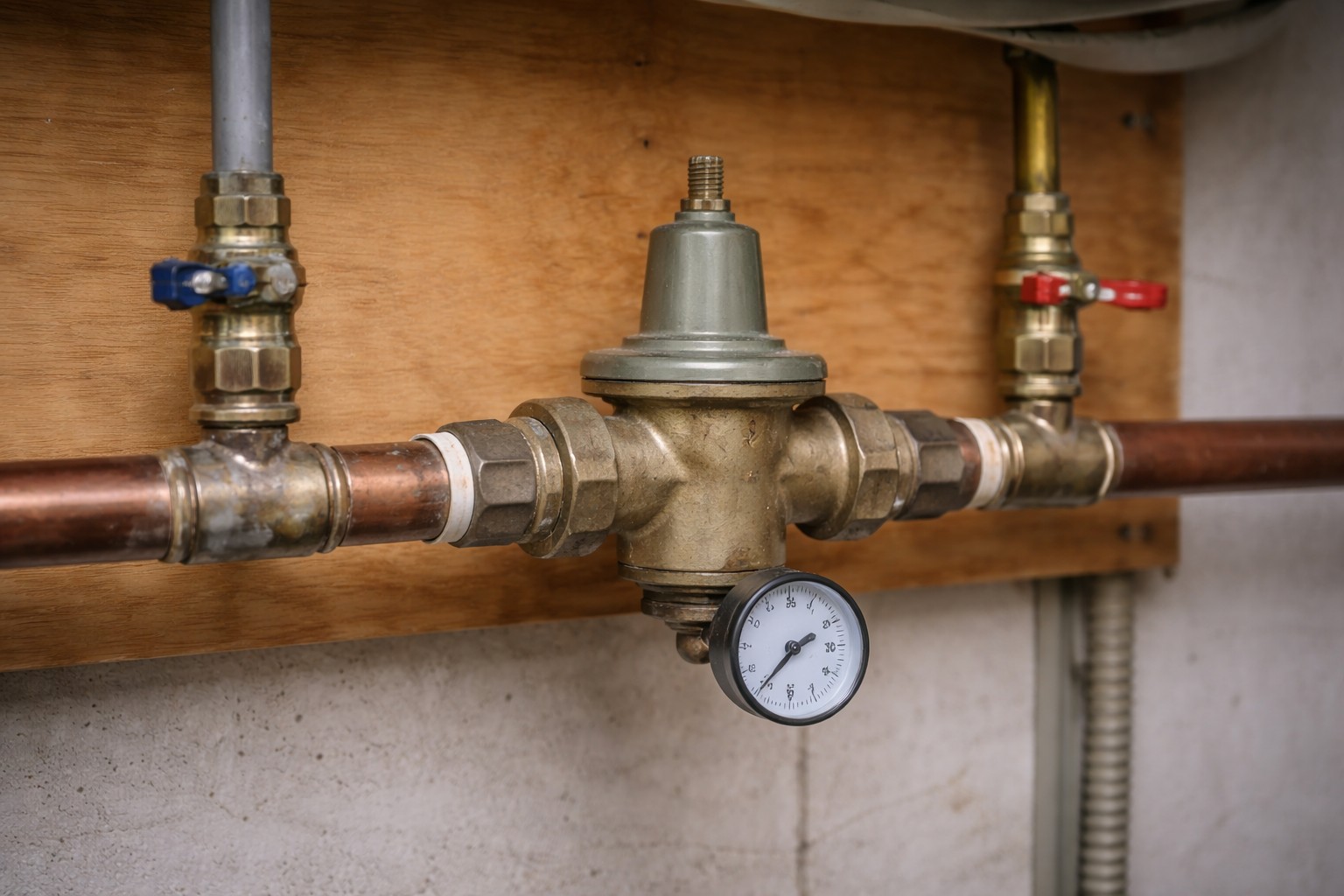
- A heater-area mixing valve is installed. Identify it rather than assuming it provides fixture-level protection. The linked Watts master valve is expressly different from required fixture protective devices.
- The effect appeared after a repair or setting change. Give the installer the work and setting history without making more adjustments. Correct flow feel alone does not verify safe temperature delivery.
What to do next
- Use the emergency response above if gas or carbon monoxide is suspected; do not operate fuel controls first.
- Give the plumber the observed timing and affected fixtures. Ask for assessment of both supply behavior and the actual fixture’s temperature protection.
- Keep mixing, pressure-balancing, anti-scald and other protective devices effective. Do not bypass them, turn a master mixer to maximum hot or randomly increase the regulator.
- Any pressure or temperature test should use the identified equipment’s procedure and a controlled discharge without bathing exposure. A meter movement or one hose-bib reading cannot prove which component caused the swing.
Will replacing a cartridge or adjusting the heater fix it?
Only if the investigation establishes that remedy for the actual system. The reported pattern can involve supply conditions, controls or both. Preserve the scenario information and verify safe delivered temperature and protection after service, rather than treating disappearance during one trial as proof.
Related situations
- Pressure drops during peak city hours
- Pressure loss when pool autofill runs
- Pressure Drops When Multiple Fixtures Run