Quick Answer:
If the whole house loses water pressure at once with no visible leak, check the service entry and main shutoff, measure pressure at an outside hose bib with a gauge, and isolate major components (pressure regulator, water heater, filters). If basic checks and flushing don’t restore normal psi, call your water utility or a plumber. Do the simple tests below before replacing fixtures.
Why This Happens
- Supply-side problem: a utility main break, a closed valve at the meter, or maintenance can drop pressure everywhere.
- Service entry blockage or failure: a failed pressure-reducing valve (PRV), clogged service line, or debris at the service connection.
- Internal component issue: clogged filters, a failed regulator, or a water heater bypass affecting hot water only.
- Meter or valve partially closed: sometimes the meter valve or main shutoff is partly closed after work or by accident.
- Occasional symptom overlap with Gradual pressure decline throughout house — the cause can be similar but sudden failures are usually simpler to trace.
Step-by-Step What to Do
1. Quick neighborhood check and main shutoff
- See if neighbors have the same problem. If they do, the utility is the likely cause; call them.
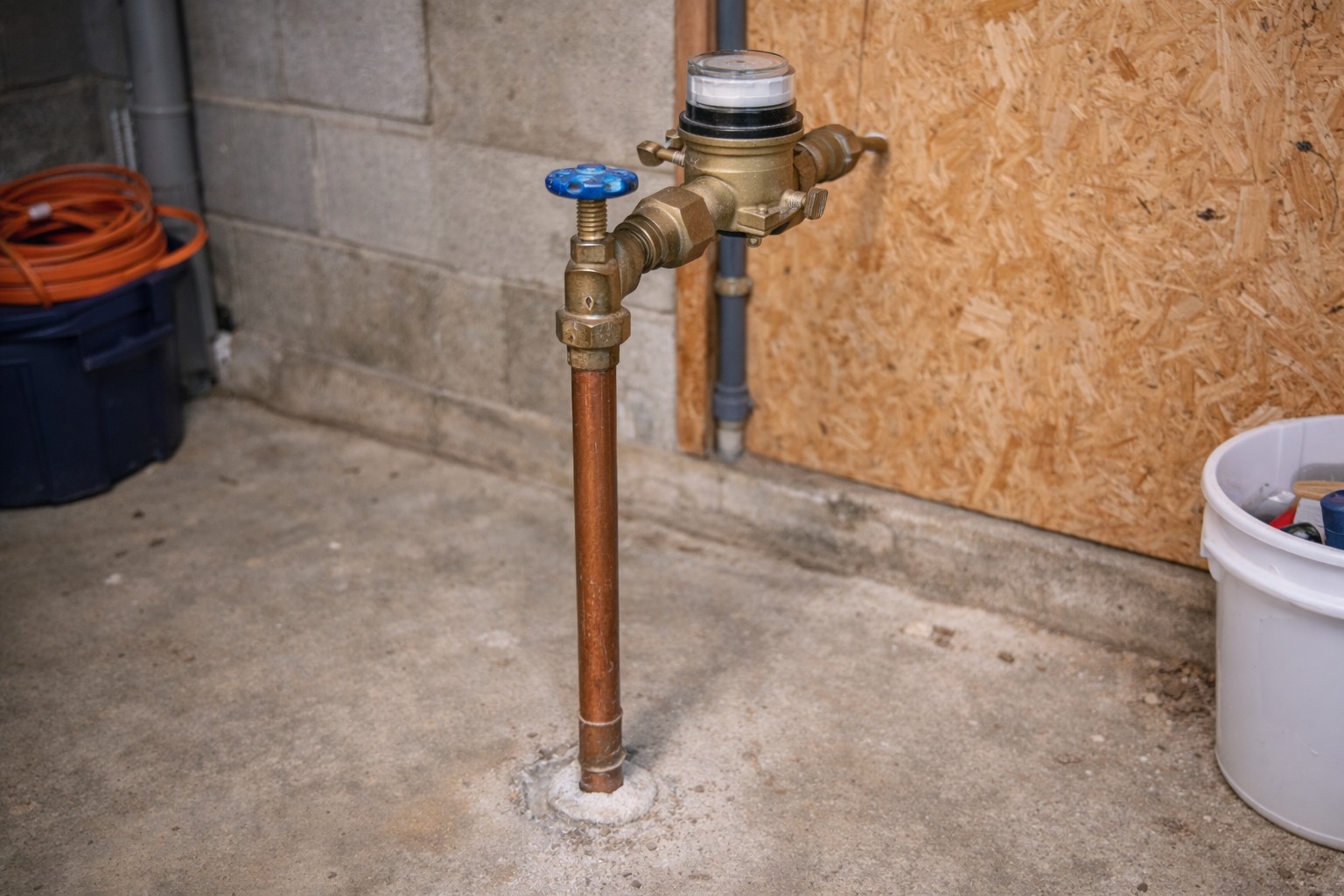
- Verify your main shutoff (usually at the meter or where the service enters the house) is fully open.
2. Measure pressure at the hose bib
- Attach a simple water pressure gauge to an outdoor hose bib (spigot) and open fully. Record the PSI. Typical homes are 40–60 psi; anything under about 20–25 psi is low.
- Measure both cold and hot separately if possible. That helps narrow whether the issue is upstream or a hot-side component.
3. Isolate main components
- Shut off and isolate the water heater (turn off power/gas and close valves) to check if hot-side components are causing low hot pressure.
- Bypass or remove inline filters and softener temporarily to see if pressure returns. Close valves around those devices and retest pressure at the hose bib.
- Check the pressure-reducing valve (PRV) near the service entry. If you can safely access it, test pressure upstream and downstream of the PRV to see if it’s stuck or failed.
- Watch behavior when you open multiple taps — some problems show up only under flow. Note if **Pressure improves when multiple taps open**; that behavior points toward certain regulator or clog patterns.
4. Flush system appropriately
- Open the outside hose bib fully for a couple of minutes to flush debris from the service line. A steady, full flow helps clear small clogs.
- Flush fixtures one at a time: remove aerators and run taps to check flow from each branch. Sediment in aerators can make pressure feel low at individual fixtures.
- Consider flushing the water heater if hot pressure is low and you have not flushed it in a long time (follow manufacturer instructions; power/gas must be off before draining).
- After flushing, reattach aerators and retest pressure at the hose bib and inside fixtures.
5. Check the meter and call the utility if needed
- Look at the water meter indicator. If it shows flow when all taps are off, you may have an unseen leak; if the meter is dead, the utility may have shut service off for work.
- If your measured pressure at the hose bib is low and you confirmed the main is open, contact the water utility — the issue may be on their side of the meter.
What Not to Do
- Do not immediately replace fixtures without verifying service entry issues.
- Do not remove or adjust the pressure-reducing valve unless you are comfortable and understand how to re-set it; it can cause high pressure if misadjusted.
- Do not open the water heater relief valve to “test” pressure — that is unsafe.
- Do not use harsh chemicals to try to clear a suspected service-line clog; that can damage plumbing or the environment.
When to Call a Professional
- There is no pressure improvement after measuring at the hose bib, isolating components, and flushing.
- The meter shows flow with everything off (possible hidden leak) or you see water damage or unexplained wet areas.
- You suspect a failed PRV, a service-line blockage, or need the utility to inspect the service connection.
Safety Notes
- Turn off the main before doing major isolation work. If unsure where it is, ask the utility or a plumber.
- Shut off power or gas to the water heater before draining it. Scald risk and electrical hazards exist when working on hot-water equipment.
- Avoid working on the meter or cutting the service line; that is typically utility or licensed-plumber work.
- Wear eye protection when flushing lines that may eject debris or sediment.
Common Homeowner Questions
- Why measure at the hose bib? — It gives a direct reading of service pressure before house plumbing affects it.
- Can a water heater cause whole-house low pressure? — Usually only the hot side is affected; if both are low, the problem is likely upstream.
- How long should I wait for the utility to fix it? — If neighbors are affected, call the utility and expect them to update on timing; response time varies by situation.
For more related articles, see the Whole-House Low Water Pressure hub.